How to Create Safer Sounding Workspaces
Open-plan rooms can create acoustic challenges, but there are workarounds
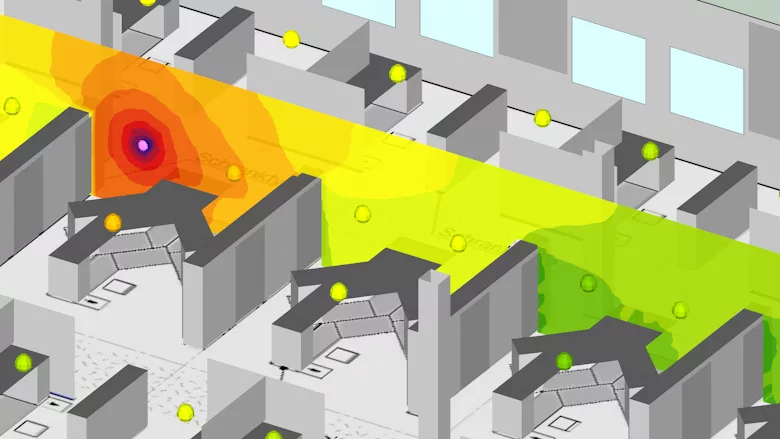
Credit: SoundPLAN
Across all types of facilities, including manufacturing, industrial workplaces, service industries and healthcare, people are exposed to high levels of noise. Excessive levels can affect people’s ability to do their job well, cause serious health problems, or lead to danger if warning signals cannot be heard.
Balancing aesthetics and functionality are a challenge in room acoustics. Modern architecture is often based upon new and innovative technologies and tends to feature large open rooms with many sound-reflecting materials and minimalistic décor such as exposed concrete and glass facades. This can result in generally higher sound levels and poses a great challenge to achieving pleasant acoustics suitable for the intended use of the room, as well as issues for clear speech transmission.
Key risks
There are mainly two concerns in spaces where the room acoustics are poor. The first one is safety. In areas where there is an emergency announcement system, or places where people’s safety depends on them understanding announcements (industrial sites, health facilities, airports, public buildings, ships etc.), there are typically strict requirements that need to be met for their effective operation. Places like educational facilities, courtrooms and political spaces also pose important requirements for speech intelligibility.
The other concern is acoustic comfort. While not directly life-threatening, it can have a serious impact on health and performance. In places like restaurants, schools, and offices, bad acoustics can lead to discomfort, causing loss of revenue or reduced cognitive performance and health issues. This can lead to poor work performance amongst employees and students alike.
Sectors particularly affected
There are high-profile projects everybody thinks about when talking about acoustics, like concert halls and auditoriums, to enrich the sound. However, everyday rooms like schools, healthcare facilities, restaurants, airports, and offices are just as important. These sites often suffer from bad acoustics because this gets overlooked in the planning stage.
There is a vast array of acoustic considerations in the ever more flexible work environments of today (desk sharing, remote work, etc.). In the education sector, there are challenges with changing modern teaching concepts e.g., less focus on a lecture-based lesson. This means that making sure rooms are well designed for clear speech transmission from the lecturer to the students is vital.
Noise regulations, guidelines, and standards
Regulations and guidelines are dependent both on country specific legislation and international standards, including ISO 3382 for room acoustics. In the USA, regulations include the Occupational Health and Safety Act (OSHA). While numerous standards are well established, new ones are being developed for specific places like music practice rooms and teaching spaces. There are many other guidelines in the international sphere.
Assessing the impact of noise in a room
Acoustic consultants, (building, environmental, or acoustic) engineers, and interior architects can use specialist noise simulation software in the design process to optimize the room layout, so that excessive noise is reduced, and good acoustic conditions are achieved.
Using input data, the software produces a noise map of the area, such as a production plant, and produces a visual display of how it will propagate and at what volumes. This helps to isolate and address problem areas. Different options can be trialed and costed on the computer, rather than having to expensively retrofit mitigation measures. In addition, future noise levels can be predicted, and pre-emptive steps taken to control it.
The option to use auralization to communicate results to laypeople is also helpful. This enables you to hear the sound generated by a source in a room as if you were present in it. This tool helps to communicate the effects of acoustic treatments directly to clients, independent of their background in acoustics.
Software to analyze and document workplace noise
Specialist software is also available that enables occupational health and safety experts to easily map and assess and document noise levels, to ensure that they are compliant and protecting their workforce. With the program-supported calculation of noise exposure at the workplace, risk assessment becomes an easy task.
Based on measurement data, colored noise maps can be generated to visualize the distribution of the noise levels over the area using fast interpolation algorithms. This saves manual numerical analysis. Meaningful tables and graphic outputs are created at the push of a button, which allows you to present and document your results professionally and clearly.
Look for software that can calculate any floor plans. Many programs are only capable of calculating standard, rectangular rooms. The software should enable you to manage multiple mapping areas and numerous measurement files, with the ability to combine data as needed. For example, you may wish to analyze different floors or different days of the week. With the help of formulas, you can link the measurements to perform advanced analysis, such as calculating mean values or differences.
Steps to improve room acoustics
Early consideration of room acoustics when designing spaces and planning work processes is important. Many problems, and hence costly solutions, can be avoided by designing a beneficial floor plan which considers the zoning of different work processes. This can help to minimize costs by needing less acoustic treatment and being able to choose the most effective solutions in the planning and building stages instead of fixing them after completion.
For example, one project we supported was a noise assessment for a new control room for an energy company that was to be built in a former transformer energy center. The original architecture was to be preserved, while the complete inner structure was rebuilt. This caused a very uncommon floor plan with an unusually high ceiling and a gallery. It took several iterations to come to a functioning acoustic concept that worked with the architects' requirements whilst allowing a sufficient environment for highly concentrated working. Modelling of floor plans and sectional cuts during the planning phase as well as using color maps for documenting noise helped to illustrate results.
Room acoustic trends
While for the last decades, reverberation time has been the predominant metric, in recent years the STI (Speech Transmission Index) has gained momentum as a method for prediction and measurement of speech transmission quality.
There is also a move to a more human perception approach, as well as actively using sound to improve and shape human well-being, for example through immersive soundscapes. Another trend is modern absorber variants like metamaterials, which are engineered to have acoustic or mechanical properties. Moreover, the need to acoustically treat rooms in places like educational facilities, and restaurants is gaining awareness, and these projects are becoming more common.
There are developments on the interface between room acoustics and electroacoustics – how sounds are amplified and transmitted through sound sources e.g., loudspeakers. There will be improvements regarding the inclusion of more physical effects into noise prediction models, e.g., taking phase into account or using hybrid methods. Moreover, AI is also going to change the way we work and design within the field of room acoustics in ways that are not yet fully imaginable. Also, BIM (Building Information Modelling) is becoming more common, and we are looking forward to seeing changes on that frontier, too.
Looking for a reprint of this article?
From high-res PDFs to custom plaques, order your copy today!