The Effect of Mindfulness in Construction Communication
Think things through to foster better understanding and positivity

Photo: Amorn Suriyan / iStock / Getty Images Plus
Common construction practices pose various challenges to productive and safe operations and the prevention of worker injuries. With a majority of the work performed by subcontractor personnel, managing project productivity and safety becomes even more complex and challenging.
Introduction
Effective operational control and delegation management which result in high performance, quality, and safe outcomes depends on the "right communication." Generally, the owner holds the general contractor (GC) or construction manager (CM) field operation personnel accountable for performance, quality, and safety on the project. Communication between the GC or CM's field personnel and the various subcontractor foremen is critical to ensuring that everyone is fully engaged in meeting project requirements and expectations.
Generally, the diverse organizations involved are required to work cooperatively to meet their contractual obligations in order to deliver the completed project. Each of these organizations have their own means, methods, practices and procedures. The differences in organizational culture, values, operational strategy, human dynamics, the worksite climate, as well as numerous other factors come into play. Highlighting the critical need for mindfulness in communication and management.
Mindful Communication Practices
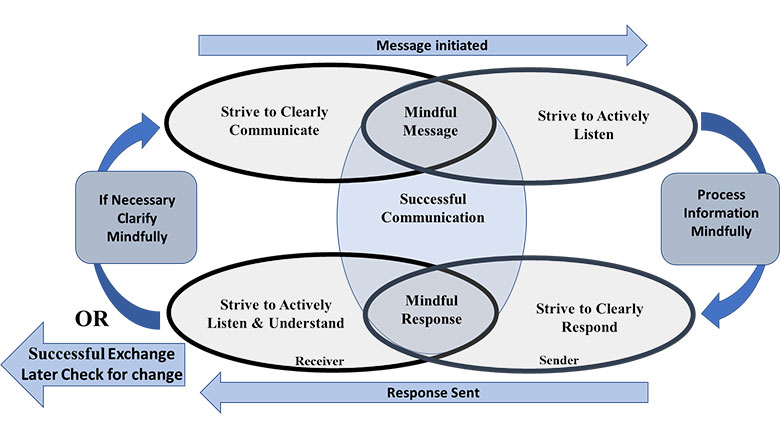
Mindfulness is an outgrowth of Eastern meditation practices. It has been utilized successfully in mental health practices. Mindfulness in execution or performance is a state wherein people have an acute awareness of the situation and/or environment they are in. The application of mindfulness has been explored in various communication settings and found to have a positive effect on the process, fostering understanding and impacting outcomes or results. In communication that is mindful, the person trying to communicate with another strives to clearly articulate the message so as to elicit understanding.
Depending on the verbal response or nonverbal reaction to the message, the sender has two options. If the response or reaction indicates misunderstanding, the sender must change the message so that the recipient understands it and, more importantly, responds positively by accepting and utilizing the suggested information or solution. If the response is positive, the sender can expand on the subject matter or thank the other person for their understanding and attention.
Successful Mindful Conversation
Mindful communication is concerned with the understanding of the meaning and the significance of the information resulting in acceptance. This is pivotal in construction where situations and associated risk may be continually changing. Mindful communication must be integrated into the project's management practices and procedures to ensure a robust understanding of plans, execution, and obligations on the part of everyone. For my other communication articles, see Communication Leads to Engagement, Nov/Dec 2023, Insights into Effective Safety Communication, June 2024, and More Effective Conversation, Nov/Dec. 2024
Mindful communication must be integrated into the project's management practices and procedures to ensure a robust understanding of plans, execution, and obligations on the part of everyone.
This represents good work practices, but is especially relevant to the management of safe operations for the following:
The worker
- May have work habits that involve an element of risk
- Wants to meet the foreman's production expectations and so may take on some additional risk
The GC's safety managers
- Observes unsafe behavior and tries to get the worker to correct it
- Without having direct oversight of the subcontractor's workforce, he/she needs to convince the worker to change their behavior
- Alerts project operational staff to situations that require correction
This requires a mindful approach to clearly describe the activity's risk and then convey the information related to a safer way to perform the work and, more importantly, elicit understanding and acceptance of the suggested change.
Project Delivery Practices
Typically, subcontractors’ workers perform much if not all of the work. They are generally selected based on the lowest price. This places pressures on their profits which drives controlling material, labor, and to a lesser extent equipment utilization, as well as indirect costs. Material costs are somewhat similar for all of the subcontractors competing for that work. Labor costs may be reduced by "pushing" the workforce to be somewhat more productive, thereby using fewer people. They can also try hiring less-experienced workers, thereby paying them less (excepting union labor).
The subcontractor may also assign younger, less experienced, and motivated supervisors to try to further reduce cost, with the expectation that main office will increase oversight to ensure the project delivery process progresses properly and meets expectations. Just about every option increases the risk of producing defective work, may reduce output, possible poorer quality or increase the risk of worker injury. This places the GC's or CM's project staff at a severe disadvantage in trying to meet their own company’s performance and the owner's project expectations as well. All of the steps mentioned increase the project risk and leads to the increased potential of some form of discrepancy, failure, or loss.
So far, the discussion has addressed the operational aspect of the project. It becomes even more complicated when the GC's or CM's safety manager tries to ensure project safe practices are followed by the subcontractor personnel over whom he has no direct control. This requires ensuring that subcontractors are fully cognizant and committed to all the project requirements and expectations at the time of contract negotiation, reinforced at project onboarding, and held accountable during construction. “Mindful communication” is a novel approach to improving communication, enhancing delegation, furthering understanding, and increasing workplace safety.
Effective Operational Management
Mindful communication in operational management are required regardless of the selected project delivery method. Traditionally some part of the work is performed by subcontractors, who employ their own means and methods. In the day-to-day operational oversight, project staff may conclude that the subcontractor may not meet project expected performance. They will have to communicate mindfully in order to foster greater attention as well as amicable cooperation.
Mindful management guidelines:
- Consider the capabilities, knowledge, and motivation of the person you are communicating with.
- Envision their needs, constraints, and the situation.
- Plainly describe the existing situation, risks, and the possible negative outcome.
- Clearly define and communicate the desired means or methods to address and alleviate the risks involved.
- Encourage feedback, regarding requirements, and any existing or anticipated impediments or issues.
- Discuss their performance requirements, time factors, expectations, and obligations to succeeding activities of others and the project’s overarching goals.
- Stress the need for coordination as well as cooperation.
- Monitor progress.
Graphic: Peter Furst
Mindfully Communicating
The project staff need to communicate mindfully with the subcontractor's personnel to discuss project expectation regarding responsibilities and obligation. They have to make sure that communication is clear and understandably, as well as mindful. Following are four key aspects to keep in mind.
Strive to converse where there are minimal distractions, and allow sufficient time for the discussion. Speak clearly using common words in short sentences. Be mindful of both parties’ non-verbal communication.
To mindfully confirm the foreman's understanding of their organization's obligation and commitment, say: "I want to be sure that I have communicated what I have intended to communicate to you. Please tell me in your own words what you have heard so far?" This avoids “yes” answers.
Ask for and discuss any needs or wants, as well as any perceived impediments or conditions that may impede the other's ability to perform as promised. Inform them that you are available to assist them in any way you can to ensure that they accomplish their goals and objectives.
If things are not progressing as expected, offer guidance that may be needed to resolve problems or remove barriers. When things are proceeding as planned, and it is appropriate, provide positive feedback.
Mindfulness will affect the “quality” of conversations, facilitate improvement, and amicably solve problems. This highlights the importance of shared mindfulness as it facilitates involvement, encourages engagement, resulting in mutual understanding, which increases the potential for improved production quality and/or safety on the project.
Other Benefits of Mindfulness
For the safety practitioner who does not have positional power, mindful communication and conversations increases their ability to implement change and foster goodwill. It is a fact that mindful conversations also contribute to workers’ engagement, as well as increases trust and cooperation.
Trust is the cornerstone of achieving a safe workplace. Organizations usually provide training as a solution to improve safety, but if employees aren’t listening, engaged or believing what they hear, then this will not lead to a safer environment.
To foster employee buy-in, the company needs an effective and positive safety culture. With management’s support this will build safety into every aspect of operations, from onboarding to training to day-to-day activities.
Focusing on proactive prevention, rather than reactive discipline after an accident, encourages employees to be mindful of safe practices and actively utilize them while performing their tasks.
Conclusion
Mindful management is not only a significant part of the project delivery process but an integral part of creating a productive and safe work environment for all of the participants involved. Environments that have residual risks that are ignored or unidentified are error provocative as well as predisposed to producing discrepancies, inefficiencies, waste, or losses and, more importantly, the potential for worker injuries. Given the complexity and uncertainty that generally are associated with just about any construction project, mindful communication and management become vital to project success.
Looking for a reprint of this article?
From high-res PDFs to custom plaques, order your copy today!