The True Cost of a Winter Slip and Fall
The Ripple Effect Goes Beyond the Initial Financial Impact
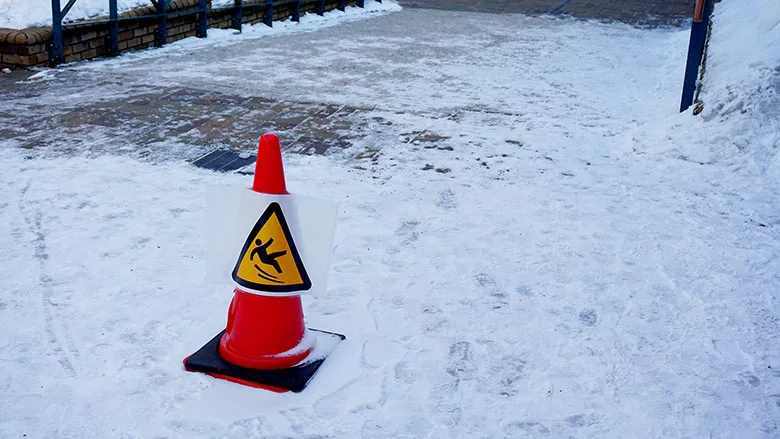
It’s a sound no manager ever wants to hear: a sudden shout, a sickening thud on the pavement, and then silence. A winter slip and fall isn’t just liability and an incident report; it’s a person. A valued team member who is now in pain, facing a recovery period, and unable to contribute at work.
While the human toll is immediate and visible, the financial impact ripples far beyond the first hospital bill. Understanding those costs, and what can be done to prevent them, is critical for any organization.
The Hard Numbers: What One Fall Really Costs
Slips, trips, and falls are among the most common workplace injuries. According to the Bureau of Labor Statistics (BLS):
- In U.S. private industry, 22.6 per 10,000 full-time workers experienced a nonfatal slip, trip, or fall requiring time away from work in 2021–2022.
- In construction, the rate was even higher at 31.5 per 10,000.
- In 2023 alone, 885 workplace fatalities were attributed to falls, slips, or trips, roughly one out of every six fatal work injuries.
The financial toll is equally striking:
- Falls and related incidents contribute to an estimated $70 billion annually in workers’ compensation and medical costs in the U.S.
- “Falls on the same level” (typically slips) alone account for $10.5 billion annually in direct costs.
- A single slip/fall injury averages $40,000+ in direct costs.
These are not rare events. They’re common, repeatable, and costly.
The Hidden Domino Effect
The visible expenses are only the start. Indirect costs, though harder to quantify, can multiply the impact. These include:
- Lost productivity: Colleagues pick up extra responsibilities, deadlines slip, and quality may suffer.
- Administrative burden: Managers spend hours on incident reports, workers’ comp paperwork, and investigations.
- Insurance consequences: Premiums often rise after claims, compounding the long-term cost.
- Employee morale and trust: Safety concerns ripple through the workforce, affecting engagement and retention.
Safety professionals often estimate that indirect costs can run 3× to 10× higher than direct medical costs, depending on the industry and severity of the incident. Even with a conservative 4:1 ratio, a $10,000 direct medical cost quickly becomes a $50,000 total financial burden.
OSHA’s “Safety Pays” calculator allows organizations to model these impacts and shows just how much additional revenue would be needed to cover the loss.
| Severity of Incident | Direct Costs | Estimated Indirect Costs | Total Cost to Employer | Equivalent Additional Revenue Needed* |
|---|---|---|---|---|
| Minor (sprain/strain) | $5,000 | $15,000 – $25,000 | $20,000 – $30,000 | $200,000 – $300,000 |
| Moderate (fracture, surgery) | $15,000 | $45,000 – $75,000 | $60,000 – $90,000 | $600,000 – $900,000 |
| Severe (multiple surgeries) | $40,000 | $120,000 – $240,000 | $160,000 – $280,000 | $1.6M – $2.8M |
| Fatality | $1,000,000+ | Often exceeds 3–5× | $3M – $6M+ | Business-threatening impact |
*Based on OSHA’s “Safety Pays” model at a 10% profit margin.
Building Layers of Prevention
The encouraging news is that slips and falls are highly preventable. The most effective approach is not one single policy, but a layered system of controls:
- Personal traction aids: Supplement work boots with ice cleats or slip-resistant overshoes during icy conditions.
- Surface management: Regular salting, sanding, de-icing, and prompt snow removal from walkways, stairs, and parking areas.
- Lighting improvements: Bright outdoor lighting helps workers spot icy patches during early mornings or evenings.
- Handrails and infrastructure: Installing rails, slip-resistant mats, and ensuring proper drainage where water collects.
- Training and awareness: Teaching employees to recognize risks, slow down, and use designated safe paths.
Each layer reduces risk; combined, they create a culture where safety is not just compliance, but care.
More Than Dollars and Cents
The numbers are compelling, but the deeper reason to act is human. Preventing a slip and fall means protecting a person’s health, livelihood, and dignity. For organizations, it means showing employees that their safety is non-negotiable.
Preventing a slip and fall means protecting a person’s health, livelihood, and dignity.
When workers know they’re valued and protected, engagement rises, turnover drops, and productivity thrives. The return on investment is real, but the return in trust and well-being is priceless.
Slips, trips, and falls are not rare accidents, they’re among the leading causes of serious workplace injuries. In U.S. private industry, 22.6 per 10,000 workers suffer a nonfatal slip or fall each year, and in 2023, 885 workers lost their lives.
The financial stakes are just as steep. Falls contribute to an estimated $70 billion annually in medical bills and workers’ compensation costs. A single slip can average $40,000+ in direct costs, while hidden costs, lost productivity, investigations, and insurance hikes, often multiply the burden 3× to 10× higher.
The Good News
Most slips and falls are preventable using layered safety measures like traction gear, de-icing and snow removal, better lighting, handrails. Worker training is also recommended to dramatically reduce risk.
Ultimately, prevention isn’t just about cutting costs. It’s about protecting people.
References
- Bureau of Labor Statistics. (2024). A look at falls, slips, and trips in the construction industry. https://www.bls.gov/opub/ted/2024/a-look-at-falls-slips-and-trips-in-the-construction-industry.htm
- Bureau of Labor Statistics. (2023). Census of Fatal Occupational Injuries – Latest Numbers. https://www.bls.gov/iif/latest-numbers.htm
- Centers for Disease Control and Prevention (CDC), NIOSH. Falls – About. https://www.cdc.gov/niosh/falls/about/index.html
- Insurance Journal. (2025). Top 10 causes of disabling workplace injuries and their costs. https://www.insurancejournal.com/news/national/2025/07/22/832644.htm
- Fit2wrk Clinical Education Review. (2015). Average claim costs of slip and fall injuries. https://fit2wrk.com/wp-content/uploads/2015/08/ARTICLE_Fit2wrk_ClinicalEd_vol1-16.pdf
- North American Retail Hardware Association (NARFA). (2023). The direct and indirect costs of workplace injury. https://www.narfa.com/the-direct-and-indirect-costs-of-workplace-injury/
- Occupational Safety and Health Administration (OSHA). Safety Pays Estimator. https://www.osha.gov/safetypays/estimator-text
Looking for a reprint of this article?
From high-res PDFs to custom plaques, order your copy today!