Are Safety Jobs Safe from an AI Takeover?
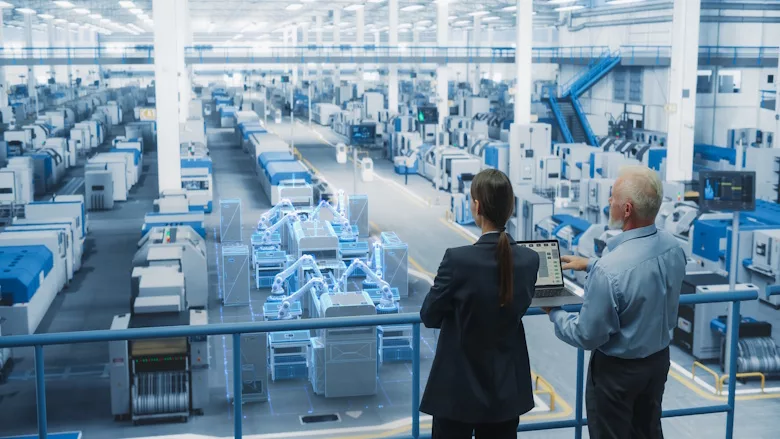
“We are starting to see projects that used to require big teams now be accomplished by a single very talented person.”
Mark Zuckerberg, CEO of Meta
Could those projects include entire safety and health programs? Could safety come down to one very talented individual using artificial intelligence?
Unless you’ve been living under a rock, you know there is widespread apprehension about AI taking away thousands and thousands, if not millions, of jobs — whole categories of jobs. Microsoft AI chief executive Mustafa Suleyman has said that artificial intelligence can replace most white-collar work in the 12 to 18 months. The key is achieving “humanist superintelligence.”
In an interview with the Financial Times, he said, “I think we’re going to have a human-level performance (through AI) on most, if not all, professional tasks. So, white-collar work, where you’re sitting down at a computer — either being a lawyer, or an accountant, or a project manager, or a marketing person — most of those tasks will be fully automated by AI within the next 12 to 18 months.”
This prediction echoes Anthropic CEO Dario Amodei’s claim that AI will wipe out half of all entry-level white-collar jobs in five years.
Ford CEO Jim Farley agrees, saying "half of all white-collar workers in the U.S." could lose their jobs to artificial intelligence in the coming years. Other CEOs are also sounding warning bells. Fiverr's CEO Micha Kaufman said in a staff memo earlier this year that it didn't matter what field you were in, "AI is coming for you."
So, is AI coming for safety and health professionals? Should the safety and health profession be heeding those warning alarms?
Safety and health pros give their opinions
A sampling of posts by safety and health pros on Reddit, a social media platform, shows the wide disparity of opinions:
- “Anyone who thinks any job is safe from AI is delusional.”
- “Health and safety is largely soft skills, building culture, and supporting managers. Most of this cannot be done by AI.”
- “Unless they have robots patrolling areas with built-in cameras and announcements like ‘You're engaging in unsafe work practices. Please redirect your behavior or you will be reported to management.’ I think the field is safe.”
- “I’m fairly certain that we’ll see enough implementation of AI to reduce the amount of EHS jobs out there by a decent margin in the next decade.”
- “If AI converts every worker into a safety professional through AI tools, it is possible that organizations will transfer the burden of staying safe to the workers themselves and have one safety professional for oversight and legal reasons.”
- “AI solutions might look ‘good enough’ to warrant reducing budget or telling a safety manager they can’t hire a technician because AI can do it.”
- “We’re not close to being safe from AI, but probably less so than AI replacing workers and eliminating the need for occupational health and safety.”
Staying in the loop
AI safety and health vendors are adamant that safety and health people will remain in the loop. “The human touch is crucial to preventing AI from making wrong decisions or providing false information,” says Benchmark Gensuite CEO R. Mukund.
“Senior leaders need to understand there will be the need for the human in the loop; AI is not replacing human beings,” says Tom Goodmanson, CEO of EcoOnline.
Interestingly, the talk about a human remaining involved in safety and health work — and other occupations – often uses the singular term “a human,” not the plural “humans.” Goodmanson allows that “EHS departments might remain the same size of staffing or possibly require fewer heads in the case where AI is broadly scaled up.” Which brings us back to that “single very talented individual.”
Still, potential staff reductions are a stage of implementation that only a few organizations are at in 2026, says Goodmanson.
John Dony, CEO and co-founder of the What Works Institute, has a good feel of where safety and health pros are at in terms of leveraging AI based on the institute’s dozens of big brand corporate members. He says the most common application is using ChatGPT or similar generative AI apps as a personal assistant, creating training, drafting incident reports, answering safety questions and enhancing communication. The current emphasis is on efficiency and productivity, not strategic risk management using predictive analytics.
As of 2025, Dony says few pros were using data sets (forklift telematics, surveillance footage, incident reports, etc.) and pattern analysis (near miss incidents with specific times, locations and operators associated with higher risk, for example) for predictive modeling (predicting incidents by time, location, risk factors, etc.) and resource creation (AI-generated recommendations for the organization to reduce risk.)
There are four stages of AI use in safety and health, according to Dony: 1) uncontrolled, ad hoc applications with no policies or strategies; 2) policed use of AI with guardrails to protect worker privacy and data quality; 3) focused AI implementation with policies; and 4) using scaled-up AI for organization-wide risk-informed strategies and decision-making. Most pros are in the first or second stages, he says, with the most sophisticated AI use still “a ways out” at this point, he says.
What to expect
Based on interviews with AI vendors and safety and health pros, research and a literature review, here are some points regarding any AI takeover of safety and health jobs:
- The professional most at risk of being replaced by AI is one who sits all day at a computer in an office.
- Many professionals work as the only full-time safety and health officer in a workplace. These lone wolf professionals can leverage AI apps for various projects, but their heavy workload and time spent on the floor will make them hard to replace.
- It’s realistic to expect leaner safety and health staffs – this is already the case in numerous workplaces due to budget cuts – as focused implementation of AI increases.
- It’s realistic to expect senior leaders, when asked by pros about adding to staff, to ask, “Is this work AI can do?”
- Until a Jetsons-like human-friendly robot roams the floor with mobility and agility, has personal conversations with workers and has the emotional intelligence to handle socio-emotional Total Work Health® issues and improve culture, trust, engagement and situational awareness there will be the need for professionals with the human touch. As one pro says, “Safety is all about person-to-person relationships and soliciting input, ideas, feedback and collaboration.”
Says another: “Engagement and culture are fundamentally relational. Trust arises from fairness, consistency, and integrity — qualities exercised by people, not algorithms.”
With at least some safety and health staff already trimmed back, training volunteers in leadership and outsourcing certain safety and health tasks to volunteers to fill in the void will be more common.
The idea of safety and health pros being redundant because the workforce has become fully 100% automated is years if not decades away — if ever. Stationary manufacturing jobs and warehouse work are more likely to be automated — a number already are — in contrast to work in construction, healthcare, education, utilities and other jobs requiring mobility, agility and people skills.
The idea of dirty work — the jobs with the most hazardous exposures, such as toxic chemical exposures — being taken over by robots and lessening the need for pros to protect humans, is more likely and already happening in the military, for instance, with defusing explosives and the heavy use of drones replacing boots on the ground.
Almost all full-time professionals in 2026 are using AI, most as chatbots at the entry level of AI capabilities.
It’s inevitable as AI becomes more accepted and accessible throughout organizations that educated pros will direct more sophisticated and strategic risk identification and management implementations. The move from stage one to stage four implementation for many pros is a matter of when, not if.
Looking for a reprint of this article?
From high-res PDFs to custom plaques, order your copy today!