Sampling and Monitoring
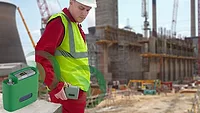
Instruments today can calibrate themselves, calculate time-weighted averages and short-term exposure limits, and operate with the touch of only two or three buttons, one of which is the on/off switch. Powerful microprocessors allow monitors to be so miniature you can clip one onto a belt loop. Their sensors are more reliable and need to be replaced less frequently. Some even detect motion and alert command control by telemetry if a man goes down in the field. Monitors can double check you on the gas you're measuring, or log data all day long in the field and feed the saved information into a computer back at the shop.
Deceptive simplicity
Personal air monitors have, in fact, become so user-friendly that with just a little training anyone can operate one. Therein lies the paradox. On the one hand, technology enables companies to protect more workers than ever before. With smaller, cheaper instruments, employers can outfit everyone in the plant with their own personal air monitor. And operations that avoided more complicated equipment requiring calibrating and calculating are now purchasing air monitors for the first time. "A lot of new customers are attracted by the simpler-to-use monitors. We're finding more and more small operations buying equipment," says Rick Wanek, marketing manager for instrument manufacturer, Bacharach, Inc.Mark Collins, product manager for instrument maker Photovac adds, "Our customers say they want simplicity-as few buttons to press as possible, accurate, reliable, specific results, and a small, ergonomically designed package."
Trouble is, not every Joe who turns a monitor on and off knows what to do with the data he gathers with it. Simplicity can be deceptive. After all, there's no expertise required to wear a personal air monitor. "You can put one on the janitor," says Wanek. But data crunching requires an industrial hygienist.
Monitoring might be simple, but Collins says an IH has to make sure the results are meaningful. "Otherwise it will be anybody's guess," he says. Still, many of his customers use someone other than an IH to specify and purchase industrial hygiene instruments, says Bacharach's Wanek. It's especially true among smaller companies, but even big Fortune 500 firms have brought the manufacturer in to train their workforce to handle the new instruments. He worries they get misused. "We've made it so easy that I wonder if people get sloppy," says Wanek.
That should not be happening, say industrial hygienists. Technology should make an IH's job easier, not give employers the idea that workers can do it themselves. "Even in the days when you used pumps that had to be calibrated, air sampling was technician's work. The hygienist would determine who, what, and where to sample, but the technician could do the sampling," says Lance Percival, CIH.
Now that anybody can get their hands on equipment that doesn't require calibration, people with no background try to use it and don't know how to decipher the data, says Percival. "The important part of any sampling-who to sample, how many samples to take, and what to sample-still requires an industrial hygienist."
Matthew Carmel, who served a stint 17 years ago as an OSHA compliance officer trainee and now runs a consulting firm, OSHA DATA in N.J., agrees: "Even using the impingers and hand-cranked sampling pumps of yesterday didn't take too much skill. Interpreting the results is what counts."
The dumbing-down dilemma
But that's not how some employers see it. Stories about workers left with high tech monitoring devices to manage their own air monitoring programs circulate in the IH community. A few of them go like this: ·- A team of CIHs is let go from a major chemical company after they set up workers with portable air monitors and a program that can "run itself." ·
- Workers at a U.S. oil company manage their own confined space monitoring program. No IH required. ·
- A corporate safety pro trains safety committees and managers at 12 satellite plants to maintain their monitoring programs. The company decides to let the plants carry on without corporate direction and rely on their insurer for occasional air sampling services.
Wanek says he too has seen downsizing in IH departments "because they don't need as many people fiddling with instrumentation."
Some industrial hygienists tell Industrial Safety & Hygiene News that, on top of other trends like downsizing, outsourcing and relaxed OSHA enforcement, smarter technology is one more factor threatening their profession. Running a monitoring program has become as simple as brushing your teeth, one long-time IH says. This "dumbing down" will cost professionals their jobs, he predicts: "More IHs are going to be out of work because you just don't need as many of them today."
"I would say that's not a misplaced apprehension," says industrial hygienist John Tiffany of Tiffany-Bader Environmental, Inc. in Bedford, N.J. "Instrumentation is easier to work with. We have some biopumps that will automatically adjust themselves. We don't even use a screwdriver to adjust the flow rate. So I can see with the way corporate downsizing is going it's not an irrational jump to say we might be in trouble."
Others say the situation is not dire, that professionals need to evolve along with technology. "There will always be a need for industrial hygienists, but the nature of the individual has changed," says Darrell Mattheis, a consultant with Organization Resources Counselors in Washington, D.C. But recent on-line discussion among safety and health professionals on the Internet reflects current concerns: "Many employers and human resources people do not understand what a CSP or CIH actually is. Safety and industrial hygiene is still a relatively unknown science for many. TLV? Is that a sandwich?" a CSP griped to his colleagues on a safety engineers' newsgroup.
"The truth is that the marketplace determines the need for a product or service. Industry has spoken loudly. They do not want or need the services of IHs or safety professionals...I suggest you work towards finding a new career," responded a CIH.
Too much "woe is me"?
A significant minority of ISHN's industrial hygiene readers responding to the 1997 White Paper survey raised red flags about their profession's outlook. More than a third say they're worried about job security or will actively look for another job in 1997 (see info. box below).But is advanced technology really to blame for their predicament? It might be an element, but other factors are bigger influences, says ORC's Mattheis. Like automation, for one. "As corporations change the way they do business, many processes don't present exposure risks anymore. There just isn't as much IH work to do as before," says Mattheis. Engineering out exposure risks simultaneously engineers out the need for industrial hygienists.
The outsourcing trend is another of the "bigger elements" Mattheis mentions. "Increasingly corporations are getting rid of oversight operations at headquarters. The model is a holding company with IH services at each operating site. This is one reason we see more IHs operating as consultants," he says.
"Those talking about the dumbing down of equipment aren't looking at the bigger picture," Mattheis says. "Too many of them have looked at industrial hygiene as a science/lab thing instead of as management."
Safety consultant Allan McLean says he thinks gripes that the field is dumbed down-"really the equipment is smarter," he says-is just the bitterness of people who were once in-house experts and now find themselves shopping their services around.
"The discussion seems to me to be more about "woe is me" rather than "wow, technology is opening an even brighter future," says 25-year safety veteran Joe Arway.
To be sure, management-minded IHs are grateful for instrumentation advances that allow workers to monitor their own exposures. John Tiffany says the tools can be a great help to industrial hygienists at large firms who have so much to do "it's like they're on roller-skates." Two of Tiffany's large clients, a telecommunications firm and a pharmaceutical company, are each down to just one industrial hygienist who acts as a coordinator. The instruments are not to blame for the lean staffs, he says. "These companies were downsizing come hell or high water. The instrumentation makes life that much simpler" for the survivors.
David Dyjack, chairman of the department of environmental and occupational health at the Loma Linda University School of Public Health in California says his colleagues and students see the advances in instrumentation as benefits. "They allow us to be more effective in our practice. We can delegate routine manual labor to others and dedicate our own time to management and policy concerns," he says.
Therese Perrette, director health and safety and the only IH among a staff of about 500 at a N.J. environmental consulting and groundwater recovery firm, Handex Environmental, Inc., says employees there use monitoring equipment to determine if work situations are safe, but they look to her for advice on purchasing, maintaining and using the instruments. "The consensus here is that although anybody could use [these instruments] they shouldn't." The company values her professional opinions in that area, she says.
Future responsibilities
Those who fear technology is threatening their careers will have more to fret about in the future considering the sort of advances predicted for IH monitoring.One source describes this scenario in the near future: Networks of tiny monitors will transmit data across a company's operations through a computer network. Remote wiring devices and tiny badges will allow companies to monitor everyone down to the receptionist at the front desk.
Of course, it will still take an IH to interpret what gets transmitted. But those jobs will be reserved for "very experienced level IHs with management skills," Darrel Mattheis says. That is, people who are "excellent communicators with big vocabularies who can express themselves articulately." David Dyjack says those IHs who can't practice outside their traditional discipline are at risk. His students who get IH jobs are cross-trained, flexible and able to go across department lines, he says.
Then, there will probably be jobs for IHs back at the plants that laid them off in the '90s and left the monitoring programs up to the workers. "There's going to come a point when these programs are going to fall apart," says Lance Percival. "Maybe you can get away with it for five years, but not ten."
What's worrying industrial hygienists?
What's worrying industrial hygienists?ISHN's industrial hygiene readers raise red flags about their profession's outlook. Technological advances, along with trends like downsizing, outsourcing and relaxed OSHA enforcement, might be to blame. ·- Asked "which segment of the safety, health & environment field offers the best employment opportunities?" industrial hygienists weren't optimistic: 52% said environmental 22% said industrial hygiene 10% said safety ·
- Overall, EHS professionals are even more skeptical about opportunities in industrial hygiene: 11% named industrial hygiene as a segment of the field offering the best employment opportunities. ·
- Asked to select items that would be part of their professional life in 1997, many industrial hygienists were gloomy: 37% said "worrying about job security" 34% said "actively looking for another job" 25% said "seriously considering a career change" 29% said "hitting a career plateau" ·
- More than professionals in other EHS disciplines, industrial hygienists (27%) say they are less satisfied with their jobs now than they were five years ago ·
- Nearly 30% of EHS professionals say their company's industrial hygiene services are delivered by outside consultants.
Looking for a reprint of this article?
From high-res PDFs to custom plaques, order your copy today!