ISHN logo
search
cart
facebook twitter linkedin youtube
  • Sign In
  • Create Account
  • Sign Out
  • My Account
ISHN logo
  • NEWS
    • Today's News
    • Global Safety News
    • Government Regulations
  • PRODUCTS
    • Product Innovations
    • Featured Products
  • TOPICS
    • Environmental Health and Safety
    • Facility Safety
    • Workplace Health
    • Occupational Safety
    • PPE
    • More Topics
  • CONSTRUCTION
  • TECHNOLOGY
  • COLUMNS
    • Best Practices
    • Dave Johnson: What’s going on
    • Editorial Comments
    • Leading Safety
  • MULTIMEDIA
    • ISHN Podcast
    • Videos
    • Cold Stress Education Quiz
    • Webinars
    • White Papers
  • MORE
    • Buyer's Guide
    • Newsletters
    • Convention Companion
    • Polls
    • Events
    • ISHN Store
    • Sponsor Insights
  • EMAGAZINE
    • eMagazine
    • Archived Issues
    • Contact
    • Advertise
  • JOIN TODAY!

Fall Protection

By John Corriveau
November 5, 2008


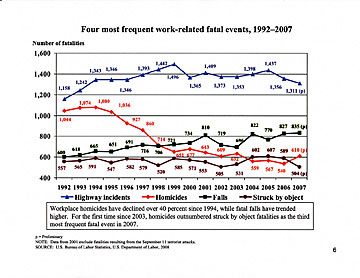
The 2007 U.S. Bureau of Labor Statistics show, once again, that fatal falls are on the increase. Since the initial release of OSHA 1926.500 Fall Protection Guidelines for the Construction Industry in 1998, fatal falls have increased every year except 2003.

New standards pave the way for improved safety
Ten years later we haven’t made any progress. The number of OSHA citations for fall protection violations and their related fines are consistently among the top three and continue to increase from year to year. Fines for fall protection violations in 2008 reached as high as $877,000.

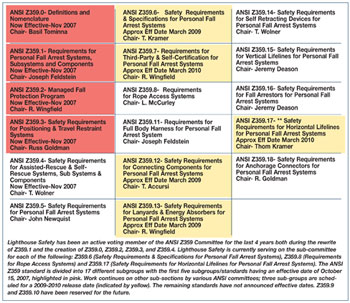
Hopefully this will change with the release of the new ANSI Z359.1 standards that took effect in November of 2007. This standard provides the guidelines and tools to develop a complete fall protection program and increase worker safety by mandating the introduction of new snap hooks and a new style of Y-lanyards. An entire family of new standards has evolved. This original family of standards is now available for under $400, through the American Society of Safety Engineers (ASSE) with membership. Visit www.asse.org for more information.

Another family of standards dealing with horizontal lifelines; engineered systems; leading edge, self-retracting lifelines and more, is slated for completion in early 2009. This next family of standards will also help educate workers with regard to the dangers of “at-foot-level” anchorages and the equipment required for those exposures. Even though we now have stronger gates on our snap hooks, which help reduce burst-out, we can still have roll-out with an auto-locking carabiner.

Invest in new equipment and updated training
The probability of roll-out is greatly increased with an “at-foot-level” anchorage. A 12-foot free fall increases the forces on the body as well as on the connecting hardware. Only a few lanyards are rated for 12-foot free falls. A standard 6-foot lanyard, rated for a 6-foot fall, will blow out almost the entire shock-pak should a 6-foot fall occur. In a 12-foot fall, that lanyard may produce 2,000 to 3,000 lbs. of force on the body which is well above the OSHA limit of 1,800 lbs.

Many exposures can be reduced by using 12-foot free-fall lanyards, leading edge self-retracting lifelines, properly engineered and manufactured horizontal lifeline systems and newer anchorage devices. The cost to buy the correct equipment and provide the appropriate training for any given hazard may be 30-40 percent above standard equipment costs.

Many manufacturers now provide very specific, updated instructions on the proper use of their equipment, complete with illustrated “do’s and don’ts.” Unfortunately, these instructions are often lost or thrown away. Since they provide examples of proper installation and use, they should be treated like material safety data sheets (MSDS) and kept in a binder for easy worker access.

Keeping equipment information in an accessible place, raising expectations for worker safety, investing in new equipment and updated training, and carefully reviewing and following the new ANSI standards offer the best return for your safety dollar. These measures should go a long way toward providing a solid foundation for any successful fall-protection program

SIDEBAR: Facts about Roll-out and Burst-out

  1. Roll-out can occur when someone is using a non-locking snaphook.
  2. Roll-out occurs when someone is using a non-locking carabiner or an auto-locking carabiner. Triple locking or double action carabiners greatly reduce roll-out potential.
  3. The standards address the problem of roll-out. If someone has a locking snaphook, or carabiner, they may be meeting the standards.
  4. Burst-out is not addressed by the standards but is still a concern.
  5. Burst-out is a concern because the snaphook gates are only tested to 220 lbs. (350 side load) (ANSI Z359.1) (1992).
  6. The forces generated during a fall are much greater (at least 900 lbs.), and may cause failure of the gate if the load is applied to the gate.
  7. By choosing the correct geometry, we can reduce the possibility that any load will be applied to the gate.
  8. By using a carabiner with a capture pin, we can reduce the possibility that loading will be applied to the gate.
  9. By using a snaphook or carabiner with a compatible radius to its attachment point, we can reduce improper loading.
  10. By using a carabiner with a properly sized opening, when using with rope or cable thimbles, we can reduce roll-out/burst-out possibilities.
  11. Burst-out and roll-out have been greatly reduced by the new ANSI Z359.1 (2007). However, at foot level, anchorages still leave snaphooks and carabiners at risk when equipment is misused. A competent person should review compatibility of the snaphooks and carabiners as stated in the current OSHA and ANSI standards.

Share This Story

Looking for a reprint of this article?
From high-res PDFs to custom plaques, order your copy today!

John Corriveau is a fall protection & confined space specialist who began working with his father, mother and brothers at Wardco Safety in 1978. John has over 35 years’ experience working with safety equipment and engineered systems. He has been providing all levels of fall protection training since 1993 both in the U.S. and abroad. John is an active member of the Z359 Committee and has spent the last couple of years working on the updated standards for fall protection. You can reach John at (262) 790-1155, john@lighthousesafety.com; visit us at www.lighthousesafety.com.

Recommended Content

JOIN TODAY
to unlock your recommendations.

Already have an account? Sign In

  • forklift safety

    Exploring the latest technologies in forklift safety

    With more staff and more stock in warehousing now more...
    Workplace Training Strategies
    By: Josh Cramer
  • welding

    All about welder’s flash or arc eye

    A flash burn is a painful inflammation of the cornea,...
    Environmental Health and Safety
  • dangerous jobs

    The 10 most dangerous jobs in the U.S.

    On-the-job deaths have been rising — hitting the highest...
    Construction Industry Safety and Health
    By: Benita Mehta
Manage My Account
  • eMagazine Subscriptions
  • ISHN Newsletter & Other Newsletter Alerts
  • Online Registration
  • Manage My Preferences
  • Subscription Customer Service

More Videos

Sponsored Content

Sponsored Content is a special paid section where industry companies provide high quality, objective, non-commercial content around topics of interest to the ISHN audience. All Sponsored Content is supplied by the advertising company and any opinions expressed in this article are those of the author and not necessarily reflect the views of ISHN or its parent company, BNP Media. Interested in participating in our Sponsored Content section? Contact your local rep!

close
  • man wearing the the Sundström SR200 Full Face Mask Respirator
    Sponsored byOHD

    5 Fit Testing Mistakes That Could Cost You

  • This image shows Magid AcuSpex polarized blue mirrored safety glasses.
    Sponsored byMagid Glove and Safety

    Construction PPE Guide: What Crews Need for Each Task

  • lone worker in confined space
    Sponsored byAlphasense Ltd.

    GET THE LEAD OUT of your Safety Oxygen Sensors!

Popular Stories

SpaceX 7 launch

OSHA Investigating Fatal Fall at SpaceX Starbase

Worker Impairment

How to Tell When a Co-Worker is Impaired? A Safety Pro’s Challenge

psychology in the workplace

Most Workplaces Measure Psychological Safety, Ignoring Psychosocial Risks

top 10 most dangerous jobs

Poll

Seasonal Readiness

With the federal heat stress prevention rule on the horizon, which area of your safety program needs the most attention?
View Results Poll Archive

Products

Surviving an OSHA Audit A Management Guide, 2nd Edition

Surviving an OSHA Audit A Management Guide, 2nd Edition

See More Products

ISHN Podcasts

Related Articles

  • Knowledge of the new ANSI fall protection standards is a must

    See More
  • Diversified fall protection, leaders in engineered fall protection solutions and training services, rolls out new line of portable fall arrest systems

    See More
  • Fall protection systems by Diversified Fall Protection

    See More
×

Become a Leader in Safety Culture

Build your knowledge with ISHN, covering key safety, health and industrial hygiene news, products, and trends.

JOIN TODAY
  • RESOURCES
    • Advertise
    • Contact Us
    • Directories
    • Manufacturing Division
    • Store
    • Want More
  • SIGN UP TODAY
    • Create Account
    • eMagazine
    • Newsletters
    • Customer Service
    • Manage Preferences
  • SERVICES
    • Marketing Services
    • Reprints
    • Market Research
    • List Rental
    • Survey/Respondent Access
  • STAY CONNECTED
    • LinkedIn
    • Facebook
    • YouTube
    • X (Twitter)
  • PRIVACY
    • PRIVACY POLICY
    • TERMS & CONDITIONS
    • DO NOT SELL MY PERSONAL INFORMATION
    • PRIVACY REQUEST
    • ACCESSIBILITY

Copyright ©2026. All Rights Reserved BNP Media, Inc. and BNP Media II, LLC.

Design, CMS, Hosting & Web Development :: ePublishing