PSYCHOLOGY OF SAFETY: How to remain "cool" when facing risks

The demonstrable intellectual difference between the year-old baby and the monkey…is that he (the baby) responds to more things and in more ways…
Edward L. Thorndike (1909)
This opening quotation was excerpted from the scholarship of Edward L. Thorndike, the psychologist who laid the scientific groundwork for applied behavior analysis (the foundation of behavior-based safety), and was most instrumental in introducing intelligence testing to the U.S. education system. Thorndike used this statement to illustrate the special discriminative capacity of humans, as opposed to other animals. In other words, the ability to alter our thinking, attitude, and behavior as a function of complex and fluid social and environmental cues reflects a critical aspect of human intelligence.
The situational personality
Last month, I introduced the research and theory of esteemed psychologist Walter Mischel in order to dispel the myth that people’s personalities can be reliably classified into a few generic categories. I reviewed some seminal field research by Dr. Mischel and others to illustrate some oversimplified and misleading viewpoints of personality, popularized by some consultants giving workshops. The fundamental conclusion of this research, reflected in the opening statement by Edward Thorndike, is that people’s dispositions are not stable but change dramatically as a function of the situation. We have the flexibility and discriminative facility to adaptively match our actions to the requirements and opportunities of different situations.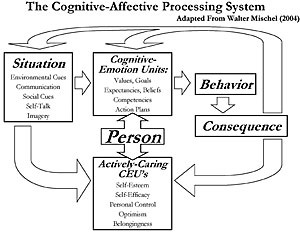
The Cognitive-Emotional Unit (CEU)
Dr. Mischel proposed the Cognitive-Affective Processing System (CAPS) to account for his observations of an individual’s distinctive patterns of behavior in various situations, termed “if-then behavioral signatures.” Basically, specific situations, which can include environmental and social cues, self-talk, and mental imagery, activate particular idiosyncratic mental representations of a person’s values, expectancies, feelings, beliefs, emotions, competencies, and action plans.In turn, this cognitive activity influences decision-making and behavior. Mischel calls these mental states cognitive–affective units (CAUs), which are hierarchically organized and thus differentially accessible for a particular individual in a given situation.
I suggest substituting the term “emotion” for “affect,” and then we have “cognitive-emotional unit” (CEU). This will help readers remember the term by relating CEU to “continuing education unit,” and an effective education program can substantially alter the accessibility of various CEUs, as well as inspire the development of a new CEU.
For example, an emotional safety presentation might activate the formation of a safety-related goal or move a safety-related expectation or action plan to the top of the hierarchy of existing CEUs. This modified CEU structure is then likely to increase the probability of relevant injury-preventive behavior.
Figure 1 illustrates the flow of events in Dr. Mischel’s CAPS. Specific environmental and social cues are interpreted as meaningful to an individual, resulting in the activation of relevant CEUs, which reflect situation-specific values, beliefs, expectancies, competencies, and action plan. The nature and relative priority of the CEUs are unique to each individual and vary across different settings and circumstances.
The same situation might activate different CEUs across different individuals; and within the same context, individuals may perceive different characteristics that activate a unique hierarchy of CEUs.
Safety leaders help people see the immediate or potential hazards in a certain setting, and then facilitate CEU development and/or organization so the relevant safety CEUs receive top priority and activate safe behavior.
The Actively-Caring CEUs
Figure 1 adds the five actively-caring dispositional factors to Mischel’s CAPS. Certain mutable person states influence one’s propensity to go beyond the call of duty on behalf of another person’s safety or welfare.Research-based strategies exist for enhancing each of these person states, thereby increasing the likelihood of actively-caring behavior. These states are depicted as CEUs in Figure 1, receiving input from the situation and influencing decision-making and behavior. When a person’s organization of CEUs includes an actively-caring CEU, the probability of looking out for the safety of others is increased.
Figure 1 depicts the powerful influence of consequences, as emphasized by behavior-based and people-based safety (see, for example, my ISHN contributions in November 1995 and October 2007). The intrinsic (natural) and extrinsic (extra) consequences a person perceives following a behavior affect the relative accessibility and influence of relevant CEUs and can activate the formation of a new CEU.
For example, authentic recognition for a safety-related behavior can boost self-esteem, optimism, and a sense of belongingness, thus facilitating the accessibility of an actively-caring CEU.
The result: Mental representations of proactive competencies and action plans to prevent personal injury are given higher priority than the efficiency-related CEUs that suggest taking convenient shortcuts for faster productivity.
The self-regulatory CEU System
Walter Mischel is world renowned for his creative research of self-regulatory mechanisms. More specifically, he put preschoolers in situations that gave them a choice between a soon and positive consequence (for example, one marshmallow or an Oreo cookie) or a delayed and more sizeable positive consequence (two marshmallows or two Oreo cookies). The children who delayed immediate gratification demonstrated behaviors reflecting self-regulatory CEUs. For example, their behavior during the delay suggested the involvement of a “cool” system of self-control CEUs. They strategically switched their attention from the desired marshmallow or cookie and engaged in distracting behaviors, such as singing or covering their eyes.Much of safety calls for a “cool” and reflective system of CEUs that successfully wards off temptations to take shortcuts for faster, more comfortable, and more efficient results. But a soon and more sizeable consequence cannot be promised with certainty, as it was in Dr. Mischel’s studies. Rather, we ask for slower, mindful, and relatively inconvenient behavior to avoid the improbable occurrence of a serious injury.
This requires a CEU system of self-regulatory competencies, values, and expectations, activated at appropriate times by environmental and social cues, self-talk, imagery, and perhaps an actively-caring disposition. Safety leaders understand the special challenge of making this happen, given the more common and naturally reinforced system of CEUs that call for the soon, certain, and positive consequences of at-risk behavior.
To conclude
The entirely theoretical and conceptual nature of this presentation may be a “turn off” for some readers. Where are the practical lessons or strategies we can use to develop a safety-focused CEU system in ourselves and others?How can we apply these musings about mental representations to our industrial safety and health program?
My defense: I have offered a research-supported model of how human dynamics are affected by the environmental, social and self-generated cues of a setting. Too often presentations of the ABC model of behavior-based safety (BBS) are oversimplified by excluding a discussion of the complex cognitive and emotional factors that mediate the occurrence of a stimulus and a response. Admittedly, this presentation is a grossly simplified version of Walter Mischel’s CAPS, but perhaps it will activate constructive intra- and interpersonal conversations about people’s situation-specific and personal CEUs for injury prevention.
Looking for a reprint of this article?
From high-res PDFs to custom plaques, order your copy today!


