ISHN logo
search
cart
facebook twitter linkedin youtube
  • Sign In
  • Create Account
  • Sign Out
  • My Account
ISHN logo
  • NEWS
    • Today's News
    • Global Safety News
    • Government Regulations
  • PRODUCTS
    • Product Innovations
    • Featured Products
  • TOPICS
    • Environmental Health and Safety
    • Facility Safety
    • Workplace Health
    • Occupational Safety
    • PPE
    • More Topics
  • CONSTRUCTION
  • TECHNOLOGY
  • COLUMNS
    • Best Practices
    • Dave Johnson: What’s going on
    • Editorial Comments
    • Leading Safety
  • MULTIMEDIA
    • ISHN Podcast
    • Videos
    • Cold Stress Education Quiz
    • Webinars
    • White Papers
  • MORE
    • Buyer's Guide
    • Newsletters
    • Convention Companion
    • Polls
    • Events
    • ISHN Store
    • Sponsor Insights
  • EMAGAZINE
    • eMagazine
    • Archived Issues
    • Contact
    • Advertise
  • JOIN TODAY!
Columns

PSYCHOLOGY OF SAFETY: Equity and personality

By E. Scott Geller Ph.D.
May 7, 2009


It’s the first warm and sunny day of spring, and you are stuck indoors. But not for long. Realizing no one will miss your absence, you slip out through a back exit. Suddenly you’re in your car and driving home to enjoy the marvelous climate.

As you drive, you think about what you just did. You intentionally sneaked away from work, and will get paid for the full day. Do you feel guilty and make a personal commitment to put in extra effort later to make up for this lost time? Or do you feel vindicated because you often do more than what’s required at work? You may feel neither of these emotions, because thoughts of contributing less than others at work this day don’t enter your mind.
An issue of equity

If you read my ISHN column last month, you noted the concept of “equity” in the opening scenario. Equity is a perception of relative fairness determined by people’s evaluation of their inputs (contributions) vs. outputs (benefits) in a particular situation, relative to the input/output ratio of others in the same or similar context. Leaving work early and receiving wages for a full day represents a relatively low input/output ratio compared to those who worked all day. In equity terms, you would be overcompensated for the day compared to your co-workers.

Individual differences in equity perceptions

Readers’ answers to my questions about skipping out on work might vary substantially. For some, the thought of contributing less than their coworkers on a particular workday elicits no guilt feelings or motivation to increase personal effort on subsequent days. In contrast, other readers are very sensitive to variations in perceived fairness at work and would feel distress until their perceptions of inequity were eliminated.

Let’s consider three different orientations toward equity, and their potential implications for actively caring for safety.

Benevolents: Benevolent individuals prefer their input/output ratio to be larger than the input/ output ratios of comparative others. Most are likely to actively care for the safety and health of others. These individuals would feel the most guilt after skipping a day of work, and would work hard on subsequent days.

Entitleds: Opposite to the benevolents are the entitled, who would feel no distress or guilt after sneaking a day off. Entitleds strive for low input/output ratios, and have high thresholds for feeling indebted. Any extra benefit they receive is their due, and they feel minimal obligation to reciprocate. These individuals are least likely to go beyond the call of duty on behalf of the safety or health of another person.

Equity sensitives: Equity sensitives subscribe to the norm of equity, and are most content when their input/output ratio at work is equal to that of their coworkers. They feel distress when undercompensated and guilt when overcompensated.

This is the only group that experiences both distress and guilt with regard to equity imbalance. Entitleds feel distress when underworked, but are satisfied when overworked. In contrast, benevolents experience guilt when overrewarded, but feel good when under-rewarded.

The Equity Sensitivity Inventory (ESI)

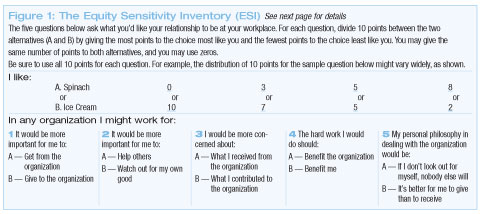
Figure 1 (shown on the previous page) includes a personality scale used to classify people into one of the three equity-sensitivity categories described above. The ESI is easy to administer and score. As indicated in Figure 1, participants merely distribute ten points between two alternatives per each of five questions. Then, the number of points given the benevolent alternatives for each question is summed, which are: 1B, 2A, 3B, 4A, and 5B.

An individual is considered entitled if his or her score is less than 29; benevolent if his or her score is greater than 32, and equity sensitive if his or her score is between 29 and 32. Plus, the degree of an entitled vs. benevolent perspective is indicated by one’s score. For example, a score of 28 is only suggestive of an entitled state, whereas a score below 12 reflects a highly entitled personality.

Lively and informative group conversation can follow the administration and scoring of the ESI. Participants could discuss circumstances and contingencies that can increase a person’s ESI score, perhaps transitioning an attitude from entitled to equity sensitive, or from equity sensitive to benevolent.

This latter point presumes a person’s equity outlook is a mutable state rather than a stable trait. A person’s propensity toward benevolence (or actively caring) can be increased by establishing a relevant accountability system and/or by enhancing particular person states (specifically, self-esteem, self-efficacy, personal control, optimism, and belongingness).

I suggest you introduce equity theory to a work team and then administer and score the ESI. The accompanying individual introspection and group conversations can be instrumental in helping people develop an actively-caring mindset, leading to more actively-caring behavior throughout a workplace.


Editor’s Note: This marks Scott’s final column for ISHN, after writing more than 200 columns for the magazine since 1990. On behalf of ISHN’s 71,400 subscribers, the editors thank Scott for his time, energy and actively caring about the quality of each and every one of his contributions.

Share This Story

Looking for a reprint of this article?
From high-res PDFs to custom plaques, order your copy today!

By E. Scott Geller, Ph.D., Senior Partner, Safety Performance Solutions, Distinguished Professor, Virginia Tech

Recommended Content

JOIN TODAY
to unlock your recommendations.

Already have an account? Sign In

  • forklift safety

    Exploring the latest technologies in forklift safety

    With more staff and more stock in warehousing now more...
    Facility Safety
    By: Josh Cramer
  • welding

    All about welder’s flash or arc eye

    A flash burn is a painful inflammation of the cornea,...
    Environmental Health and Safety
  • dangerous jobs

    The 10 most dangerous jobs in the U.S.

    On-the-job deaths have been rising — hitting the highest...
    Government Safety Regulations
    By: Benita Mehta
Manage My Account
  • eMagazine Subscriptions
  • ISHN Newsletter & Other Newsletter Alerts
  • Online Registration
  • Manage My Preferences
  • Subscription Customer Service

More Videos

Sponsored Content

Sponsored Content is a special paid section where industry companies provide high quality, objective, non-commercial content around topics of interest to the ISHN audience. All Sponsored Content is supplied by the advertising company and any opinions expressed in this article are those of the author and not necessarily reflect the views of ISHN or its parent company, BNP Media. Interested in participating in our Sponsored Content section? Contact your local rep!

close
  • man wearing the the Sundström SR200 Full Face Mask Respirator
    Sponsored byOHD

    5 Fit Testing Mistakes That Could Cost You

  • This image shows Magid AcuSpex polarized blue mirrored safety glasses.
    Sponsored byMagid Glove and Safety

    Construction PPE Guide: What Crews Need for Each Task

  • lone worker in confined space
    Sponsored byAlphasense Ltd.

    GET THE LEAD OUT of your Safety Oxygen Sensors!

Popular Stories

SpaceX 7 launch

OSHA Investigating Fatal Fall at SpaceX Starbase

Worker Impairment

How to Tell When a Co-Worker is Impaired? A Safety Pro’s Challenge

Automated loading dock equipment

After March 2026 Rivian Death, Safety Managers Reassess Loading Dock Systems Under OSHA's Warehouse Emphasis Program

top 10 most dangerous jobs

Poll

Seasonal Readiness

With the federal heat stress prevention rule on the horizon, which area of your safety program needs the most attention?
View Results Poll Archive

Products

Surviving an OSHA Audit A Management Guide, 2nd Edition

Surviving an OSHA Audit A Management Guide, 2nd Edition

See More Products

ISHN Podcasts

Related Articles

  • PSYCHOLOGY OF SAFETY: Actively caring for equity

    See More
  • PSYCHOLOGY OF SAFETY: Personality's powerful role in safety

    See More
  • PSYCHOLOGY OF SAFETY: How flexible is personality?

    See More

Related Directories

  • American Society of Safety Professionals (ASSP)

    The American Society of Safety Professionals (ASSP) is a global association of occupational safety and health professionals who are dedicated to workplace safety. We provide education, safety standards, advocacy and a professional community that supports our diverse members and the profession.
  • Board of Certified Safety Professionals (BCSP)

    Since 1969, BCSP has been setting and certifying the technical competency criteria for safety, health, and environmental practitioners; ensuring safety through certification. In 2019, BCSP developed examCORE a comprehensive educational program for safety certification.
  • Alliance of Women’s Safety Apparel Manufacturers (AWSAM)

    The Alliance of Women's Safety Apparel Manufacturers is a collection of specialty manufacturers and distributors committed to providing properly designed and fitted PPE for women. Our foundational pillars are Awareness, Access and Advocacy. Our non-profit organization has 12 Founding Members and aligns the needs of women in the workforce and the companies they work for with specialty manufacturers dedicated to providing appropriate PPE for women. The Founding Members of the organization have made great strides in removing barriers to access that have existed for many years and kept women from being equally protected. Together, we create a platform that increases awareness of products made for women, encourages equal access to appropriately fitting PPE, and advocates for the safety of women in the workforce. In the spirit of co-opetition, we collaborate to envision what is next for women in industry as we work side by side to accomplish our mission, increase our impact, and share the journey with everyone seeking to elevate diversity and equality in their workplace.
×

Become a Leader in Safety Culture

Build your knowledge with ISHN, covering key safety, health and industrial hygiene news, products, and trends.

JOIN TODAY
  • RESOURCES
    • Advertise
    • Contact Us
    • Directories
    • Manufacturing Division
    • Store
    • Want More
  • SIGN UP TODAY
    • Create Account
    • eMagazine
    • Newsletters
    • Customer Service
    • Manage Preferences
  • SERVICES
    • Marketing Services
    • Reprints
    • Market Research
    • List Rental
    • Survey/Respondent Access
  • STAY CONNECTED
    • LinkedIn
    • Facebook
    • YouTube
    • X (Twitter)
  • PRIVACY
    • PRIVACY POLICY
    • TERMS & CONDITIONS
    • DO NOT SELL MY PERSONAL INFORMATION
    • PRIVACY REQUEST
    • ACCESSIBILITY

Copyright ©2026. All Rights Reserved BNP Media, Inc. and BNP Media II, LLC.

Design, CMS, Hosting & Web Development :: ePublishing