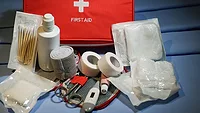
Your responder requirements
Throughout the year, we have discussed what first aid is, what you need to do to comply with regulations, and what composes a first aid kit. We have looked at pandemic preparedness, and what to look for in emergency equipment such as AEDs.
Now let’s discuss responder equipment, the need for such equipment, and selecting the best for your needs. Find 15 considerations for first responder equipment below.
1 What do you need?
OSHA regulations are a great starting point. Most industries have specific OSHA guidelines for first response. Some pertain only to first aid response while other industries have very detailed OSHA guidelines regarding emergency response and monitoring for contamination, spills, biohazards, confined spaces, environmental exposure and more.
Easy-to-read privately published OSHA manuals and guidebooks with industry indexes, interpretations, and easy-to-follow diagrams are available. These are inexpensive alternatives to time-consuming and costly research. When determining your responder equipment needs, consider these codes and regulations as well as your business, environment, unique hazards, and the rescuer.
2 Is it appropriate?
Guidelines are not enough. Apply some common sense in preparing your equipment list. Body warmers and portable heaters are on many standard equipment lists, but aren’t necessarily as much of a priority in southern climes as they are in the north. Conversely, sunblock or insect repellants may not be at the top of your list if you are in the upper regions of our nation. Review readily available guidelines for your industry and then consider your environment and potentials risks and exposures.
3 Is it worthy?
Wouldn’t you rather pay a few dollars more for reliability? Make sure you choose proven products, with track records and brand names. Once you determine the quality products you are looking for, there are plenty of ways to assure you are getting the best price for the best products.
4 Does it fit?
When choosing equipment, whether the devices themselves, or the transportation methods (responder bags) — make sure they fit the situation and the rescuer. If your team has a long way to travel with equipment, make sure it rolls. If your team will be traversing uneven surfaces or stairs, consider backpack carriers.
5 Is it ready?
Check your equipment regularly, monthly at minimum:
- are your tanks filled?
- are your batteries charged?
- are your meds current?
6 Is it guaranteed?
Quality responder equipment is not an inexpensive acquisition. Make sure the products you choose are not only well-made, but also well-backed. A “Lifetime Guarantee” sounds great, but how much does it mean when promised by a company that has only been around a few years?
7 Is there enough?
Your list might indicate you need an AED, oxygen, and a gas detector or monitor. Do you need just one? How about personal protective equipment? Do you require only enough for your first responders, or more for others that may be exposed and possibly trapped in an area of threat? Consider your circumstance and apply some math to the question.
8 Is it nearby?
Can you access your one set of equipment in sufficient time from anywhere in the area you are preparing for? What if you suffer a major catastrophe such as an earthquake or tornado? Can you access your equipment from anywhere even should a portion of your facility collapse? Can you guarantee an adequate round-trip response time? (Three minutes is a general guideline.) Consider preparing more than one cache of equipment for easier access under varying conditions.
9 Is it all you need?
Your industry guidelines may not call for gas detection, but does your building require one? Ours has gas water heaters for the break and restroom facilities. We don’t deal in hazardous chemicals as a part of our day-to-day business, but we do have a battery charger for our forklift. Consider your needs, then have someone else consider your needs, then consider them again. You probably have more hazards at your facility than it may at first appear.
10 Is it safe? Are you?
Just purchasing the appropriate responder equipment is not enough. Some emergency response equipment can introduce new hazards as well. Read the manuals and warnings. Store and maintain your equipment properly.
11 Do you know how to use it?
The Federal Emergency Management Agency says: “Responders must be adequately trained to use, care for, and select appropriate personal protective equipment.”
I say, “Everyone should be adequately trained to use, care for, and select appropriate equipment.” As noted above, some safety or response equipment can introduce new hazards. Consider life-saving oxygen: It is a vital element in rescue operations. It is also hazardous, flammable, compressed gas. Know how to use what you have, and make sure everyone in the area knows the basics properties, risks, and use of your equipment so they show it the respect it deserves.
12 Vendor
Just because your first responder equipment reseller looks big doesn’t mean they are. Websites can give the appearance of size and stability. Choose a vendor that has been in business a while; I recommend at least ten years. Isn’t it worth the small extra expense to know the company has been in business and will continue to be around in a few years in case you need any warranty support?
13 Source & resource
Besides OSHA, there are a number of readily available guides and websites to help you sift through the morass of responder equipment. A particular favorite of mine is the Responder Knowledge Base (www.rkb.us), a website designed for responders, and maintained by DHS/ FEMA. While designed for public safety responders, it has a wealth of information on responder products. The U.S. Department of Homeland Security (DHS) established the System Assessment and Validation for Emergency Responders (SAVER) Program – offering Standardized Equipment List (SEL) & Authorized Equipment List (AEL). The SAVER Program mission includes:
- Conducting impartial, practitioner-relevant, and operationally-oriented assessments and validations of emergency responder equipment
- Providing information that enables decisionmakers and responders to better select, procure, use, and maintain emergency responder equipment.
As previously mentioned, responder equipment is a serious investment, but your organization can look for funding assistance in many forms; including insurance premium reductions, tax breaks, and possibly even FEMA or other preparedness grants.
15 Are you getting the best for the best?
Take your time, make your list, and then put it out for bid. I could say “in these economic times”, but come on… in any economic times, your business should be worth the effort. Whether you have created a new responder equipment list, or you are ready to check your current list for competitive pricing, serious first responder equipment resellers will be pleased to provide you a price quote.
Email your list to your top three or four chosen suppliers, and see who can give you the best quality, value and service. I don’t recommend making your selection and “All or None” bid — you may find substantial savings by purchasing part of your list through one supplier, and the rest through another — capitalize on their specialization and save.
Looking for a reprint of this article?
From high-res PDFs to custom plaques, order your copy today!