SYSTEMS THINKING: Management types & planning styles

Note: this is part one of a two-part series.
As I mentioned in last month’s column, we all fall into one of four dominant orientations toward work. The same can be said for a manager’s orientation toward planning.
A manager’s attitude toward time will dictate his or her style of planning.
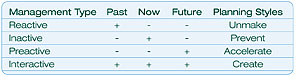
Management types are Reactive, Inactive, Preactive or Interactive. Time is an obliging variable breaking down into Past, Now or Future. Attitudes toward time are even simpler being Positive (+) or Negative (-). Defining a manager’s planning style reflects the manager’s approach to and tolerance for change.

Reactive management and planning
Reactive managers are typically dissatisfied with the way things are and the way things are going. They are quite satisfied with the way things were dealing with problems in a way to return to that state. They have nostalgic longing for the “good ole days.”From a planning standpoint, Reactive managers are tactically oriented, using bottom-up planning that consists of identifying deficiencies in the organization’s performance and devising projects to remove or reduce each deficiency one by one.
For example, a manufacturing plant manager exhibited a reactive command and control style of management. The plant was experiencing a poor safety record (TRIR = 9.785). The plant manager’s boss expressed concern for the poor safety performance during a routine visit, and he strongly suggested that he regain control of his safety performance and immediately reduce the injury rate. Turning to his on-site safety pro, he asked for any suggestions, and the safety pro recommended a behavior-based safety approach. To overcome this deficiency and impress his boss, the plant manager decided to embrace the deployment of a behavior-based safety initiative.
The plant manager approved the implementation plan, which included training all the operators and mechanics in behavior-based safety methods. The plant’s supervisors received the training also; however, they retained their command and control style fearing they would lose their power over their subordinates. In addition, the supervisors did not allow their subordinates to practice any of the skills they had learned in their training due to production issues; while expecting their subordinates to implement the behavior-based safety initiative.
Over the course of the following year, the overall injury rate decreased substantially; however, the severity of the injuries increased significantly. The supervisor-subordinate relationship deteriorated due to management’s unwillingness to allow for the full implementation of the behavior-based safety initiative. This led to a collapse in employee morale, loss of trust, a 30 percent increase in employee turnover, no rec- ognition for achieved safety improvements, and a decline in product quality.
Reactive managers are prone to getting rid of what they do not want; unfortunately, not guaranteeing that one will get what one does want and often leading to getting what one wants even less. Effective management must be directed at getting what one wants, not getting rid of what one does not want.

Inactive management and planning
As you might expect, Inactive managers are satisfied with the way things are. Although things may not be perfect, for an Inactivist, they are good enough. They adhere to the old adage, “if it ain’t broke, don’t fix it.” They actively work to prevent change and only respond when either their personal or organization’s survival is at risk. They sustain their management approach by finding ways to keep people busy doing nothing or in “make work” efforts for others who have productive work to do.Inactive managers respond to survival predicaments by focusing on suppressing the symptoms, also known as crisis management. In our current pace of continuous change, the Inactive manager actually is quite active in preventing change.
As an Inactivist, the plant manager’s career followed a path of maintaining the status quo and avoiding his boss’s “radar screen.” He had mastered the skill of recognizing and dodging “career incidents.”
Late one afternoon, the plant’s industrial hygienist met to inform him of a new regulation that would affect the plant. As the IH pro explained the new regulation, the plant manager thought compliance would lead to increased costs and reduced productivity. In addition, with a new class of possible injuries being identified, he would become “noticed” by his boss.
As a practitioner of inactivism, the plant manager established a committee to review the new regulation and propose an implementation strategy. [Note: An inactivist’s most effective tool for inactivism is the committee.] Even though the IH pro was a member of the committee, the chairman of the committee was a supervisor who was loyal to the plant manager.
During the course of the committee’s deliberations, the chairman discovered that the new regulation contained a “grandfather” provision that would allow for postponement in implementation. Meeting with the plant manager, the chairman convinced him to take advantage of the “grandfather” clause, which certainly fit his “do nothing” nature.
Even though the plant manager disbanded the committee, the IH pro took the initiative to prepare an implementation strategy, which she presented to the plant manager and his staff. The plant manager responded to her presentation by establishing yet another committee to review her implementation strategy and make recommendations to the plant manager. With respect to this committee, the IH pro only played a consulting role, if asked. Ultimately, this committee was disbanded and the implementation strategy was discarded.
Next month: Dissecting Preactive and Interactive management and planning.
References
1 Ackoff, R.L. 1999. Re-Creating the Corporation – A Design of Organizations for the 21st Century. Oxford University Press. New York, NY.
2 Ackoff, 47.
3 Ackoff, 49.
4 Ackoff, 50.
5 Ackoff, R.L. 1981. Creating the Corporate Future – Plan or be Planned For. John Wiley & Sons. New York, NY.
Looking for a reprint of this article?
From high-res PDFs to custom plaques, order your copy today!


