ISHN logo
search
cart
facebook twitter linkedin youtube
  • Sign In
  • Create Account
  • Sign Out
  • My Account
ISHN logo
  • NEWS
    • Today's News
    • Global Safety News
    • Government Regulations
  • PRODUCTS
    • Product Innovations
    • Featured Products
  • TOPICS
    • Environmental Health and Safety
    • Facility Safety
    • Workplace Health
    • Occupational Safety
    • PPE
    • More Topics
  • CONSTRUCTION
  • TECHNOLOGY
  • COLUMNS
    • Best Practices
    • Dave Johnson: What’s going on
    • Editorial Comments
    • Leading Safety
  • MULTIMEDIA
    • ISHN Podcast
    • Videos
    • Cold Stress Education Quiz
    • Webinars
    • White Papers
  • MORE
    • Buyer's Guide
    • Newsletters
    • Convention Companion
    • Polls
    • Events
    • ISHN Store
    • Sponsor Insights
  • EMAGAZINE
    • eMagazine
    • Archived Issues
    • Contact
    • Advertise
  • JOIN TODAY!
PPE

When the heat is on…

Outfit workers with arc flash protection

By Randy Kaminsky
September 1, 2011
While industrial equipment has progressed to accommodate production demands, these high-power solutions create additional safety concerns. Machines perform faster, with increased power, heat and electrical circuits. Workers are subjected to numerous health and safety risks such as flammable materials, machine contact, dust, noise, toxins and perhaps the most critical, electrical arc flash. Responsibility for protecting against these serious risks rests directly on employers.

Prior to selecting suitable safeguards, facility managers must assess the potential dangers associated with each industrial application for tailored safety chartsolutions. By providing appropriate personal protective equipment (PPE), employers will not only protect against costly injuries, but also increase productivity, reduce unnecessary downtime and avoid potential liability.
Dangers of arc flash

One of the primary safety risks in industrial environments is electrical arc flash. Arc flash is an explosive blast of flame, debris, sounds and force, reaching up to 35,000°F in less than one second. Easily ignited, the causes of arc flash are diverse and often uncontrollable, including accidental contact with an energized part, contamination from dust or wiring errors, each creating a spark that creates a dangerous burst of flames.

With as many as ten arc flash injuries occurring every day in the U.S., there are a wide range of potential consequences, including third degree burns, blindness, nerve damage, cardiac arrest and even death. To prevent harm, workers who perform duties that could result in arc flash conditions should wear flame-resistant apparel.

Personal protective equipment

PPE is necessary to protect against injuries resulting from contact with chemical, physical, mechanical, electrical hazards and more. Utilizing various equipment, including goggles, gloves, hard hats, facemasks and flame-resistant apparel, enables employees to protect their eyes, limbs, skin and lungs from a wide range of industrial risks.

Assessing the unique safety challenges present in each industrial environment is a crucial component for selecting PPE. Completing an assessment using NFPA 70E electrical workplace safety guidelines will aid employers in categorizing and understanding their existing electrical hazards. By knowing the risks, employers can effectively protect their employees from injury with application-specific PPE.

To safeguard against electrical dangers, such as arc flash, utilizing PPE like flame-resistant apparel can provide the precise level of protection needed to ensure employees are safe without impacting productivity.

Flame-resistant apparel

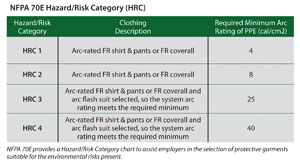
Flame-resistant apparel is separated into distinct Hazard/Risk Categories, offering an easy-to-follow guide for selecting clothing. Categorizing protective apparel ensures the proper protective gear is used for the appropriate hazard. Ranked from HRC levels one through four, each category offers information regarding types of apparel and energy calorie levels for a simple reference guide to proper protection standards. The chart below illustrates Hazard/Risk Category requirements for flame-resistant apparel.

Flame-resistant apparel can be further broken down into primary and secondary protective clothing. Primary protective equipment is used when the worker is aware of a high likelihood of exposure to hazards, such as repairing equipment with high voltage ratings. Primary falls within HRC levels three and four, requiring employees to be fully protected with a flash suit. Secondary protective apparel guards against the most common risks, HRC 2, with ratings between 8 and 24 calories of energy. By wearing a flame-resistant shirt/pant combination or coveralls, workers are sufficiently protected. Further, depending on the application, additional equipment may be necessary, including volt-rated gloves, goggles, and in some cases, a head covering for increased safety.

In the field

In any industry, one of the most dangerous jobs is performing equipment maintenance. Often this requires working near live machines or energized parts — increasing the risk of arc flash, thereby escalating the likelihood of injury. However, performing maintenance is an essential function for sustaining plant productivity.

When a piece of equipment requires maintenance, if possible, the machine should be powered down to protect employees and equipment from damage. When it has not been turned off, an arc flash can be ignited by actions as simple as dropping a tool or placing it is the wrong location, causing a spark that quickly leads to flames.

At times, a worker performs near a live part, where the margin for error is minute. Removing or installing circuit breakers, low voltage testing and unbolting equipment covers can all lead to arc flash hazards. Any accidental contact with an energized part or other miscalculations can quickly ignite arc blasts, instantaneously burning anything or anyone in its path. By implementing proper industrial safety measures, such as flame-resistant apparel, workers are better protected from the devastating injuries resulting from arc flash and other threatening conditions.

Share This Story

Looking for a reprint of this article?
From high-res PDFs to custom plaques, order your copy today!

Randy Kaminsky is director of procurement for AmeriPride Services in Minnetonka, Minn.

Recommended Content

JOIN TODAY
to unlock your recommendations.

Already have an account? Sign In

  • forklift safety

    Exploring the latest technologies in forklift safety

    With more staff and more stock in warehousing now more...
    Facility Safety
    By: Josh Cramer
  • welding

    All about welder’s flash or arc eye

    A flash burn is a painful inflammation of the cornea,...
    Environmental Health and Safety
  • dangerous jobs

    The 10 most dangerous jobs in the U.S.

    On-the-job deaths have been rising — hitting the highest...
    Government Safety Regulations
    By: Benita Mehta
Manage My Account
  • eMagazine Subscriptions
  • ISHN Newsletter & Other Newsletter Alerts
  • Online Registration
  • Manage My Preferences
  • Subscription Customer Service

More Videos

Sponsored Content

Sponsored Content is a special paid section where industry companies provide high quality, objective, non-commercial content around topics of interest to the ISHN audience. All Sponsored Content is supplied by the advertising company and any opinions expressed in this article are those of the author and not necessarily reflect the views of ISHN or its parent company, BNP Media. Interested in participating in our Sponsored Content section? Contact your local rep!

close
  • man wearing the the Sundström SR200 Full Face Mask Respirator
    Sponsored byOHD

    5 Fit Testing Mistakes That Could Cost You

  • This image shows Magid AcuSpex polarized blue mirrored safety glasses.
    Sponsored byMagid Glove and Safety

    Construction PPE Guide: What Crews Need for Each Task

  • lone worker in confined space
    Sponsored byAlphasense Ltd.

    GET THE LEAD OUT of your Safety Oxygen Sensors!

Popular Stories

SpaceX 7 launch

OSHA Investigating Fatal Fall at SpaceX Starbase

Worker Impairment

How to Tell When a Co-Worker is Impaired? A Safety Pro’s Challenge

Automated loading dock equipment

After March 2026 Rivian Death, Safety Managers Reassess Loading Dock Systems Under OSHA's Warehouse Emphasis Program

top 10 most dangerous jobs

Poll

Seasonal Readiness

With the federal heat stress prevention rule on the horizon, which area of your safety program needs the most attention?
View Results Poll Archive

Products

Surviving an OSHA Audit A Management Guide, 2nd Edition

Surviving an OSHA Audit A Management Guide, 2nd Edition

See More Products

ISHN Podcasts

Related Articles

  • When the heat is on

    See More
  • The heat is on

    See More
  • Thermometer in the sun

    Heat is on everyone’s minds

    See More

Related Products

See More Products
  • 1119906652.webp

    Alive and Well at the End of the Day: The Supervisor's Guide to Managing Safety in Operations, 2E

See More Products

Events

View AllSubmit An Event
  • March 4, 2015

    ACGIH® TLV® for Heat Stress and Strain in the Context of Heat Stress Management webinar

    While the Heat Stress and Strain TLV® is designed for exposure assessment, it exists in the context of an integrated heat stress management program. This webinar will outline the components of a heat stress management program to illustrate how the TLV® can be used for exposure assessment and the development of controls.
View AllSubmit An Event
×

Become a Leader in Safety Culture

Build your knowledge with ISHN, covering key safety, health and industrial hygiene news, products, and trends.

JOIN TODAY
  • RESOURCES
    • Advertise
    • Contact Us
    • Directories
    • Manufacturing Division
    • Store
    • Want More
  • SIGN UP TODAY
    • Create Account
    • eMagazine
    • Newsletters
    • Customer Service
    • Manage Preferences
  • SERVICES
    • Marketing Services
    • Reprints
    • Market Research
    • List Rental
    • Survey/Respondent Access
  • STAY CONNECTED
    • LinkedIn
    • Facebook
    • YouTube
    • X (Twitter)
  • PRIVACY
    • PRIVACY POLICY
    • TERMS & CONDITIONS
    • DO NOT SELL MY PERSONAL INFORMATION
    • PRIVACY REQUEST
    • ACCESSIBILITY

Copyright ©2026. All Rights Reserved BNP Media, Inc. and BNP Media II, LLC.

Design, CMS, Hosting & Web Development :: ePublishing