There's no crying in baseball...but is crying in college football ok?
New research on men and emotion yields surprising results
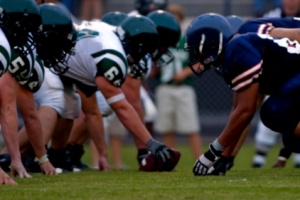 While there’s no crying in baseball, as Tom Hanks’ character famously proclaimed in “A League of Their Own,” crying in college football might not be a bad thing, at least in the eyes of one’s teammates.
Although college football players feel pressure to conform to some male stereotypes, players who display physical affection toward their teammates are happier, according to new research. The findings were reported in a special section of Psychology of Men & Masculinity®, published by the American Psychological Association.
“Overall, college football players who strive to be stronger and are emotionally expressive are more likely to have a mental edge on and off the field,” said psychologist Jesse Steinfeldt, PhD, of Indiana University-Bloomington, who co-authored each article in the special section.
In one experiment, 150 college football players with an average age of 19 were randomly assigned to four groups to read different vignettes about “Jack” -- a football player who cries after a football game. In the vignettes, Jack either sobs or tears up after his team loses or wins. The players in the experiment were mostly white and played for one of two teams, one from the NCAA Division II and the other at the National Association of Intercollegiate Athletics level.
Those who read about Jack tearing up after losing thought his behavior was appropriate, but drew the line at his sobbing. The players also said they were more likely to tear up than sob if they were in Jack’s situation. Players who read vignettes in which Jack sobs after losing a game said his reaction was more typical among football players than the players who read that Jack sobs after his team won the game.
“In 2009, the news media disparaged University of Florida quarterback Tim Tebow for crying on the sidelines after losing a big game, even labeling him Tim ‘Tearbow,’” said psychologist Y. Joel Wong, PhD, the study’s lead author. “However, the college football players in our study who believed Jack’s crying was appropriate had higher self-esteem. In contrast, players who believed Jack’s crying was inappropriate yet felt they would likely cry in Jack’s situation had lower self-esteem.”
In another experiment at the same colleges, researchers surveyed 153 football players, also mostly white and with an average age of 19. The researchers asked the players if they felt pressured to act a certain way because society expects men to be powerful and competitive, and to show little emotion and affection in front of other men. Other studies have shown that this type of pressure to conform can lead to poor self-esteem and disruptive behavior. The researchers also asked the players about their overall life satisfaction and how they expressed emotions on and off the field.
The study found players do feel pressure to conform to these gender roles. But players who were never affectionate toward their teammates were less satisfied with life.
In another study of 197 mostly white college football players from three NCAA Division II level schools, the drive to be muscular meant more risk taking, less emotion and a stronger work ethic. But wanting to be more muscular was not related to the players’ desire to win or a tendency to be physically violent. For most, the primary reason they wanted to be muscular was so they could perform better on the field and avoid injuries. A secondary reason was so they could appear more “manly,” with a better physical appearance and sex appeal.
“These guys have to be physically stronger for athletic performance and to reduce injury,” said Steinfeldt. “Yet they also acknowledged some masculine stereotype pressures, and previous research has shown that can have a negative impact on a player’s psyche.”
The American Psychological Association, in Washington, D.C., is the largest scientific and professional organization representing psychology in the United States and is the world's largest association of psychologists. APA's membership includes more than 154,000 researchers, educators, clinicians, consultants and students. Through its divisions in 54 subfields of psychology and affiliations with 60 state, territorial and Canadian provincial associations, APA works to advance psychology as a science, as a profession and as a means of promoting health, education and human welfare.
Article: “A Contextual Examination of Gender Role Conflict Among College Football Players,” Jesse A. Steinfeldt, PhD, Y. Joel Wong, PhD, Aleska R. Hagan, PhD, and Jacquelyn M. Hoag, PhD, Indiana University-Bloomington; Matthew C. Steinfeldt, PhD, Fort Lewis College; Psychology of Men & Masculinity, Vol. 12, No. 4.
Article: “Drive for Muscularity and Conformity to Masculine Norms Among College Football Players,” Jesse A. Steinfeldt, PhD, Indiana University-Bloomington; Garrett A. Gilchrist, PhD, Pacific Lutheran University; Aaron W. Halterman, PhD, and Alexander Gomory, PhD, Indiana University-Bloomington; Matthew C. Steinfeldt, PhD, Fort Lewis College; Psychology of Men & Masculinity, Vol. 12, No. 4.
Article: “Men’s Tears: Football Players’ Evaluations of Crying Behavior,” Y. Joel Wong, PhD, Jesse A. Steinfeldt, PhD, Julie R. LaFollette, PhD, and Shu-Ching Tsao,
Indiana University-Bloomington; Psychology of Men & Masculinity, Vol. 12, No. 4.
Looking for a reprint of this article?
From high-res PDFs to custom plaques, order your copy today!


