CSB releases final report on Hoeganaes investigation
Board urges OSHA to develop a combustible dust standard within a year
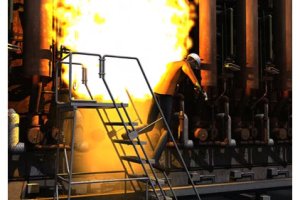 The U.S. Chemical Safety Board has released its final report on three accidents that occurred in 2011 at the Hoeganaes powdered metals plant in Gallatin, Tennessee. Flash fires and an explosion killed a total of five workers and injured three others.
The CSB investigation found that significant amounts of fine iron powder had accumulated over time at the Hoeganaes facility, and that while the company knew from its own testing and experience with flash fires in the plant that the dust was combustible, it did not take the necessary action to reduce the hazards through engineering controls and basic housekeeping. The investigation also found that Hoeganaes did not institute procedures such as combustible gas monitoring or provide training for employees on avoiding flammable gas fires and explosions.
The Board issued several safety recommendations, including that the Occupational Safety and Health Administration (OSHA), develop and publish a proposed combustible dust standard within one year and ensure that the new standard includes coverage for combustible iron and steel powders.
CSB Chairperson Rafael Moure-Eraso said, “The three accidents at the Hoeganaes facility were entirely preventable. Despite evidence released by the CSB and information that Hoeganaes had in its possession even before the first accident in January 2011, the company did not institute adequate dust control or housekeeping measures. Dust fires and explosions continue to claim lives and destroy property in many industries. More must be done to control this hazard. No more lives should be lost from these preventable accidents.”
The CSB also released a safety video entitled “Iron in the Fire,” which features computer animations depicting each accident.
The first of the three 2011 accidents at the Hoeganaes plant occurred on January 31 when fine particles of iron dust ignited while a maintenance mechanic and an electrician were troubleshooting a problem with a bucket elevator. Both employees suffered burns and later died from their injuries. The CSB investigation into that accident was underway when, just two months later, on March 29th, a similar flash fire burned another Hoeganaes worker.
At a news conference in Tennessee on May 11, 2011, the CSB released laboratory test results on dust samples taken from the plant after the second accident. The testing demonstrated the combustibility of even small amounts of the iron dust when dispersed in air in the presence of an ignition source.
Just sixteen days after the CSB released those test results, on May 27th, a hydrogen explosion erupted in the plant, after the gas began leaking from a corroded furnace pipe. The blast shook loose iron dust accumulations from the upper reaches of the building, which ignited and rained down on workers. The explosion and ensuing fire killed three workers and injured two others. The CSB found that the company did not require atmospheric testing for hydrogen or other explosive gases.
Investigator Johnnie Banks said, “When the Hoeganaes facility was built, more than thirty years ago, it was not designed according to good practice guidelines on combustible dust, such as those set forth by the National Fire Protection Association, or NFPA. And during its decades of operation, it was never redesigned to address the serious dust hazard. The CSB is recommending that Hoeganaes conduct periodic audits to ensure compliance with the appropriate NFPA codes and standards.”
The CSB report notes that engineering controls, such as enclosing conveyors and installing properly designed dust collection equipment are the best ways to prevent dust accumulations. CSB investigators found that the plant’s powder handling equipment was not adequately sealed.
The Hoeganaes facility has numerous flat overhead surfaces where dust can accumulate, such areas are difficult to reach and clean. The CSB case study noted that NFPA 484, the Standard for Combustible Metals, recommends that floors, elevated platforms, and gratings be designed to prevent dust accumulations and to facilitate cleaning. The NFPA standard also requires that all machines that release combustible dust be connected to a dust collection system.
The CSB is recommending that the International Code Council, which sets safety standards that may be adopted by state and local governments, revise its standards to require mandatory compliance and enforcement with the detailed requirements of NFPA standards related to preventing accumulation of combustible dust in workplaces. Additionally, the CSB is recommending that the City of Gallatin require all facilities covered by the International Fire Code to conform to National Fire Protection Association standards for combustible dusts.
Investigator Banks said, “It is a tragedy that five lives were lost at Hoeganaes from these accidents. The CSB believes that adhering to recommended industry practices will greatly reduce the potential for a future dust fire or explosion. ”
In 2006 the CSB released a study on the hazards of combustible dust, ultimately recommending that the Occupational Safety and Health Administration create a combustible dust standard for general industry.
In response, OSHA initiated a National Emphasis Program in 2007 to target industries with combustible dust hazards for additional inspections and enforcement. Two years later, OSHA announced it would begin rulemaking on a comprehensive standard for general industry. Yet, in 2011, at the time of the accidents at Hoeganaes, a specific standard had not yet been proposed or completed.
As a result, the CSB is recommending that OSHA develop and publish a proposed combustible dust standard within one year - ensuring that the new standard includes coverage for combustible iron and steel powders. The Board is also recommending that the Tennessee Occupational Safety and Health Administration target facilities that generate metal dust.
The Board also is making recommendations to Hoeganaes, the Metal Powder Producers Association, the Gallatin Fire Department and City of Gallatin.
More information is available at: www.csb.gov
Looking for a reprint of this article?
From high-res PDFs to custom plaques, order your copy today!


