ISHN logo
search
cart
facebook twitter linkedin youtube
  • Sign In
  • Create Account
  • Sign Out
  • My Account
ISHN logo
  • NEWS
    • Today's News
    • Global Safety News
    • Government Regulations
  • PRODUCTS
    • Product Innovations
    • Featured Products
  • TOPICS
    • Environmental Health and Safety
    • Facility Safety
    • Workplace Health
    • Occupational Safety
    • PPE
    • More Topics
  • CONSTRUCTION
  • TECHNOLOGY
  • COLUMNS
    • Best Practices
    • Dave Johnson: What’s going on
    • Editorial Comments
    • Leading Safety
  • MULTIMEDIA
    • ISHN Podcast
    • Videos
    • Cold Stress Education Quiz
    • Webinars
    • White Papers
  • MORE
    • Buyer's Guide
    • Newsletters
    • Convention Companion
    • Polls
    • Events
    • ISHN Store
    • Sponsor Insights
  • EMAGAZINE
    • eMagazine
    • Archived Issues
    • Contact
    • Advertise
  • JOIN TODAY!
Workplace Safety Culture

How to avoid safety failures
By Shawn M. Galloway
October 5, 2012
The late business guru, Peter Drucker, warned, “Your system is perfectly designed to give you the results you’re getting.” Injures and incidents are failures in your systems. Injury prevention tools, culture, strategy, capabilities and focus are part of the elements that make up your systems. Are yours aligned to focus on failing less or achieving success? Both are important, providing different types of organizational performance clarity. However, I’ve yet to see great sustained accomplishments in business, personal life or sporting events obtained by setting and working toward a goal of not screwing up.ISHN1012_f10_fig1_300px.jpg

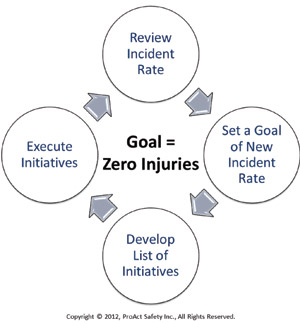
Leaders responsible for establishing strategy must move past what I call “The Perpetual Cycle of Avoiding Failures,” outlined in Figure 1, to experience different results and performance in safety and culture.

Failure Avoidance Step 1: Review Incident Rate

A leader decides to improve safety. Typically the measurement available to them is their failure metric, the lagging indicator of incident rate. Please recognize this number does not inform how to improve and the average employee is challenged to describe the formula used to determine it. Absent a transformational dashboard or balanced safety scorecard, this becomes the solitary indicator by which safety is measured, goals are established and performance change validated.

Failure Avoidance Step 2: Set a Goal of New Incident Rate

Improvement goals must be set. Too often this becomes a new incident rate number to achieve, sending leadership on a mission to manage to a number. If the goal is negatively defined (zero injuries), people work to avoid. Moreover, this creates the mindset that zero equals excellence in safety. It does not. People then internalize, “If what I do does not produce an incident or injury, it is therefore safe.” This is also not true. Zero incidents is not a continuous improvement goal; it is a failure metric. If the goals are positively oriented (100% safe, 100% of the time, or create safety culture excellence), people work to achieve something.

 Failure Avoidance Step 3: Develop List of Initiatives

Next, leadership develops a list of initiatives with the intentions of accomplishing the new desirable incident rate. Often training, programs, and processes are purchased with the confidence that by performing all of these well, a transformation will occur. But what is the prioritization process that demonstrates confidence in the ability to observe progress toward the goal, as well as confidence that results occurred because of purposeful, focused intent, rather than luck?

Failure Avoidance Step 4: Execute Initiatives

Once the list has been narrowed down and an implementation path has been chosen, resources are focused on executing the activities. Then the cycle begins again. After the initiatives are underway or complete, the incident rate is measured. If there is improvement, an invalidated sense of accomplishment is perceived because, “We took action and the results improved!” Correlation doesn’t always indicate causation.

Avoiding failure is not a strategy

If the goal is excellence in safety culture and performance, your efforts must be focused on achieving more of what you want rather than what you don’t want. Leaders must develop a safety excellence strategy, providing a framework that facilitates appropriate and prioritized decisions to both continuously improve safety culture and prevent accidents. Improving safety, deploying an initiative and achieving zero incidents (failing less) are not strategies; they are goals and objectives. Prior to approving an initiative, the following five questions must be answered:

1. How will doing this demonstrate we are executing our strategy, aligning with our vision and accomplishing the objectives and goals?

2. What precise value does this provide?

3. How will this advance the culture?

4. How will this eliminate these types of accidents, or minimize or control the risk exposure?

5. Different than measurement, how will we observe progress toward accomplishing our goal?

If these questions do not have substantive answers, the “Why are we doing this?” question isn’t answered, support will be undetermined, confidence in leadership ability will be diminished and results will be a gamble.

With the resources to improve safety becoming leaner and leaner, it is imperative that focus becomes the key tool. Continuous improvement is important; however, it is a slow and tedious process without a comprehensive and aligned strategy, transformational focus and confidence in a validated direction.

Share This Story

Looking for a reprint of this article?
From high-res PDFs to custom plaques, order your copy today!

Shawn M. Galloway is CEO of ProAct Safety and an author of several bestselling books. His latest book is Bridge to Excellence: Building Capacity for Sustainable Performance. As an award-winning consultant, trusted adviser, leadership coach, and keynote speaker, he has helped hundreds of organizations within every primary industry to improve safety strategy, culture, leadership, and engagement. He also hosts the highly acclaimed weekly podcast series Safety Culture Excellence®. For more information, call (936) 273-8700 or email info@ProActSafety.com.

Recommended Content

JOIN TODAY
to unlock your recommendations.

Already have an account? Sign In

  • forklift safety

    Exploring the latest technologies in forklift safety

    With more staff and more stock in warehousing now more...
    Facility Safety
    By: Josh Cramer
  • welding

    All about welder’s flash or arc eye

    A flash burn is a painful inflammation of the cornea,...
    Environmental Health and Safety
  • dangerous jobs

    The 10 most dangerous jobs in the U.S.

    On-the-job deaths have been rising — hitting the highest...
    Transportation Safety
    By: Benita Mehta
Manage My Account
  • eMagazine Subscriptions
  • ISHN Newsletter & Other Newsletter Alerts
  • Online Registration
  • Manage My Preferences
  • Subscription Customer Service

More Videos

Sponsored Content

Sponsored Content is a special paid section where industry companies provide high quality, objective, non-commercial content around topics of interest to the ISHN audience. All Sponsored Content is supplied by the advertising company and any opinions expressed in this article are those of the author and not necessarily reflect the views of ISHN or its parent company, BNP Media. Interested in participating in our Sponsored Content section? Contact your local rep!

close
  • man wearing the the Sundström SR200 Full Face Mask Respirator
    Sponsored byOHD

    5 Fit Testing Mistakes That Could Cost You

  • This image shows Magid AcuSpex polarized blue mirrored safety glasses.
    Sponsored byMagid Glove and Safety

    Construction PPE Guide: What Crews Need for Each Task

  • lone worker in confined space
    Sponsored byAlphasense Ltd.

    GET THE LEAD OUT of your Safety Oxygen Sensors!

Popular Stories

SpaceX 7 launch

OSHA Investigating Fatal Fall at SpaceX Starbase

Automated loading dock equipment

After March 2026 Rivian Death, Safety Managers Reassess Loading Dock Systems Under OSHA's Warehouse Emphasis Program

psychology in the workplace

Most Workplaces Measure Psychological Safety, Ignoring Psychosocial Risks

top 10 most dangerous jobs

Poll

Seasonal Readiness

With the federal heat stress prevention rule on the horizon, which area of your safety program needs the most attention?
View Results Poll Archive

Products

Surviving an OSHA Audit A Management Guide, 2nd Edition

Surviving an OSHA Audit A Management Guide, 2nd Edition

See More Products

ISHN Podcasts

Related Articles

  • How to avoid the headache of diverse safety training requirements

    See More
  • How to avoid the headache of diverse safety training requirements

    See More
  • Honeywell white paper

    Honeywell publishes white paper revealing risks of fogging safety eyewear – and how to avoid them

    See More

Related Products

See More Products
  • Top Ten Pitfalls in OSHA Recordkeeping and How to Avoid Them

See More Products
×

Become a Leader in Safety Culture

Build your knowledge with ISHN, covering key safety, health and industrial hygiene news, products, and trends.

JOIN TODAY
  • RESOURCES
    • Advertise
    • Contact Us
    • Directories
    • Manufacturing Division
    • Store
    • Want More
  • SIGN UP TODAY
    • Create Account
    • eMagazine
    • Newsletters
    • Customer Service
    • Manage Preferences
  • SERVICES
    • Marketing Services
    • Reprints
    • Market Research
    • List Rental
    • Survey/Respondent Access
  • STAY CONNECTED
    • LinkedIn
    • Facebook
    • YouTube
    • X (Twitter)
  • PRIVACY
    • PRIVACY POLICY
    • TERMS & CONDITIONS
    • DO NOT SELL MY PERSONAL INFORMATION
    • PRIVACY REQUEST
    • ACCESSIBILITY

Copyright ©2026. All Rights Reserved BNP Media, Inc. and BNP Media II, LLC.

Design, CMS, Hosting & Web Development :: ePublishing