ISHN logo
search
cart
facebook twitter linkedin youtube
  • Sign In
  • Create Account
  • Sign Out
  • My Account
ISHN logo
  • NEWS
    • Today's News
    • Global Safety News
    • Government Regulations
  • PRODUCTS
    • Product Innovations
    • Featured Products
  • TOPICS
    • Environmental Health and Safety
    • Facility Safety
    • Workplace Health
    • Occupational Safety
    • PPE
    • More Topics
  • CONSTRUCTION
  • TECHNOLOGY
  • COLUMNS
    • Best Practices
    • Dave Johnson: What’s going on
    • Editorial Comments
    • Leading Safety
  • MULTIMEDIA
    • ISHN Podcast
    • Videos
    • Cold Stress Education Quiz
    • Webinars
    • White Papers
  • MORE
    • Buyer's Guide
    • Newsletters
    • Convention Companion
    • Polls
    • Events
    • ISHN Store
    • Sponsor Insights
  • EMAGAZINE
    • eMagazine
    • Archived Issues
    • Contact
    • Advertise
  • JOIN TODAY!
PPEConstruction Industry Safety and Health

Choose the right high-viz gear

Traffic patterns determine retroreflective material needed
By Gregory Whittle
March 6, 2013
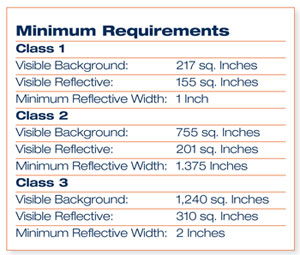
The current hi-viz national standard, ANSI/ISEA-107-2010, was published in January 2010 as the American National Standard for High Visibility Safety Apparel. Guidelines include, but are not limited to, work wear, rainwear and safety vests.ISHN0313_F7_table_300px.jpg

A few decades ago, there was no national standard governing hi-viz apparel. Prior to 1999, people working in “low light” daytime conditions or at night were subject primarily to regulations drawn at the state level. Compliance with 50 different sets of regs led to both dangerous situations and high costs. Consistent national standards give workers and employers alike a firm foundation. They also establish a baseline for hi-viz garment manufacturers.

The standard applies to working conditions 24 hours a day. To meet the safety needs of different work environments, apparel is divided into three classes, with each class requiring a minimum amount of fluorescent background along with a minimum level of retroreflective material (see chart).

Class 1 apparel is to be used in environments where workers are adequately separated from conflicting streams of traffic, where they possess ample conspicuity to non-complex environment backgrounds and where vehicle and work equipment speeds are 24 mph or less. Applications falling within these guidelines include warehouse and parking lot attendants, sidewalk maintenance workers and delivery truck drivers.

Class 2 apparel applies to vicinities where vehicle speeds are in the 25-49 mph range and in environments that require increased visibility. Work conditions may include inclement weather, the presence of complex environment backgrounds and activities that require workers to be in close proximity to vehicle traffic or may distract them from conflicting traffic. Depending on specific conditions, roadway construction workers, utility workers, survey crews, railroad workers, school crossing guards, airport baggage handlers, law enforcement personnel, accident site personnel, emergency response personnel, high volume parking and toll gate personnel may all wear Class 2 apparel.

Class 3 apparel is required in areas where vehicle speeds are in excess of 50 mph. Workers exposed to these speeds include emergency services personnel, survey crews and road construction crews. It also applies to any workers required to be conspicuous throughout their entire range of motion for at least 1,280 feet, be identifiable as a person and be required to perform multiple tasks that could distract them from conflicting traffic.

Lots of options

Work wear suppliers are taking steps to help employers comply with the high-visibility standard. They’ve launched high-visibility lines with items rated according to the apparel classes identified in the standard. As determined by the specifications, the fabric will not shrink or fade. Breathable materials protect from the sun, release soil, dry quickly and resist bacteria and odor.

Many options allow compliance with the standard while also meeting workers’ needs. Just about all features available in traditional winter wear, for example, can be found in high-viz styles, such as bomber jackets or parkas, zip in-out fleece liners and attached or separate hoods. The same can be said for lighter weight windbreakers and rainwear, along with “hoodies” and T-shirts. All of this apparel meets ANSI Class 3 or Class 2 requirements.

The 2010 ANSI standard also describes Class E garments. Shorts or pants complying with Class E requirements must have a minimum of 465 square inches of fluorescent background, along with 108 square inches of retroreflective material. They are made to be worn with a Class 2 garment, thus creating a Class 3 ensemble.

Even hi-viz head wear is available. Under the Class E provision, high-viz head wear has a minimum background of 78 square inches with 10 square inches of reflective material.

Comfort and security

Work apparel is not only a matter of safety; it must allow workers to move easily and perform required tasks, as well as protect them from the elements. Factors such as temperature, exposure time, wind, humidity, gender, age and body metabolism affect a worker’s comfort level. Shirts and pants also need to withstand tough work conditions. Fabric choice is important. In warm seasons and climates, a 65 percent polyester/35 percent cotton blend is durable, absorbent and cool — and will hold up to multiple washings. In cold weather, layering enables workers to start their day bundled up for warmth and then remove layers as the temperature rises and activity warms the workers.

Effective layering is based on a simple principle: keep warmth in and moisture out. Thanks to today’s breathable and wicking fabrics, comfort is more attainable than ever.

Security is also a primary consideration. Uniforms, vests, hats and footwear help identify who does or does not belong on a work site. Contractors often place their logos on apparel to easily identify their workers.

What about vests?

The most familiar hi-viz garment is the vest, which comes in lime green or orange with reflective stripe. Vests are manufactured as Class 1, 2 or 3 apparel.

 Beyond basic design specs, users can select other product features. What type of closure do you prefer or need? Hook and loop, zipper or snaps? If a zipper, do you need a non-conductive material?

Do you want pockets? Where? How many? What style? Consider what will be placed in the pockets.

How about a breakaway feature? Additional hook-and-loop closures allow the vest to be ripped off if caught in machinery or traffic.

Finally, color and fabric! Lime green or orange? Both meet the standard. Mesh or solid? Mesh is cooler — an important factor if working in high heat and humidity.

KEYWORDS: Eye Protection high-visibility apparel high-visibility standard rainwear

Share This Story

Looking for a reprint of this article?
From high-res PDFs to custom plaques, order your copy today!

Gregory Whittle began his career in the hi-viz garment business in the late 1990s. He founded SafetyGear U.S.A. as a manufacturer and importer in 2007. He served as CEO until 2009 when he sold the company. BodyGuard Safety Products was then established as a distributor, selling to end-users.

Recommended Content

JOIN TODAY
to unlock your recommendations.

Already have an account? Sign In

  • forklift safety

    Exploring the latest technologies in forklift safety

    With more staff and more stock in warehousing now more...
    Facility Safety
    By: Josh Cramer
  • welding

    All about welder’s flash or arc eye

    A flash burn is a painful inflammation of the cornea,...
    Environmental Health and Safety
  • dangerous jobs

    The 10 most dangerous jobs in the U.S.

    On-the-job deaths have been rising — hitting the highest...
    Construction Industry Safety and Health
    By: Benita Mehta
Manage My Account
  • eMagazine Subscriptions
  • ISHN Newsletter & Other Newsletter Alerts
  • Online Registration
  • Manage My Preferences
  • Subscription Customer Service

More Videos

Sponsored Content

Sponsored Content is a special paid section where industry companies provide high quality, objective, non-commercial content around topics of interest to the ISHN audience. All Sponsored Content is supplied by the advertising company and any opinions expressed in this article are those of the author and not necessarily reflect the views of ISHN or its parent company, BNP Media. Interested in participating in our Sponsored Content section? Contact your local rep!

close
  • man wearing the the Sundström SR200 Full Face Mask Respirator
    Sponsored byOHD

    5 Fit Testing Mistakes That Could Cost You

  • This image shows Magid AcuSpex polarized blue mirrored safety glasses.
    Sponsored byMagid Glove and Safety

    Construction PPE Guide: What Crews Need for Each Task

  • lone worker in confined space
    Sponsored byAlphasense Ltd.

    GET THE LEAD OUT of your Safety Oxygen Sensors!

Popular Stories

SpaceX 7 launch

OSHA Investigating Fatal Fall at SpaceX Starbase

Worker Impairment

How to Tell When a Co-Worker is Impaired? A Safety Pro’s Challenge

Automated loading dock equipment

After March 2026 Rivian Death, Safety Managers Reassess Loading Dock Systems Under OSHA's Warehouse Emphasis Program

top 10 most dangerous jobs

Poll

Seasonal Readiness

With the federal heat stress prevention rule on the horizon, which area of your safety program needs the most attention?
View Results Poll Archive

Products

Surviving an OSHA Audit A Management Guide, 2nd Edition

Surviving an OSHA Audit A Management Guide, 2nd Edition

See More Products

ISHN Podcasts

Related Articles

  • Choose the right rubber insulating glove for the task at hand

    See More
  • Choose the right LENS TINT for the job

    See More
  • hard hats for head protection

    How to choose the right type and class of hard hat for the job

    See More

Related Products

See More Products
  • 1119906652.webp

    Alive and Well at the End of the Day: The Supervisor's Guide to Managing Safety in Operations, 2E

  • fearless world.jpg

    The Fearless World of Professional Safety in the 21st Century

See More Products

Related Directories

  • MSA - The Safety Co.

    WE KNOW WHAT'S AT STAKE. Unpredictable work environments are often part of the job. That's why it's critically important to have the right safety equipment at the moment it matters most. MSA's complete lines of safety solutions help protect those workers at the heart of your operation.
×

Become a Leader in Safety Culture

Build your knowledge with ISHN, covering key safety, health and industrial hygiene news, products, and trends.

JOIN TODAY
  • RESOURCES
    • Advertise
    • Contact Us
    • Directories
    • Manufacturing Division
    • Store
    • Want More
  • SIGN UP TODAY
    • Create Account
    • eMagazine
    • Newsletters
    • Customer Service
    • Manage Preferences
  • SERVICES
    • Marketing Services
    • Reprints
    • Market Research
    • List Rental
    • Survey/Respondent Access
  • STAY CONNECTED
    • LinkedIn
    • Facebook
    • YouTube
    • X (Twitter)
  • PRIVACY
    • PRIVACY POLICY
    • TERMS & CONDITIONS
    • DO NOT SELL MY PERSONAL INFORMATION
    • PRIVACY REQUEST
    • ACCESSIBILITY

Copyright ©2026. All Rights Reserved BNP Media, Inc. and BNP Media II, LLC.

Design, CMS, Hosting & Web Development :: ePublishing