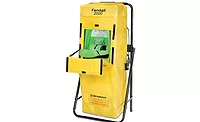
Identify safe and effective emergency eyewash
But still, more than 2,000 occupational eye injuries occur in the U.S. daily, and when they do, proper and immediate treatment is the best defense for a positive outcome and minimal financial impact. The American National Standards Institute requires that the first step following chemical contact of any kind with the eyes is immediate and continuous flushing with fluid from either a portable or plumbed primary eyewash station.
Options for eyewash delivery systems and the fluids they deliver are vast. What many safety managers don’t realize is that not all flushing fluids are equal in content, safety or even intended use. They may be derived from tap, potable, purified or sterile water and are offered in various end products ranging from concentrates or additives to purified or sterile solutions. Significant differences in ingredients and manufacturing processes also exist.
Treating an injured eye with sub-standard fluid increases risk of irritation, allergic reaction or infection; it can prolong the length of recovery; and it can even lead to permanent vision loss for the affected individual. Making informed selections can significantly improve the injury outcome and its costs to the employer. This article examines the ways flushing fluids vary and offers tips on how to select a reliable source for safe and effective ophthalmic flushing fluids.
Eyewash regulation
Since flushing fluid enters the body through an open orifice and can potentially introduce harmful elements, eyewash is regulated as an over-the-counter (OTC) ophthalmic drug by the U.S. Food and Drug Administration (FDA). Aside from tap water, which is regulated by the Environmental Protection Agency in the U.S., all forms of eyewash fluid must be registered with the FDA as an OTC ophthalmic drug. The FDA requires that current good manufacturing practices be followed, and that the manufacture of fluids be conducted in accordance with that agency’s Quality Systems Regulation.
Eyewash marketers and manufacturers are also required to have a National Drug Code, which is listed on the FDA website. This ensures that purchasers and end-users can look up a drug’s compliance with FDA standards by searching for its NDC number, brand or product name, manufacturer name or by active ingredient on the FDA website.
Hidden dangers of flushing fluids
Non-sterile solution
Despite government controls and oversight, there is a lot to consider when selecting emergency eyewash. You’ll find that commonly used flushing fluids are not sterile and include concentrate, additive and purified water, and saline. Yet use of such fluids does not guarantee safe treatment, as most of these are left to the consumer to ensure proper mixing and measuring.
Plus, when manufactured using poor-quality ingredients or large amounts of additives, non-sterile fluid can in fact be detrimental. For example, chemicals such as boric acid, benzalkonium chloride and benzethonium chloride are commonly used to kill bacteria or prevent its growth in non-sterile fluids or fluids that are not sterile from inception. These and other additives and preservatives have the potential to introduce harmful impurities, cause allergic reactions, lengthen recovery periods and increase the chances of infection and disability.
Regarding ophthalmic drug products, the U.S. Code of Federal Regulations (21 CFR 200.50) states, “The Food and Drug Administration concludes that all such preparations (offered or intended for ophthalmic use), if they are not sterile, fall below their professed standard of purity or quality and may be unsafe.”
Sterile solution
The 21 CFR 200.50 regulation goes on to state: “Informed medical opinion is in agreement that all preparations offered or intended for ophthalmic use, including preparation for cleansing the eyes, should be sterile. It is further evident that such preparations purport to be of such purity and quality as to be suitable for safe use in the eyes.”
Buffered, sterile saline is the safest ophthalmic flushing fluid for two reasons: first, because its properties are physiologically compatible with human tears and second, because it is devoid of impurities. These attributes minimize the likelihood of irritation, infection or allergic reaction and maximize the chance for a positive outcome.
The manufacture of sterile, buffered saline through aseptic production is rigorous and requires compliance with process controls, inspections and testing. Manufacture of aseptically-filled sterile eyewash is conducted in a clean room using filtration and demanding controls. The result is the type of eyewash that assures 100-percent purity as well as pH and isotonic qualities that match those of the human eye.
The other process used in creating sterile eyewash is gamma irradiation, which also requires manufacture in a clean room. In this case, a non-sterile eyewash bag or bottle is filled with non-sterile fluid; the package is then irradiated as a whole to achieve sterilization. When gamma irradiation is employed, the end product may still contain traces of chlorine, boric acid and other harmful chemicals used in manufacturing the fluid. The presence of such residual elements leads to harsher flushing conditions that can cause reddening or burning sensations in the eyes and can make a continuous flush extremely uncomfortable.
How to qualify safe, effective eyewash manufacturers and distributors
Employers need a reliable source for safe, effective eyewash. Given the many variables involved, making a selection can prove challenging. Here are the top considerations for qualifying a reliable eyewash supplier.
- Check for a NDC, which ensures the product is approved by the FDA. Visit www.FDA.gov/drugs to search the NDC directory for registered products.
- Review the list of ingredients. Look for sterile saline that is produced from 100-percent sterile water from the inception and uses sodium chlorides (salt) only for the purpose of matching the pH to that of the human eye. Solutions containing numerous additives or chemicals may introduce irritants, allergens or worse. Tamper-resistant packaging is the best option to ensure safety and purity.
- Confirm that the fluid is intended for use in the eyes. Ask your distributor, contact the manufacturer directly or visit www.FDA.gov/drugs. Look for the 21 CFR 200.50 reference, which denotes an ophthalmic-grade product.
- If the fluid has a New Product Application (NPA), be wary. This means it has been approved as a new product based on paperwork, but it has not yet passed thorough testing by the FDA. Products with an NPA designation have not yet been granted a NDC and the manufacturer or supplier may not be a reliable source.
- Consider buying products made in the U.S.A. Domestic manufacturing regulations and inspections are more stringent than those in some overseas markets.
- Heed expiration dates. Products are tested and approved to maintain efficacy for a measured length of time and are approved by the FDA according to those parameters. Over time, compounds can change form, packaging can degrade and drugs may lose their ability to perform at safe standards. Renew eyewash solution according to the manufacturer’s guidelines to ensure its sterility and stability.
Select a reputable manufacturer that supplies FDA-approved, sterile, ophthalmic-grade eyewash. Uninterrupted access to a product with integrity is important. That translates into the highest level of care for workers in the event of an eye injury. When workers recover quickly, companies recover quickly, and the safety benefits of exceptional emergency eyewash are clear for everyone to see.
This article is an excerpt from the whitepaper, “How to Identify Safe and Effective Emergency Eyewash — and the Hidden Dangers to Avoid,” published by Honeywell and available in full at www.honeywellsafety.com/USA/Eyewash_Training.
Looking for a reprint of this article?
From high-res PDFs to custom plaques, order your copy today!