Luxembourg has become the first European Union (EU) country to completely ban products containing glyphosate, the controversial herbicide at the center of high-profile lawsuits, and conflicting scientific studies and health claims. Glyphosate has already been banned in Vietnam and Thailand. Mexico has announced plans to do the same.
The European Commission, on advice from the European Food Safety Agency (EFSA), has banned two pesticides: chlorpyrifos and chlorpyrifos-methyl and two organophosphates used as ingredients in a number of insecticides.
Chlorpyrifos has been on the market since 1966 and is currently in use in some 80 countries.
OSHA has cited Wright Metal Products Crates LLC – based in South Bend, Indiana, and operating as WMP Crates – for exposing employees to amputation, chemical and other safety hazards at a worksite in Lavonia, Georgia. The company faces $195,034 in penalties.
A pilot project by the European Chemicals Agency (ECHA) intended to gather information on chemical substances “of very high concern” found in consumer articles has yielded some alarming results, according to the European Trade Union Institute (ETUI).
The inspectorates of 15 EU Member States checked 682 articles supplied by 405 companies.
The U.S. Chemical Safety Board's (CSB) is inviting comment on its just-issued Notice of Proposed Rulemaking regarding accidental release reporting.
The proposed rule describes when an owner or operator is required to file a report of an accidental release and the required content of such a report and is intended to ensure that the CSB receives rapid, accurate reports of any accidental release that meets established statutory criteria.
In a unanimous decision, a three-judge panel of the U.S. Ninth Circuit Court of Appeals ruled Monday that Exxon Mobil Oil Corp. must produce information to the U.S. Chemical Safety Board (CSB) related to a tank filled with hydrofluoric acid at the site of a 2015 oil refinery explosion in Torrance, California.
The decision reverses a lower Court ruling that the information was not sufficiently relevant to the CSB’s investigation.
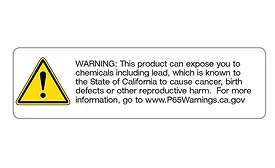
California’s Safe Drinking Water and Toxic Enforcement Act of 1986, aka Proposition 65 (Prop 65) was revised August 30, 2018. The revised Prop 65 requires a warning label, example shown below, for any consumer product containing any of the more than 950 chemicals known to the State of California to cause cancer or birth defects.
Mesothelioma cancer is the most fatal among asbestos-related diseases. The cancer presents itself 20 to 50 years after exposure and may originate in the lungs, heart, or abdominal cavity. The disease will begin to form after inhalation or ingestion of airborne asbestos particles. Due to the generic symptoms a patient may experience, late stage diagnosis is a common occurrence among mesothelioma patients.
New Pig Corporation, the leading brand for helping workplaces manage leaks, drips and spills to create safer, cleaner and more productive environments, has recently introduced an exclusive line of single-use PIG® Cleanup Kits for grab-and-go response to a variety annoying small spills.
Single-Use Kits are faster and more efficient than dragging a large spill kit to a small cleanup and much more effective than rags and paper towels.
VelocityEHS, the global leader in cloud-based environment, health, safety (EHS) and sustainability solutions, announced today the launch of its new 24-hour Emergency Response Services. Powered by ChemTel – which VelocityEHS acquired earlier this year – the Emergency Response Services provide an around-the-clock hotline customers can use to address a wide-range of chemical safety and compliance needs such as shipping compliance, exposure support, right-to-know safety data sheet (SDS) access, and more.