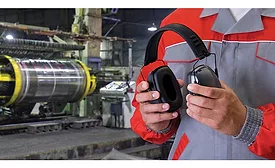
Approximately 22 million workers are exposed to potentially damaging noise at work each year. Over the past 20 years, government agencies have consistently identified noise-induced hearing loss as one of the top concerns of workers.
Every year 22 million workers are at risk of losing their hearing from workplace noise hazards. Work-related hearing loss is a widespread problem, but it is a problem that can be solved. On August 1, 2016, NIOSH, OSHA, and MSHA issued a challenge to inventors and entrepreneurs with the dual goals of inspiring creative ideas and raising business awareness of the market for workplace safety innovation.
Every year 22 million workers are at risk of losing their hearing from workplace noise hazards. Work-related hearing loss is a widespread problem, but it is a problem that can be solved. On August 1, 2016, NIOSH, OSHA, and MSHA issued a challenge to inventors and entrepreneurs with the dual goals of inspiring creative ideas and raising business awareness of the market for workplace safety innovation.
Every year 22 million workers are at risk of losing their hearing from workplace noise hazards. Work-related hearing loss is a widespread problem, but it is a problem that can be solved. On August 1, 2016, NIOSH, OSHA, and MSHA issued a challenge to inventors and entrepreneurs with the dual goals of inspiring creative ideas and raising business awareness of the market for workplace safety innovation.
With a large number of kids using ear buds and headphones, noise-induced hearing loss is a serious issue, according to the American Speech-Language-Hearing Association (ASHA).
Last year, the World Health Organization estimated 1.1 billion teenagers and young adults are at risk of hearing loss due to the unsafe use of personal audio devices, including smartphones, and exposure to damaging levels of sound at noisy entertainment venues such as nightclubs, bars, and sporting events.
A New York City institution is looking to tackle the city’s massive noise problem head-on
November 23, 2016
Sounds of New York City, otherwise known as SONYC, is a new multi-year project involving a team of scientists from New York University (NYU) and collaborators at Ohio State University. It is a “first-of-its-kind comprehensive research initiative to understand and address noise pollution in New York and beyond,” and the National Science Foundation recently awarded the project a $4.6 million grant.
Soldiers returning from combat can face a host of mental, physical and emotional challenges. The nature of their job exposes them to more risk than most non-military people, and they are sometimes left to contend with traumatic brain injury, musculoskeletal injuries or the effects of chemical exposure for the rest of their lives.
I'm 61 and have noticed my hearing is not what it used to be. Do I need to see my doctor, or is it OK to wait until I think I need hearing aids?
Don't wait. Make an appointment to have your hearing evaluated now. Most health care providers recommend a baseline hearing check at 50 and then regularly scheduled follow-up assessments after that based on your individual needs.
With a large number of kids using ear buds and headphones, noise-induced hearing loss is a serious issue, according to the American Speech-Language-Hearing Association (ASHA).
Last year, the World Health Organization estimated 1.1 billion teenagers and young adults are at risk of hearing loss due to the unsafe use of personal audio devices, including smartphones, and exposure to damaging levels of sound at noisy entertainment venues such as nightclubs, bars, and sporting events.
Anyone whose blood pressure is 140/90mmhg or more for a sustained period is said to have high blood pressure or hypertension. A study shows that long-term exposure to both air and noise pollution can make the hypertension of a person high.