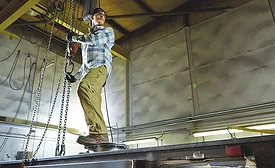
Members of the new generation workforce have a work hard, play hard mentality. They actively pursue their interests and take pride in their accomplishments.
New foam earplug dispensers, a heavy duty ladder and next-level safety gloves were among the top occupational safety and health products featured on ISHN.com this week.
At least four million workers go to work each day in damaging noise environments, ten million people in the U.S. have a noise-related hearing loss, and 22 million workers are exposed to potentially damaging noise each year, according to the Centers for Disease Control and Prevention (CDC).
Like other jobs or careers, welders must wear suitable protective equipment. In general, Personal Protective Equipment (PPE) must protect against hazards such as burns, sparks, spatter, electric shock, and radiation.
Sparks and spatter fly off from the welding arc. Hot metal and sparks blow out from the cutting flame. The workpiece and equipment get hot. The flying sparks and hot metal, slag, spatter, hot workpiece, and hot equipment can cause burns. Additionally, arc rays can cause radiation burns.
A year or so ago a major waste company placed 12 street cleaners, wearing yellow hi viz coats in a busy out of town shopping complex and asked shoppers coming out how many they remembered seeing. The average the shoppers reported seeing was four.
Researchers at the National Institute for Occupational Safety and Health (NIOSH) are studying ultraviolet (UV) energy as a way to disinfect disposable respirators so that healthcare providers could reuse them during emergency situations, if they were in short supply.
Workers operating in high-risk industries, such as oil and natural gas and chemical, encounter environments rich with hazardous gases that may be unseen or unfamiliar, such as hydrogen sulfide (H2S).
One of the big challenges for safety managers when it comes to managing slips, trips and falls is to identify and place critical control and accident prevention measures into working environments.
 RSS
RSS