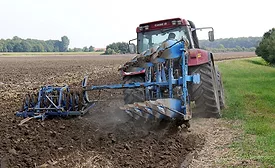
Long hours of sitting on machinery and working in uncomfortable positions, like kneeling and crawling, along with lifting heavy loads can lead to injuries for farmers. Because of such physically demanding environments, farmers have a greater risk than workers in many other industries of experiencing musculoskeletal disorders—soft-tissue injuries from frequent motion, force, and awkward positions—especially low back pain.
A long-term silicosis study yields valuable results; an OSHA trainer makes thousands selling fake training cards and a risk from wearable tech you may not have thought of. These were among the top occupational safety and health stories featured on ISHN.com this week.
In many European countries, women workers have a more difficult time than their male counterparts to get their cancer recognised as having been caused by work.
That’s one of the conclusions of a report of the European Agency for Safety and Health at work (EU-OSHA) which analyses the alert and sentinel systems used in various European countries for the early detection of work-related diseases.
Younger women having more acute heart attacks in the U.S.
February 22, 2019
Women who spent less of their day in sedentary behaviors—sitting or reclining while awake—had a significantly decreased risk of heart disease, but there has been an increase in the incidence of younger women having acute heart attacks in the U.S., according to two studies in a special Go Red for Women issue of the American Heart Association’s (AHA) journal Circulation, published in February, American Heart Month.
Silicosis is a lung disease caused by exposure to airborne silica. Generally, it causes scarring (pulmonary fibrosis) after 20 or more years of exposure. Since 1988, Michigan has been identifying individuals who develop silicosis with the goal of targeting prevention actions. Michigan’s system is both the longest running and only comprehensive surveillance system for silicosis in the United States.
A new report says without a national investment and commitment to transforming health care delivery in the United States, many people will not benefit from the substantial progress in reducing the burden of cancer already made, let alone the innovations and breakthroughs that are yet to come.
The article is the fifth in a series comprising a cancer control blueprint to identify opportunities for improving cancer control in the U.S. The latest chapter, authored by Robin Yabroff, Ph.D., and colleagues describes the state of cancer care delivery in the U.S.; provides an overview of its health care systems; and identifies goals for a high-performing health care system.
Leading gas detection solutions now with enhanced availability, performance, redundancy, and security through Amazon Web Services
February 21, 2019
Industrial Scientific, the global leader in gas detection, is pleased to announce the migration of all iNet® infrastructure to Amazon Web Services (AWS), the world’s leading cloud provider. The demand for live gas detection data continues to grow, and with that growth, there is an expectation of increased data accessibility and analytics.
A worker received a permanent injury while assessing a sugar-filling line at the company's industrial facility in Scarborough, Ontario.
Prior to the accident date, the employer had installed temporary perimeter fencing around the sugar-filling line as an interim measure while a long-term guarding solution was being designed and manufactured by a third-party engineering company.
The majority of people who suffer the partial or total loss of the hand’s motor skills report a drastic reduction in the quality of life due to the consequent inability to carry out many activities of daily life. Performing tasks often taken for granted, such as buttoning a shirt, using the phone, or grasping utensils for cooking or eating becomes frustrating or almost impossible due to reduced grip strength and poor motor control of the hand that afflicts these people.
It is well known that neural circuits in the spinal cord control seemingly simple things like the pain reflex in humans, and some motor control functions in animals. Now, a new study published in the journal Nature Neuroscience has shown that the spinal cord is also able to process and control more complex functions, like the positioning of your hand in external space.