The Center for Safety and Health Sustainability (CSHS) has released its Best Practice Guide for Occupational Health and Safety in Sustainability Reports, which provides occupational health and safety (OHS) professionals with metrics and best practices in OHS sustainability reporting.
After its latest OSHA inspection, a Florida contractor has increased the health and safety violations it’s been cited for to 23, and the fines it faces to more than $66K.
L&I cited the utility district for five serious violations and for each assessed the maximum penalty of $7,000
June 16, 2016
The Washington Department of Labor & Industries (L&I) fined Grant County Public Utility District #2 $35,000 for five serious safety violations after investigating an explosion at its Priest Rapids Dam on the Columbia River in Beverly, Wash. Six workers were hospitalized with serious electrical burns after the explosion.
Although information on the victims of the mass shooting in Orlando, Florida is still being developed, two of those killed were working at Pulse nightclub at the time of the incident.
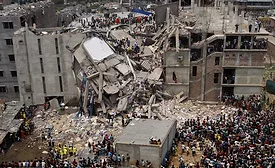
Three past presidents of the AIHA - Barbara Dawson, John Henshaw and Zack Mansdorf - are leading a fundraising effort to support a grassroots-level occupational safety and health training program in Bangladesh.
J. J. Keller & Associates, Inc. introduces Hot Work: Safety Operations Training
June 15, 2016
Because hot work in any company can mean high-risk work, J. J. Keller & Associates, Inc., the leader in safety and compliance, introduces a new training program to safeguard employees and property from the inherent dangers.
According to OSHA, 2.3 million workers are exposed to crystalline silica on the job in 676,000 construction, general industry, and maritime workplaces. To better protect these workers, OSHA has finalized two new crystalline silica standards: one for general industry and maritime (1910.1053), and one for construction (1926.1153), both effective June 23, 2016.
Butte County, California has become the fourth county in that state to ban the controversial method of harvesting natural gas known as hydraulic fracturing or fracking.
A training program will help approximately 35,000 first responders and workers whose jobs may expose them to infectious diseases protect themselves while also minimizing the spread of disease to others. The three-year, $9 million program is being launched by the National Institute of Environmental Health Sciences (NIEHS), part of the National Institutes of Health, in collaboration with the Centers for Disease Control and Prevention (CDC) and other federal agencies.