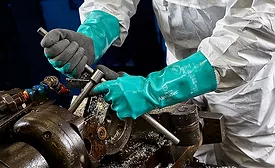
ANSI/ISEA 138 is a work in progress. The second consensus ballot/public review draft was released in October, 2018.
February 7, 2019
There are 110,000 lost-time hand injuries annually. Hand injuries send more than one million workers to the emergency room each year. And 70 percent of workers who experience hand injuries are not wearing gloves.
In recent years, technology advancement has allowed manufacturers to create more sophisticated yarns that improve glove performance significantly. The level of cut protection can be increased by using high-performance materials, and by increasing a material's weight.
Selecting chemical protective gloves is a crucial, yet challenging task for safety managers worldwide. Complex portfolios are made even more complicated by evolving standards and regulations, making compliance increasingly difficult in today’s work environments.
Canton, North Carolina employed two minors to operate chainsaws and to ride in the back of a dump truck while removing overhead tree branches on a residential street – tasks deemed too hazardous for young workers, according to child labor requirements Fair Labor Standards Act's (FLSA).
After an investigation by the U.S. Department of Labor's Wage and Hour Division (WHD), Canton, North Carolina, paid a civil penalty of $7,060 for violating the FLSA.
OSHA investigators found that employees at a Texas gun range were not only exposed to above-permissible limits of lead in the air, they also risked potential exposure due to surfaces throughout the facility that were contaminated with the substance. Tap Rack Bang Indoor Shooting Range LLC - operating as The Gun Range faces penalties totaling $214,387 for safety violations at its facility in Killeen.
During this moment, the President laid out his vision of an America united, proclaiming the strength of the economy, and speaking to the importance of safety and security. However, it is with tragic irony that the President seems to have missed a critical – but often silent – problem that impacts his priorities of economic growth and national security: America's workers are not safe at their jobs.
Following an investigation by the U.S. Department of Labor's Wage and Hour Division (WHD), Tuff Automation Inc. has paid a civil money penalty of $28,474 after a 17-year-old employee suffered an amputation of his right index finger while operating an unguarded band saw at the Grand Rapids, Michigan, manufacturing facility. The minor also suffered significant nerve damage to his right middle finger.
A teenager loses control of a ladder – and loses his life. The FDA gets an “F” when it comes to controlling tobacco use among young people. OSHA’s final injury and illness reporting rule gets challenged in court. These were among the top stories featured on ISHN.com this week.
Teenage health care worker regulation change prompted calls for review
February 1, 2019
The U.S. Department of Labor is investigating whether the U.S. Department of Labor under the Trump administration is following proper procedures when making regulatory changes to worker safety regulations.
In a letter to Congressional Democrats, who’d requested an audit of the DOL’s rulemaking process, DOL Inspector General Scott S. Dahl said a review of the “integrity of the rulemaking process” at OSHA was already underway.
A requirement that employers disclose more information about worker injuries to safety officials and the public has been scaled back by the Trump administration.
The Labor Department action, reflecting the administration’s broad push to ease regulations on business, weakens an Obama-era initiative to improve safety enforcement and crack down on underreporting of job injuries. The 2016 rule, which had been hailed by safety advocates, drew the ire of the U.S. Chamber of Commerce and other business groups.
 RSS
RSS