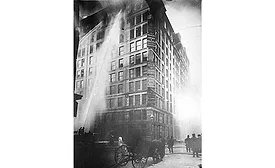
One of the deadliest industrial disasters in the history of the country – the Triangle Shirtwaist Factory fire - occurred in New York City on this day in 1911. The fire claimed the lives off 146 garment workers – many of whom jumped to their deaths from the 7th, 8th and 9th floors of the building in order to avoid the smoke and flames sweeping through their workplace.
Chemicals are used in manufacturing to make everything from food containers to your favorite pair of shoes. One such chemical is styrene, a colorless, strong-smelling liquid used to make plastics and rubber for these products and others, including insulation, fiberglass, pipes, vehicle parts, and carpet backing.
During the manufacturing process, chemical vapors contaminate the air.
Ponder this: our human reality now involves a Bluetooth toaster. For $100, you too can receive push notifications when your slice of bread reaches the desired level of toasted-ness. Yes, this is almost certainly the future Steve Jobs envisioned when introducing the iPhone as a “revolutionary and magical product”.
The opioid epidemic’s toll on the U.S. workforce, retaliation against an undocumented worker leads to his arrest and federal worker safety agencies get a look at what could be their budgets next year. These were among the top stories featured on ISHN.com this week.
Cintas Corporation has become the first company to reach 100 sites with Voluntary Protection Program (VPP) Star certification from OSHA. The company’s Dayton, Ohio location became its 100th VPP location in early 2019.
“Safety is woven into the DNA of Cintas’ culture, and we are extremely proud of this accomplishment,” said Scott Farmer, Chairman and CEO, Cintas. “Nearly 45,000 Cintas employee-partners across the country go to work every day, and it is our mission to make sure everyone goes home safe.”
OSHA has proposed penalties of $1,326,367 to Dowa THT America Inc. – a metal heat treatment company based in Bowling Green, Ohio – after the company exposed employees to atmospheric, thermal, electrical, and mechanical hazards as they performed maintenance inside heat-treating furnaces. In addition to the penalties, the agency placed the company in the Severe Violator Enforcement Program.
One of your biggest challenges as a Safety Manager may be creating a culture of safety throughout your organization. Making it a company-wide effort instead of just “your job” can be an uphill battle, but it’s a policy that will pay off in the end.
Whether you already have companywide buy-in or if you’re just beginning to introduce the idea, maximize your success by including these five steps in your safety culture planning:
How do manufacturing companies know the best and safest way to design workplaces and assign tasks? Ideally, injuries and illnesses should be prevented, but historically companies have adjusted their workplace policies, practices and procedures after an injury or illness occurred.
In a NIOSH-supported study at the University of Iowa’s College of Public Health, researchers tested the role of computer simulation in promoting workers’ well-being by designing safer work.
Last month in Seattle the National Safety Council's Campbell Institute held a conference where one of the major topics was, "Fatigue: Managing the Hidden Risk." My question: What's so "hidden" about fatigue? Everyone you talk to in today's 24/7 wired world is fatigued, tired, beat. Just ask them.
A garbage truck driver’s impairment was the likely cause of a deadly collision involving his vehicle and an Amtrak train at a crossing in Virginia, according to the National Transportation Safety Board (NTSB).
The incident occurred on January 31, 2018, about 11:16 a.m., when a 2018 Freightliner refuse truck driven by 30-year-old Dana Naylor attempted to navigate a highway-railroad grade crossing in Crozet.
 RSS
RSS