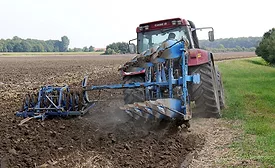
Long hours of sitting on machinery and working in uncomfortable positions, like kneeling and crawling, along with lifting heavy loads can lead to injuries for farmers. Because of such physically demanding environments, farmers have a greater risk than workers in many other industries of experiencing musculoskeletal disorders—soft-tissue injuries from frequent motion, force, and awkward positions—especially low back pain.
A ladder safety enhancement, tactical work gloves and a handheld gas monitor are among the top occupational safety and health products featured on ISHN.com this week.
A long-term silicosis study yields valuable results; an OSHA trainer makes thousands selling fake training cards and a risk from wearable tech you may not have thought of. These were among the top occupational safety and health stories featured on ISHN.com this week.
Silicosis is a lung disease caused by exposure to airborne silica. Generally, it causes scarring (pulmonary fibrosis) after 20 or more years of exposure. Since 1988, Michigan has been identifying individuals who develop silicosis with the goal of targeting prevention actions. Michigan’s system is both the longest running and only comprehensive surveillance system for silicosis in the United States.
Rollover protective structures, or ROPS, saved more than $4 million in prevented deaths and injuries among New York State farm workers from 2007 to 2017, according to a NIOSH-funded study published in the American Journal of Public HealthExternal.
ROPS, which became standard tractor equipment in 1985, help prevent injuries from tractor overturns –the leading cause of farm-related deaths.
Until now, nonfatal injuries and deaths in the motor vehicle towing industry have been largely overlooked
February 21, 2019
The motor vehicle towing industry has a higher rate of work-related injury and death compared to other industries, according to NIOSH research presented at the National Occupational Injury Research Symposium in Morgantown, West Virginia. Yet studies historically have focused on the safety of other first responders, including law enforcement officers, fire fighters, and emergency medical services workers.
The American Conference of Governmental Industrial Hygienists (ACGIH®) announced today the appointment of Frank Mortl III, CAE as Executive Director of the association. ACGIH® is a 501(c)(3) charitable scientific organization that advances occupational and environmental health. For over 80 years, the group has been highly respected around the world for their dedication to the OEHS community.
Good investigators understand what their biases are and work to control them while in investigation mode. Adopt the persona of a sports referee—the neutral arbitrator, without a stake in the outcome.
The shooting on Saturday in Aurora, Illinois involving a gunman who opened fire at a warehouse where he’d worked is the latest incident of its kind, but probably won’t be the last. Five people were killed and five police officers who responded to the scene were injured during the shooting, which reportedly lasted for approximately one hour. The suspect, 45-year-old Gary Martin, was killed in the exchange of gunfire. News reports say Martin returned to the warehouse armed after being fired from his job.
Want to enhance your chances of getting hired as an EHS generalist – also known as an environmental health and safety multidisciplinary professional? In addition to the necessary education, make sure your communication skills – both oral and written – are well developed.
That’s one of the conclusions in a white paper just released by the American Industrial Hygiene Association (AIHA), one that focuses on the hiring requirements and expectations from stakeholders for recent EHS generalist graduates.