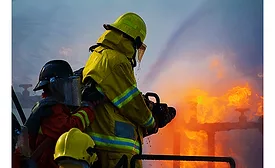
In the United States, the number of acres burned each year from wildland fires has grown, increasing work-related risks to wildland firefighters. One invisible risk is carbon monoxide (CO), produced from the burning of fuels, such as in fires or from gasoline-powered engines. In a recent study led by Scott Henn, NIOSH industrial hygienist, he describes conditions that increase this risk.
The airports across the United States have been using aqueous film-forming foam (AFFF), the premier firefighting foam in the United States for several decades. AFFF contains per- and poly-fluoroalkyl substances (PFASs), which are a large family of man-made fluorinated chemicals with thermal stability that enhances its ability to rapidly extinguish hazardous fires.
The American Conference of Governmental Industrial Hygienists (ACGIH®) and six of its Allied Industry Partners entered into a Memorandum of Understanding (MoU) during the Indoor Air Quality Association’s (IAQA) Annual Meeting & Exposition in West Palm Beach, Florida. Frank Mortl III, CAE, ACGIH®’s Executive Director signed the agreement on behalf of ACGIH®.
Hazardous materials incident response planning and pipeline safety recently were enhanced as two more safety recommendations from the National Transportation Safety Board's (NTSB) 2019 – 2020 Most Wanted List of Transportation Safety Improvementswere implemented.
The growing problem of plastic pollution in the environment is receiving an increasing amount of attention (see article in Nature). Small particles of plastics are often referred to as microplastics (plastic particles smaller than 5 mm [1]) and nanoplastics (the nanoscale fraction of plastic particles). Nano- and microplastic particles (NMPPs) can be formed through environmental and mechanical degradation (the top-down mechanism).
Several landlocked states among those with highest rates
February 19, 2020
A new study finds a wide state-by-state variation in rates of melanoma caused by ultraviolet (UV) exposure with highest rates in several states on the East and West Coast including Hawaii, but also a few landlocked states, including Utah, Vermont, and Minnesota. The report finds state-level incidence rates for UV-attributable melanoma ranged from 15 cases per 100,000 in Alaska to 65 cases per 100,000 in Hawaii.
On an unseasonably warm autumn night in 2016 near Tekamah, Nebraska, a resident ventured out of his home to find the source of the sharp, overpowering odor he was smelling. What he didn’t know was that an 8-inch-diameter underground transmission pipeline owned and operated by Magellan Midstream Partners, LP had ruptured and released 2,587 barrels (108,654 gallons) of liquid anhydrous ammonia onto his property.
Flaring at the Chevron Refinery in Richmond, California this week caused employees to be evacuated and disruptions in operations, according to news sources. Flaring is a refinery safety mechanism that burns gases that would otherwise be released into the atmosphere.
No injuries were reported.
The U.S. Chemical Safety Board and Hazard Investigation Board (CSB) has approved a final rule on accidental release reporting. The CSB has posted a prepublication version of the final rule available at the following link: https://www.csb.gov/assets/1/6/prepublicationcopy2-3-20.pdf. The official version is expected to be published early next week in the Federal Register.
Millions in OSHA fines for one roofing contractor, 2020 is off to a deadly start for the poultry industry and OSHA celebrates its 50th anniversary. These were among the top stories featured on ISHN.com this week.
 RSS
RSS