ISHN logo
search
cart
facebook twitter linkedin youtube
  • Sign In
  • Create Account
  • Sign Out
  • My Account
ISHN logo
  • NEWS
    • Today's News
    • Global Safety News
    • Government Regulations
  • PRODUCTS
    • Product Innovations
    • Featured Products
  • TOPICS
    • Environmental Health and Safety
    • Facility Safety
    • Workplace Health
    • Occupational Safety
    • PPE
    • More Topics
  • CONSTRUCTION
  • TECHNOLOGY
  • COLUMNS
    • Best Practices
    • Dave Johnson: What’s going on
    • Editorial Comments
    • Leading Safety
  • MULTIMEDIA
    • ISHN Podcast
    • Videos
    • Cold Stress Education Quiz
    • Webinars
    • White Papers
  • MORE
    • Buyer's Guide
    • Newsletters
    • Convention Companion
    • Polls
    • Events
    • ISHN Store
    • Sponsor Insights
  • EMAGAZINE
    • eMagazine
    • Archived Issues
    • Contact
    • Advertise
  • JOIN TODAY!
Today's Safety NewsOccupational SafetyEnvironmental Health and Safety

Western Illinois University students get first-hand look at confined spaces

A "mini field trip" in hazards, regulations

November 3, 2015

There are more than 50 confined spaces on Western Illinois University's Macomb campus. On any given work day at Western, technicians in WIU Facilities Management may find themselves working in one of these potentially dangerous work sites. 

Recently, Fetene Gebrewold, professor in the WIU Department of Health Sciences and Social Work, brought in one of those employees, Don Mutch, an environmental health and safety technician II, to show Gebrewold's students the practical and necessary safety aspects of working in a confined space. A "permit-required" confined space can include underground utility holes, tanks, silos or pipelines and have such characteristics as limited openings for workers to enter and exit, the potential to contain hazardous atmospheres, as well as internal configurations in which entrants could be trapped.

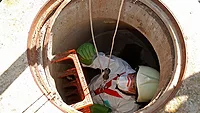
Mutch's Sept. 15 presentation to students in Gebrewold's Environmental and Occupational Safety (EOS) 377 course used one of the many permit-required confined spaces (covered in 29 CFR [Code of Federal Regulations] 1910.146, U.S. Dept. of Labor, Occupational and Health Safety Administration [OSHA]) on campus to demonstrate how to use such equipment as harnesses and air-quality monitoring devices, as well as the need for using three workers (an entrant, attendant and entry supervisor) when working on a permit-required confined space job site.

The EOS 377 course, which enables students to earn OSHA 30-hour general industry certification credentials, according to Gebrewold, covers the fundamentals of permit-required confined spaces, as well as hazardous-waste regulations, industrial hygiene requirements, workplace violence and accident causation theories.

"Don's presentation provided us with a mini field trip and showed the students how to apply OHSA regulations," Gebrewold said. "Before we went to the confined space site, which was between Horrabin and Stipes halls, Don gave students an overview of what permit-required confined spaces are and the safety hazards involved with working in them."

Gebrewold said Mutch informed students there are more than 1.6 million Americans who work in confined spaces each year, and serious injury or death can result from working in a confined space. 

"Some of the hazards Don talked to us about include engulfment, electric shock, falls and heat stress. OSHA officials believe 85 percent of these accidents can be prevented, and Don's presentation and demonstration emphasized the importance of employers taking action to control the hazards of working in permit-required confined spaces," Gebrewold added.

Dustin Rhodes (Beardstown, IL), a senior public heath major, said it was beneficial to see the procedures in action. 

"It was helpful to have the visual demonstration, instead of just reading about it in a book. We got to see the harnesses they use and all the equipment used during working in a confined space. I thought it was pretty interesting," Rhodes noted. 

"Before the demonstration, Don talked to us about what confined space is and which ones require a permit and which ones don't. We also talked about the mechanisms used, and we saw a video presentation," added Gabriel Leon (Bolingbrook, IL), a senior law enforcement major who is minoring in occupational safety. "This class gives us an understanding of occupational safety, and I feel like it prepares us for working in the field, because it's a hands-on class." 

For Brendan Kane (Geneva, IL), a senior human resources management major, the course was an elective in his major program, but he feels the knowledge he has gained, as well as the OSHA certification, will be immensely beneficial in his aspirations to work for the federal government.

"I was going to take the class anyway, so it was a bonus to get the OSHA certification. The additional fee, $5, is totally worth it, and it's nice that it's part of coursework," Kane said. "For the unit on permit-required confined spaces, we learned the goal is to keep the employees safe from different hazards, such as monitoring the oxygen levels in a confined space and the importance of using the proper equipment and following the regulations. I found it all interesting about how it all works."

Source: Western Illinois University

KEYWORDS: air quality confined space OSHA standards

Share This Story

Looking for a reprint of this article?
From high-res PDFs to custom plaques, order your copy today!

Recommended Content

JOIN TODAY
to unlock your recommendations.

Already have an account? Sign In

  • forklift safety

    Exploring the latest technologies in forklift safety

    With more staff and more stock in warehousing now more...
    Workplace Training Strategies
    By: Josh Cramer
  • welding

    All about welder’s flash or arc eye

    A flash burn is a painful inflammation of the cornea,...
    Environmental Health and Safety
  • dangerous jobs

    The 10 most dangerous jobs in the U.S.

    On-the-job deaths have been rising — hitting the highest...
    Government Safety Regulations
    By: Benita Mehta
Manage My Account
  • eMagazine Subscriptions
  • ISHN Newsletter & Other Newsletter Alerts
  • Online Registration
  • Manage My Preferences
  • Subscription Customer Service

More Videos

Sponsored Content

Sponsored Content is a special paid section where industry companies provide high quality, objective, non-commercial content around topics of interest to the ISHN audience. All Sponsored Content is supplied by the advertising company and any opinions expressed in this article are those of the author and not necessarily reflect the views of ISHN or its parent company, BNP Media. Interested in participating in our Sponsored Content section? Contact your local rep!

close
  • man wearing the the Sundström SR200 Full Face Mask Respirator
    Sponsored byOHD

    5 Fit Testing Mistakes That Could Cost You

  • This image shows Magid AcuSpex polarized blue mirrored safety glasses.
    Sponsored byMagid Glove and Safety

    Construction PPE Guide: What Crews Need for Each Task

  • lone worker in confined space
    Sponsored byAlphasense Ltd.

    GET THE LEAD OUT of your Safety Oxygen Sensors!

Popular Stories

SpaceX 7 launch

OSHA Investigating Fatal Fall at SpaceX Starbase

Worker Impairment

How to Tell When a Co-Worker is Impaired? A Safety Pro’s Challenge

Automated loading dock equipment

After March 2026 Rivian Death, Safety Managers Reassess Loading Dock Systems Under OSHA's Warehouse Emphasis Program

top 10 most dangerous jobs

Poll

Seasonal Readiness

With the federal heat stress prevention rule on the horizon, which area of your safety program needs the most attention?
View Results Poll Archive

Products

Surviving an OSHA Audit A Management Guide, 2nd Edition

Surviving an OSHA Audit A Management Guide, 2nd Edition

See More Products

ISHN Podcasts

Related Articles

  • worker being lowered into confined space

    Essentials for working at heights in confined spaces

    See More
  • First responders focus on confined spaces

    See More
  • A confined spaces hazard analysis

    A confined spaces analysis

    See More

Related Directories

  • Hand Tools Institute

    An important objective of the Hand Tools Institute is to facilitate training on safe and proper use of hand tools.
×

Become a Leader in Safety Culture

Build your knowledge with ISHN, covering key safety, health and industrial hygiene news, products, and trends.

JOIN TODAY
  • RESOURCES
    • Advertise
    • Contact Us
    • Directories
    • Manufacturing Division
    • Store
    • Want More
  • SIGN UP TODAY
    • Create Account
    • eMagazine
    • Newsletters
    • Customer Service
    • Manage Preferences
  • SERVICES
    • Marketing Services
    • Reprints
    • Market Research
    • List Rental
    • Survey/Respondent Access
  • STAY CONNECTED
    • LinkedIn
    • Facebook
    • YouTube
    • X (Twitter)
  • PRIVACY
    • PRIVACY POLICY
    • TERMS & CONDITIONS
    • DO NOT SELL MY PERSONAL INFORMATION
    • PRIVACY REQUEST
    • ACCESSIBILITY

Copyright ©2026. All Rights Reserved BNP Media, Inc. and BNP Media II, LLC.

Design, CMS, Hosting & Web Development :: ePublishing