ISHN logo
search
cart
facebook twitter linkedin youtube
  • Sign In
  • Create Account
  • Sign Out
  • My Account
ISHN logo
  • NEWS
    • Today's News
    • Global Safety News
    • Government Regulations
  • PRODUCTS
    • Product Innovations
    • Featured Products
  • TOPICS
    • Environmental Health and Safety
    • Facility Safety
    • Workplace Health
    • Occupational Safety
    • PPE
    • More Topics
  • CONSTRUCTION
  • TECHNOLOGY
  • COLUMNS
    • Best Practices
    • Dave Johnson: What’s going on
    • Editorial Comments
    • Leading Safety
  • MULTIMEDIA
    • ISHN Podcast
    • Videos
    • Cold Stress Education Quiz
    • Webinars
    • White Papers
  • MORE
    • Buyer's Guide
    • Newsletters
    • Convention Companion
    • Polls
    • Events
    • ISHN Store
    • Sponsor Insights
  • EMAGAZINE
    • eMagazine
    • Archived Issues
    • Contact
    • Advertise
  • JOIN TODAY!
Facility Safety

Turn the sound down: Bring the curtain down on noise challenges
By Chuck Ashelin
noise curtains
December 5, 2017

Despite efforts to mitigate audible dangers – assembly and machine tool operations, process equipment like compressors and blowers, material handling equipment, and power tools like saws and grinders – OSHA estimates that more than 30 million workers in industrial settings are exposed to hazardous levels of noise each year in the U.S.

In addition to long-term damage, OSHA warns that excessive noise can cause physical and psychological stress, reduce productivity, interfere with communication and concentration, and contribute to workplace accidents and injuries.

Less than 90 decibels

Due to the dangers of extreme sound levels, OSHA requires employers to limit employee noise exposure to 90 dB or less on an eight-hour time-weighted average basis. Employers are required to take action to reduce employee exposure to levels below that threshold.

Typical noise control methods

There are alternatives to personal protection in loud industrial environments, like redesigning or replacing loud equipment with new, quieter models. This option is not always possible due to the cost or availability of quieter equipment. Some noisy machines can be modified with isolation pads or vibration dampeners to reduce or vanquish excessive sound. Encasing machines in sound-absorbing enclosures or materials is another option.

Yet another possibility is to implement noise-reduction barriers. Typically, these barriers are rigid, insulated walls or partitions that are strategically placed to block the path of transmitted sound waves, and absorb and scatter them, reducing the perceived sound that reaches the affected employees. These benefits can be realized after the downtime of construction.

A flexible way to control facility noise

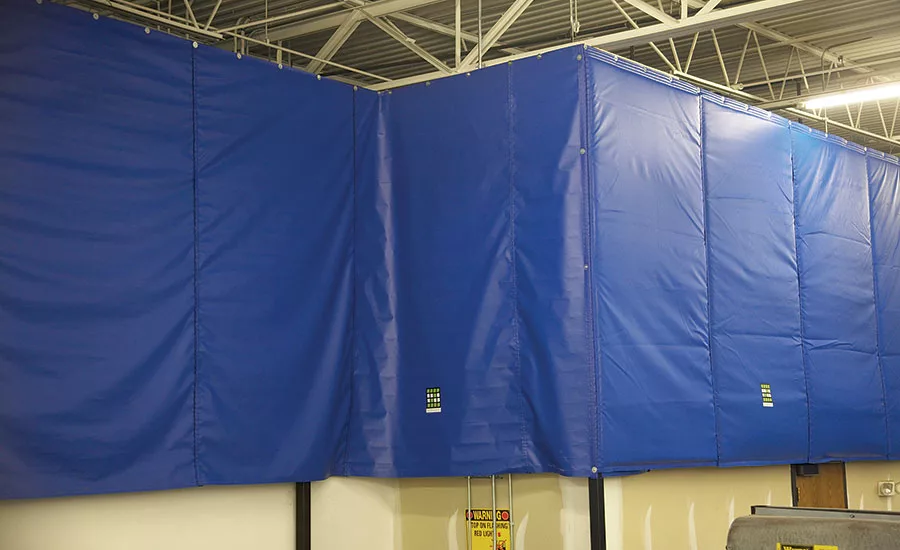
Another option that is similar to rigid, permanent walls is sound-attenuating curtain walls. Curtain walls can be configured to fit virtually any interior space and require significantly less time to set up than it takes to build permanent walls. Individual fabric panels of virtually any length are interconnected with Velcro to form each continuous wall.

Curtain walls also can be easily re-configured to adapt to changing production demands and floor layouts. It’s easy to add to or enlarge an initial curtain wall installation. If source sound levels increase for any reason, it is very simple to add a second layer of flexible sound curtain to an existing one, or even to augment an existing rigid wall (a fairly common application).

How curtain walls turn the sound down

Acoustic curtain walls normally consist of two layers of a woven, coated fabric surrounding one or more layers of various insulating materials. These materials might include fiber batting (polymer or glass), open cell foam, or densified “loaded” vinyl or other flexible polymer sheet material.

Each component plays an important role in reducing sound levels encroaching on the curtain surface. The mass loaded vinyl sheet in a sound curtain is more effective in reducing lower frequency noise than the other components (low frequency sound is best absorbed or deflected with high-density solid materials). Fiber batting is effective in reducing sound at mid to higher range frequencies.

The interior core of a typical sound curtain will consist of a layer of sound-dampening, loaded vinyl and a layer of antimicrobial polyester batting as an additional sound buffer that also serves to fill out and maintain the body of the panel. This core is captured between two outer layers of 18-ounce flame-retardant vinyl, available in a number of colors for aesthetics.

Typically, the loaded vinyl side of the core is positioned facing the offending noise source, between the source and the desired ambient sound area. In a completed installation, the wall acts to trap the sound in a specific area and limit the migration of the sound to the ambient employee areas.

A  new approach

Flexible acoustic curtain walls offer a relatively new approach to providing employee safety and comfort when it comes to noise levels in a commercial or industrial facility. These fabric curtains can be effectively used for noise source insulation, as well as for noise path insulation. Noisy machines can be wrapped in flexible sound curtains, like a “blanket.” They can also be attached to a close quarters support frame around the equipment.

Larger sound enclosures can be formed using these curtains, including complete rooms or separating walls. In a typical application of this sort, a metal mounting angle is installed across or along a run of the roof supporting bar joists (welded, clamped or bolted), and the insulated curtain is simply screwed to this angle along its top edge using self-drilling screws. The curtains are normally made of five-foot wide panels and have vertical Velcro® attachment hems to join multiple panels creating a full width curtain.

Low maintenance, all-purpose

In addition to their noise reduction performance and simple construction/adaptation, flexible curtain walls offer additional advantages. These fabric-covered walls can be easily cleaned with simple detergent and water. Acoustic curtain walls not only mitigate noise transmission, they have been engineered to provide thermal insulation for the prevention of condensate or frost buildup.

Handling dangerous noise effectively

Constant loud noises in the workplace are a significant health hazard to employees. Dealing with high noise levels can be a difficult and expensive undertaking, but it is also necessary. Acoustic curtain walls represent a cost-effective and flexible alternative to classic methods used for noise abatement, and bring their own value in other ways to an industrial environment. From employee safety to employee comfort resulting in higher productivity, the benefits of keeping noise levels under control, especially with insulated curtains, are real and obvious.

KEYWORDS: hearing protection noise

Share This Story

Looking for a reprint of this article?
From high-res PDFs to custom plaques, order your copy today!

Chuck Ashelin is engineering manager for Zoneworks. A 15-year industry veteran, he holds a bachelor’s degree in chemical engineering. For more information on Zoneworks products, call 800-553-4834 or visit www.zoneworks.com.

Recommended Content

JOIN TODAY
to unlock your recommendations.

Already have an account? Sign In

  • forklift safety

    Exploring the latest technologies in forklift safety

    With more staff and more stock in warehousing now more...
    Workplace Training Strategies
    By: Josh Cramer
  • welding

    All about welder’s flash or arc eye

    A flash burn is a painful inflammation of the cornea,...
    Environmental Health and Safety
  • dangerous jobs

    The 10 most dangerous jobs in the U.S.

    On-the-job deaths have been rising — hitting the highest...
    Government Safety Regulations
    By: Benita Mehta
Manage My Account
  • eMagazine Subscriptions
  • ISHN Newsletter & Other Newsletter Alerts
  • Online Registration
  • Manage My Preferences
  • Subscription Customer Service

More Videos

Sponsored Content

Sponsored Content is a special paid section where industry companies provide high quality, objective, non-commercial content around topics of interest to the ISHN audience. All Sponsored Content is supplied by the advertising company and any opinions expressed in this article are those of the author and not necessarily reflect the views of ISHN or its parent company, BNP Media. Interested in participating in our Sponsored Content section? Contact your local rep!

close
  • man wearing the the Sundström SR200 Full Face Mask Respirator
    Sponsored byOHD

    5 Fit Testing Mistakes That Could Cost You

  • This image shows Magid AcuSpex polarized blue mirrored safety glasses.
    Sponsored byMagid Glove and Safety

    Construction PPE Guide: What Crews Need for Each Task

  • lone worker in confined space
    Sponsored byAlphasense Ltd.

    GET THE LEAD OUT of your Safety Oxygen Sensors!

Popular Stories

SpaceX 7 launch

OSHA Investigating Fatal Fall at SpaceX Starbase

Automated loading dock equipment

After March 2026 Rivian Death, Safety Managers Reassess Loading Dock Systems Under OSHA's Warehouse Emphasis Program

psychology in the workplace

Most Workplaces Measure Psychological Safety, Ignoring Psychosocial Risks

top 10 most dangerous jobs

Poll

Seasonal Readiness

With the federal heat stress prevention rule on the horizon, which area of your safety program needs the most attention?
View Results Poll Archive

Products

Surviving an OSHA Audit A Management Guide, 2nd Edition

Surviving an OSHA Audit A Management Guide, 2nd Edition

See More Products

ISHN Podcasts

Related Articles

  • Turn down the sound to reduce your chances for noise-induced hearing loss

    See More
  • Home heating sources: Turn down the danger (1/21)

    See More
  • Down on the farm

    See More

Related Products

See More Products
  • 1119906652.webp

    Alive and Well at the End of the Day: The Supervisor's Guide to Managing Safety in Operations, 2E

See More Products

Events

View AllSubmit An Event
  • October 18, 2017

    ACGIH® TLV® For Audible Sound – Understanding the Proposed Notice of Intended Change to The Acgih® Tlv® for Noise

    Occupational noise exposures represent an important but under-recognized cause of disease and disability in the United States. Now titled as Audible Sound, the ACGIH® Threshold Limit Values for Physical Agents (TLV®-PA) Committee has proposed a revision to the TLV® for Noise.
  • September 22, 2016

    Bang! Damage from impulse noise and the effectiveness of hearing protection

    Some of the most hazardous sounds we hear are brief sounds – noises from impacts and impulses. These arise from sources like household tools, construction, industrial noise, firecrackers, guns, and even automotive airbags.
View AllSubmit An Event

Related Directories

  • MSA - The Safety Co.

    WE KNOW WHAT'S AT STAKE. Unpredictable work environments are often part of the job. That's why it's critically important to have the right safety equipment at the moment it matters most. MSA's complete lines of safety solutions help protect those workers at the heart of your operation.
×

Become a Leader in Safety Culture

Build your knowledge with ISHN, covering key safety, health and industrial hygiene news, products, and trends.

JOIN TODAY
  • RESOURCES
    • Advertise
    • Contact Us
    • Directories
    • Manufacturing Division
    • Store
    • Want More
  • SIGN UP TODAY
    • Create Account
    • eMagazine
    • Newsletters
    • Customer Service
    • Manage Preferences
  • SERVICES
    • Marketing Services
    • Reprints
    • Market Research
    • List Rental
    • Survey/Respondent Access
  • STAY CONNECTED
    • LinkedIn
    • Facebook
    • YouTube
    • X (Twitter)
  • PRIVACY
    • PRIVACY POLICY
    • TERMS & CONDITIONS
    • DO NOT SELL MY PERSONAL INFORMATION
    • PRIVACY REQUEST
    • ACCESSIBILITY

Copyright ©2026. All Rights Reserved BNP Media, Inc. and BNP Media II, LLC.

Design, CMS, Hosting & Web Development :: ePublishing