Control dust and fumes in metalworking and welding operations
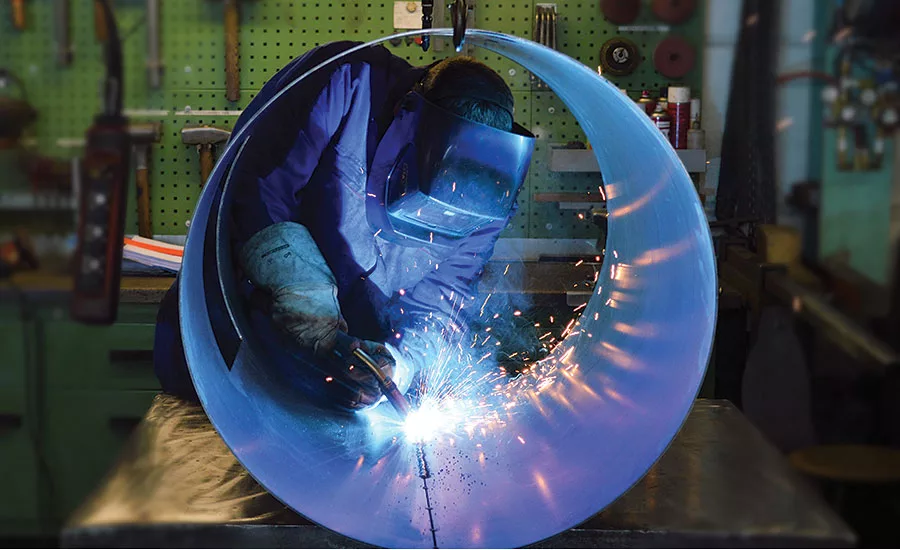
Metalworking facilities and welding shops must be diligent in controlling dust and fumes containing harmful metal particulate that are produced during metalworking processes such as welding, thermal cutting, sanding and polishing. Fortunately, there are proven controls to maintain a healthy work environment.
According to OSHA, acute exposure to various welding fume can result in eye, nose and throat irritation, dizziness and nausea. Prolonged exposure to welding fume may cause lung damage and various types of cancer, including lung, larynx and urinary tract. Health effects from certain fumes may include metal fume fever, stomach ulcers, kidney damage and nervous system damage. And prolonged exposure to manganese fume can cause Parkinson’s–like symptoms.
OSHA also notes that gases such as helium, argon, and carbon dioxide displace oxygen in the air and can lead to suffocation, particularly when welding in confined or enclosed spaces.
Dangers of welding fumes
It is imperative to understand and comply with OSHA exposure guidelines for the metals used in your shop, in order to protect your workers from serious health effects. According to the U.S. Department of Labor, welding fumes produced depend on the composition of the metals being welded and the welding rods. For example, welding wire, depending on the composition, can produce fume containing iron oxide, manganese, copper and even silica.
When the base metal is iron or steel, with welding wire of similar composition, the fume will contain iron oxide and manganese. Welding on stainless steel can generate fumes containing chromium and nickel. Welding on plated, galvanized, or painted metals may produce fumes containing lead, zinc oxide or cadmium.
Welding operations can also produce toxic gases like carbon monoxide, nitrogen dioxides and ozone. In addition, welding or cutting operations conducted in the presence of chlorinated hydrocarbons in the form of solvents on the metals or in the air may produce hazardous levels of highly toxic phosgene and hydrogen chloride gases.
OSHA maintains a list that identifies hazardous chemicals commonly associated with welding, cutting and brazing operations, with links to more specific information on sampling and analysis.
Dust / fume collection & ventilation systems
A dust collector designed specifically for your metalworking operation is an accepted and proven engineering control that can filter hazardous airborne contaminants. Dry media dust collectors containing high efficiency cartridge filters along with secondary filters are the best control for respirable particulates.
A well-designed cartridge system will properly filter welding fumes and other hazardous contaminants, and the filtered air can either be exhausted outside or, in some cases, recirculated back into the facility for significant energy savings. These systems use self-cleaning mechanisms that pulse dirt off the filters, allowing units to run for extended periods between filter change-outs.
There are three general types of dust and fume collection systems used in welding processes that generate metallic dust and fumes:
- Source capture systems are popular for applications involving small parts and fixture welding. They will typically utilize a flexible source capture arm, slotted fume hoods or smaller hoods with side shields for a work bench operation.
- Canopy hoods are often utilized if the footprint area is a medium size such as 12-foot x 20-foot or less. Curtains or hard walls may be added to the sides to create a booth or enclosure. In the case of robotic weld cells, a full enclosure over and around the application can often be used.
- In some cases, cranes cause restrictions making hood and arm system impractical. When this happens, you can choose an ambient system that filters all the air in the shop using a central system or multiple smaller collectors. Ambient systems are used to serve larger areas because they allow a facility involved in multiple operations to capture all of the fumes. It’s important to note that although ambient systems will help reduce hazardous dust, they do not remove fumes from the breathing zone, so PPE may be required.
No matter the type of cartridge dust collection system you use, when dealing with hazardous dust and fumes, you should also equip the system with a HEPA safety monitoring filter – sometimes called a final filter, secondary filter or after-filter. It’s also very important to provide a ventilation system to remove the gases produced in the space.
Monitoring your collection & ventilation system
Assuming that you already have a system in place, if you notice any of the following conditions, then your collection/ventilation system isn't working as well as it should to remove weld fumes:
Workers' concerns: If your workers notice an increase in health issues or physical discomfort, it's likely that they are being exposed to an excessive level of fumes. Workers' concerns should always be taken seriously and addressed as promptly as possible.
Visible cloud of fumes inside: With a properly functioning extraction system, you should only see occasional light fumes during the shift. A fume cloud that grows denser throughout the day likely indicates a problem.
Visible emissions outside: When you exhaust visible fumes outdoors, the air is subject to monitoring under EPA National Emission Standard for Hazardous Air Pollutants (NESHAP) Rule 6x. This rule went into effect in 2011 and is highly applicable to welding shops.
Early filter failure: If the filters in your fume extraction system are failing prematurely and requiring frequent change-out, your collector might be too small for the job, or the filter pulse-cleaning system may not be working properly. Other sources of trouble could be the valves that regulate pulsing; the compressed air system or high air moisture content of the compressed air.
Not meeting air quality standards: If air is contained indoors rather than exhausted outside, it is subject to OSHA requirements. OSHA has established permissible exposure limits (PELs) based on eight-hour time-weighted average for hundreds of dusts, including the numerous metals contained in welding fumes. For an overview of key OSHA standards, consult the OSHA Fact Sheet, “Controlling Hazardous Fume and Gases during Welding.”
Final thoughts
Clearly, taking a proactive approach to controlling dust and weld fumes is healthy for your overall metalworking operation. A well-designed and maintained dust and weld fume collection system along with ventilation will keep your workers safe and your facility in compliance with current air-quality requirements.
Looking for a reprint of this article?
From high-res PDFs to custom plaques, order your copy today!