ISHN logo
search
cart
facebook twitter linkedin youtube
  • Sign In
  • Create Account
  • Sign Out
  • My Account
ISHN logo
  • NEWS
    • Today's News
    • Global Safety News
    • Government Regulations
  • PRODUCTS
    • Product Innovations
    • Featured Products
  • TOPICS
    • Environmental Health and Safety
    • Facility Safety
    • Workplace Health
    • Occupational Safety
    • PPE
    • More Topics
  • CONSTRUCTION
  • TECHNOLOGY
  • COLUMNS
    • Best Practices
    • Dave Johnson: What’s going on
    • Editorial Comments
    • Leading Safety
  • MULTIMEDIA
    • ISHN Podcast
    • Videos
    • Cold Stress Education Quiz
    • Webinars
    • White Papers
  • MORE
    • Buyer's Guide
    • Newsletters
    • Convention Companion
    • Polls
    • Events
    • ISHN Store
    • Sponsor Insights
  • EMAGAZINE
    • eMagazine
    • Archived Issues
    • Contact
    • Advertise
  • JOIN TODAY!
Industrial Hygiene

A critical performance check: Bump testing your gas detector
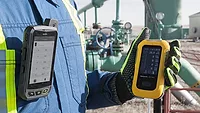
By Bryan Szczur
Bump testing your gas detector
May 3, 2018

You wouldn’t drive a vehicle without putting on your seatbelt. You wouldn’t ride a bike without putting on a helmet. You don’t go to bed at night without locking your doors. Everyday practices like these create good habits that make our lives easier and safer.

When it comes to gas detection, safe and simple practices like these are no different. Gas detectors that are used every day require the same type of attention. You may not think much about putting on a seatbelt in a vehicle, but it sure does help when you need it. You may also not think much about bump testing a gas detector, but it sure does help to know that your gas detector works when you need it most.

What is a bump test and why is it important?

Bump testing is the only way to ensure proper sensor and alarm functionality. A bump test is defined as the process of briefly exposing sensors in a gas detector to an expected concentration of gas that is greater than the alarm set points. The purpose of the bump test is to check for sensor and alarm functionality. However, it does not check for accuracy. It is important to note that accuracy is ensured through calibration, which is a completely different process than bump testing.

The first thing you should do before using your gas detector is to make sure it works. Without a bump test, how do you know that the gas detector you have can perform the way you need it to? Applying gas to the sensors in a detector is just like checking to see if a flashlight works. If the bump test fails, you know that troubleshooting or further maintenance is required.

Gas detectors are made to survive harsh environments. They are often dropped, exposed to extreme temperatures, humidity, moisture, dust, mud, and sludge. Any of these can factor into a gas detector’s performance. Sensors can become dislodged if a monitor is dropped. Filters can become clogged from moisture or dust. Enough mud or sludge can completely block a sensor from seeing gas. Because of these factors, manufacturers recommend bump testing gas detectors before each day’s use. You may not realize it, but all of these factors that occur during day-to-day use can impact a gas detector’s performance.

How does bump testing work?

For toxic and combustible sensors, the typical output in clean air is zero, whether reading in parts per million (PPM), percent of lower explosive limit (LEL), or percent by volume. One main exception to this is an oxygen sensor, which should read around 20.9% volume in ambient air when functioning. So bump testing a standard four-gas instrument will drive the gas readings up on your toxic and combustible sensors, while driving the reading for the oxygen sensor down.

The problem is that toxic and combustible sensors will generally read zero in an ambient environment whether they are functioning or not. Therefore, the only way to know if they will respond to gas is by, you guessed it, exposing them to gas.

How can I bump test my instrument?

Because of the broad range of gas detector applications, manufacturers have come up with many different ways to perform bump tests. The easiest and usually most efficient way to bump test is by using docking stations, which are often connected to web-based gas detection management software. Through this software, users can schedule bump tests to occur every day. If a failure occurs, the software can notify the user or safety manager of the failure, so they know that further action is needed. Docking stations draw gas through a connected cylinder, and then apply that gas to the detector that is docked. The stations are designed to resemble a manual bump test.

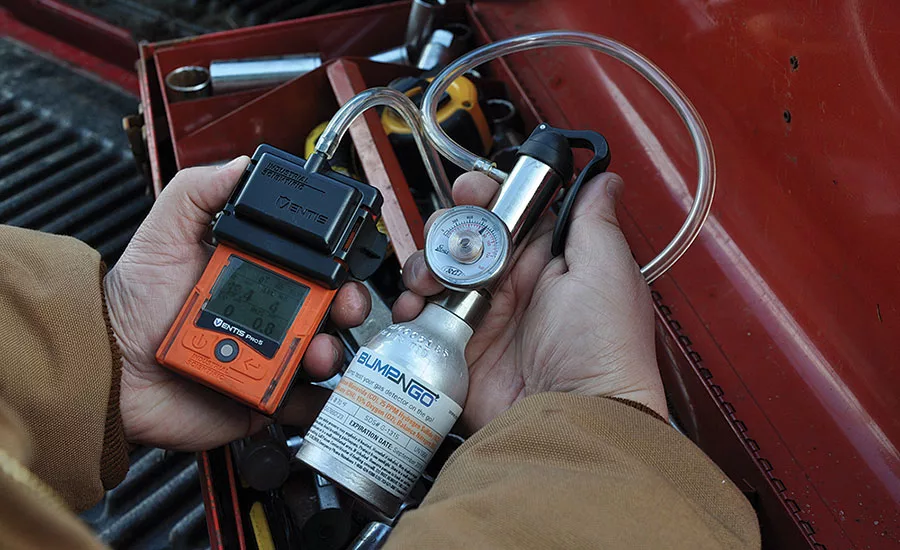
Manual bump tests are performed simply by using a gas bottle, a regulator, tubing, a calibration cup (if using a diffusion instrument), and a gas detector. Users can put the instrument into bump test mode, then apply the gas. The gas detector will either cycle through each individual sensor or do them all at once, depending on instrument settings. After the test is complete, the instrument will display results, showing whether it was a passed or failed test. Alternatively, users can perform a manual bump test simply by applying gas to the instrument while it is on its main gas reading screen.

What are the challenges of bump testing?

The need for bump testing can create some challenges. The number of instruments a company has, the applications, and locations of equipment can all come into play. For this reason, gas cylinders come in a variety of sizes. Users may need larger cylinders to connect to docking stations that are used every day. Users may also need smaller, more portable cylinders to bump test instruments when workers are on the go. Luckily for users, there is a wide array of cylinders available to fit the right application.

Another challenge of bump testing is the training aspect. It is often difficult for safety managers to find time to train users, and workers often do not have time to train one another. Luckily, gas detection companies offer a wide array of training resources available to end users.

The bottom line

The bottom line is that bump testing saves lives. Users should never risk using a gas detector without checking to make sure it is functioning. With the right training, understanding, and repetition, bump testing a gas detector can become as routine as putting on a seatbelt when you get into your car. It is just as important, so why not start now?

KEYWORDS: bump test gas detection industrial hygiene analysis industrial hygiene profession toxic substances

Share This Story

Looking for a reprint of this article?
From high-res PDFs to custom plaques, order your copy today!

Bryan Szczur serves as marketing project coordinator at Industrial Scientific.

Recommended Content

JOIN TODAY
to unlock your recommendations.

Already have an account? Sign In

  • forklift safety

    Exploring the latest technologies in forklift safety

    With more staff and more stock in warehousing now more...
    Facility Safety
    By: Josh Cramer
  • welding

    All about welder’s flash or arc eye

    A flash burn is a painful inflammation of the cornea,...
    Environmental Health and Safety
  • dangerous jobs

    The 10 most dangerous jobs in the U.S.

    On-the-job deaths have been rising — hitting the highest...
    Government Safety Regulations
    By: Benita Mehta
Manage My Account
  • eMagazine Subscriptions
  • ISHN Newsletter & Other Newsletter Alerts
  • Online Registration
  • Manage My Preferences
  • Subscription Customer Service

More Videos

Sponsored Content

Sponsored Content is a special paid section where industry companies provide high quality, objective, non-commercial content around topics of interest to the ISHN audience. All Sponsored Content is supplied by the advertising company and any opinions expressed in this article are those of the author and not necessarily reflect the views of ISHN or its parent company, BNP Media. Interested in participating in our Sponsored Content section? Contact your local rep!

close
  • man wearing the the Sundström SR200 Full Face Mask Respirator
    Sponsored byOHD

    5 Fit Testing Mistakes That Could Cost You

  • This image shows Magid AcuSpex polarized blue mirrored safety glasses.
    Sponsored byMagid Glove and Safety

    Construction PPE Guide: What Crews Need for Each Task

  • lone worker in confined space
    Sponsored byAlphasense Ltd.

    GET THE LEAD OUT of your Safety Oxygen Sensors!

Popular Stories

SpaceX 7 launch

OSHA Investigating Fatal Fall at SpaceX Starbase

Automated loading dock equipment

After March 2026 Rivian Death, Safety Managers Reassess Loading Dock Systems Under OSHA's Warehouse Emphasis Program

psychology in the workplace

Most Workplaces Measure Psychological Safety, Ignoring Psychosocial Risks

top 10 most dangerous jobs

Poll

Seasonal Readiness

With the federal heat stress prevention rule on the horizon, which area of your safety program needs the most attention?
View Results Poll Archive

Products

Surviving an OSHA Audit A Management Guide, 2nd Edition

Surviving an OSHA Audit A Management Guide, 2nd Edition

See More Products

ISHN Podcasts

Related Articles

  • Is your gas detector trying to tell you something?

    See More
  • keep your gas detector clean

    It’s essential to keep your gas detector clean to work properly

    See More
  • Accessorize your gas detector

    See More

Related Products

See More Products
  • 0470387408.jpg

    Preparing for OSHA s Voluntary Protection Programs: A Guide to Success

See More Products

Events

View AllSubmit An Event
  • December 10, 2014

    Proof Of Performance Testing For Industrial Ventilation Systems webinar

    This webinar will teach methods for testing IVSs as they pertain to the original design parameters. Topics include: indentifying published standards, selecting measuring equipment, identifying test locations, identifying proper techniques for airflow measurement, correcting field measurements for local conditions, interpreting field data compared to design data, and introduction to system balance techniques.
View AllSubmit An Event

Related Directories

  • A F C International Inc.

    Single and Multi gas detectors, fixed position gas monitors, respiratory protection, SCBAS, fit testing, calibration gases, confined space entry detectors.
×

Become a Leader in Safety Culture

Build your knowledge with ISHN, covering key safety, health and industrial hygiene news, products, and trends.

JOIN TODAY
  • RESOURCES
    • Advertise
    • Contact Us
    • Directories
    • Manufacturing Division
    • Store
    • Want More
  • SIGN UP TODAY
    • Create Account
    • eMagazine
    • Newsletters
    • Customer Service
    • Manage Preferences
  • SERVICES
    • Marketing Services
    • Reprints
    • Market Research
    • List Rental
    • Survey/Respondent Access
  • STAY CONNECTED
    • LinkedIn
    • Facebook
    • YouTube
    • X (Twitter)
  • PRIVACY
    • PRIVACY POLICY
    • TERMS & CONDITIONS
    • DO NOT SELL MY PERSONAL INFORMATION
    • PRIVACY REQUEST
    • ACCESSIBILITY

Copyright ©2026. All Rights Reserved BNP Media, Inc. and BNP Media II, LLC.

Design, CMS, Hosting & Web Development :: ePublishing