ISHN logo
search
cart
facebook twitter linkedin youtube
  • Sign In
  • Create Account
  • Sign Out
  • My Account
ISHN logo
  • NEWS
    • Today's News
    • Global Safety News
    • Government Regulations
  • PRODUCTS
    • Product Innovations
    • Featured Products
  • TOPICS
    • Environmental Health and Safety
    • Facility Safety
    • Workplace Health
    • Occupational Safety
    • PPE
    • More Topics
  • CONSTRUCTION
  • TECHNOLOGY
  • COLUMNS
    • Best Practices
    • Dave Johnson: What’s going on
    • Editorial Comments
    • Leading Safety
  • MULTIMEDIA
    • ISHN Podcast
    • Videos
    • Cold Stress Education Quiz
    • Webinars
    • White Papers
  • MORE
    • Buyer's Guide
    • Newsletters
    • Convention Companion
    • Polls
    • Events
    • ISHN Store
    • Sponsor Insights
  • EMAGAZINE
    • eMagazine
    • Archived Issues
    • Contact
    • Advertise
  • JOIN TODAY!
Industrial Hygiene

Control refrigerant gas in HVAC mechanical equipment rooms

Detecting & reducing Toxic Leaks
By Natalie Silva
Detecting & reducing toxic leaks
May 31, 2018

Maintaining a safe work environment is essential inside the heating, ventilation and air conditioning (HVAC) mechanical rooms that support large commercial buildings, corporate campuses, institutional facilities and industrial plants. The failure to monitor these rooms properly for leaking refrigerant, toxic and combustible gas hazards has led to tragic accidents with deadly consequences.

The best way to prevent such accidents is to audit HVAC mechanical room safety systems to ensure the right gas detectors are in place and installed in the proper locations for adequate protection. While this should be done regularly, it is especially important to review mechanical room safety systems whenever HVAC, boiler, electrical and fuel equipment are retrofitted or upgraded to support new functional requirements, including improved energy efficiency.

The safety industry has worked diligently over the past decade to improve the effectiveness of refrigerant, toxic and combustible gas sensors. The latest digital technologies have been employed at the sensor and systems levels to add greater intelligence and communications capabilities. This newest generation of gas sensors and systems is more robust, less susceptible to false alarms and easier to install with lower maintenance over a longer life.

HVAC rooms

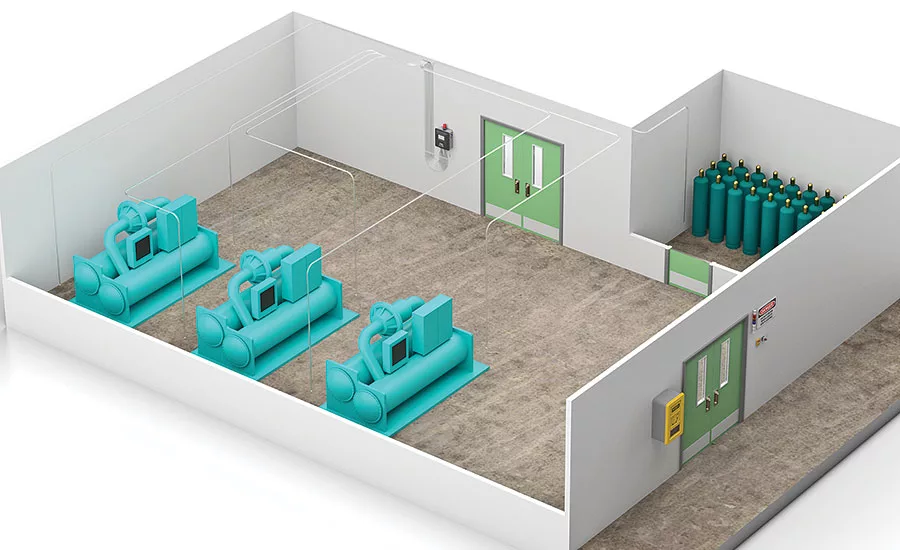
A building’s mechanical room is the hub of its heating, ventilation and air conditioning system (Fig 1). This can include central utility plants, boiler and chiller rooms, mechanical and electrical rooms and fuel rooms. The equipment within these rooms has the potential to leak refrigerant, toxic or combustible gases, which are dangerous, costly and environmentally harmful gases.

Refrigerant gas is actually considered a toxic gas, and this can be a potential surprise for some workers. Although refrigerants have low toxicity, at high concentrations they can displace oxygen which makes it difficult to breathe. Leaking refrigerant gas that results in oxygen deficiency can cause serious accidental injury or even death to workers, which is a violation of safety regulations under OSHA.

Furthermore, these chemicals are controlled substances regulated by the U.S. Environmental Protection Agency (EPA), which means not only are they dangerous to worker health and safety, but they are harmful to the environment. Many of these refrigerants are categorized as ozone depleting substances and are highly scrutinized.

Gas detectors satisfy the requirements for equipment room emissions monitoring included in EPA regulations. In addition to the EPA, there are the specific requirements of the American Society of Heating, Refrigeration, and Air Conditioning Engineers (ASHRAE) Standard 15 and applicable state and local building codes to consider as well.

ASHRAE 15 states: (1) Each machinery room shall contain a detector located where a refrigerant leak would concentrate. (2) The detector shall trigger an audible and visual alarm both inside and outside the mechanical room and activate mechanical ventilation. In addition for economic reasons, refrigerant leak detection is encouraged due to the high cost of refrigerant gases lost during leak events.

Detector placement

Refrigerant gas detectors and monitoring systems should be mounted to the unit vertically: Do not mount the unit to HVAC structures that are subject to vibration and shock (such as piping). Do not locate the unit near excessive heat sources, direct solar heating or in a wet and damp location. For proper cooling, allow at least three inches of clearance around all surfaces except the mounting surface.

Sample point locations

Depending on the gas monitoring system’s manufacturer’s recommendations, a gas sample point can be remotely located up to 150 ft (46 m) from the monitor (500 ft. [152 m] for 0.18” [4.6 mm] ID tubing) in an area where refrigerant vapors are most likely to leak or accumulate. It is widely accepted to locate the sample point near the barrel of the chiller and on adjacent corners to enhance ability to monitor leaks.

As refrigerants are heavier than air, be sure to monitor the refrigerant in locations like pits, stairwells and trenches. If possible, monitor the vent line of the chiller. Remember to monitor the cylinder storage area if inside or near the chiller room in case of cylinder leakage.

Choosing a gas monitoring system

There are several refrigerant gas detector and monitoring systems available from multiple manufacturers (Fig 2) that are designed for refrigerant applications in mechanical rooms. They all have their advantages and some of them have limitations. Be sure to set up a list of any key monitoring capabilities that you think are necessary.

To develop your check list, here are some suggested questions to ask suppliers:

  • Is the monitoring system compliant with ASHRAE 15?
  • At what ppm level does the detector register the presence of gas?
  • Does the system include multi-point monitoring? Can it be easily expanded?
  • Does the controller have multiple relays for fault and alarm alerts, as well as connection to a horn and strobe (required by ASHRAE 15)?
  • Does the system controller include integrated BACnet or Modbus for direct digital communication to the facility’s centralized control system?

Review the setup requirements to be sure the system is intelligent enough to include plug-and-play capability, eliminating the need for time-consuming configuration tasks.

Ask about the maintenance requirements and frequency of maintenance.

Conclusion

Refrigerant gas safety is important and should not be overlooked. Refrigerant gas is toxic, can lead to worker oxygen deficiency accidents, is harmful to the environment when released, and is expensive. These issues can be avoided with the newest generation of refrigerant gas monitoring systems that meet ASHRAE 15, rapidly detect gas, are easy to install and use.

KEYWORDS: gas detection systems gas monitoring injuries toxic substances

Share This Story

Looking for a reprint of this article?
From high-res PDFs to custom plaques, order your copy today!

Natalie Silva is a Product Line Manager at MSA, The Safety Company. After joining the company in 2010, Natalie held various positions; most recently, managing product strategy and new product development for gas detection products. Contact MSA at www.MSAsafety.com or 1-800-672-2222.

Recommended Content

JOIN TODAY
to unlock your recommendations.

Already have an account? Sign In

  • forklift safety

    Exploring the latest technologies in forklift safety

    With more staff and more stock in warehousing now more...
    Facility Safety
    By: Josh Cramer
  • welding

    All about welder’s flash or arc eye

    A flash burn is a painful inflammation of the cornea,...
    Environmental Health and Safety
  • dangerous jobs

    The 10 most dangerous jobs in the U.S.

    On-the-job deaths have been rising — hitting the highest...
    Government Safety Regulations
    By: Benita Mehta
Manage My Account
  • eMagazine Subscriptions
  • ISHN Newsletter & Other Newsletter Alerts
  • Online Registration
  • Manage My Preferences
  • Subscription Customer Service

More Videos

Sponsored Content

Sponsored Content is a special paid section where industry companies provide high quality, objective, non-commercial content around topics of interest to the ISHN audience. All Sponsored Content is supplied by the advertising company and any opinions expressed in this article are those of the author and not necessarily reflect the views of ISHN or its parent company, BNP Media. Interested in participating in our Sponsored Content section? Contact your local rep!

close
  • man wearing the the Sundström SR200 Full Face Mask Respirator
    Sponsored byOHD

    5 Fit Testing Mistakes That Could Cost You

  • This image shows Magid AcuSpex polarized blue mirrored safety glasses.
    Sponsored byMagid Glove and Safety

    Construction PPE Guide: What Crews Need for Each Task

  • lone worker in confined space
    Sponsored byAlphasense Ltd.

    GET THE LEAD OUT of your Safety Oxygen Sensors!

Popular Stories

SpaceX 7 launch

OSHA Investigating Fatal Fall at SpaceX Starbase

Automated loading dock equipment

After March 2026 Rivian Death, Safety Managers Reassess Loading Dock Systems Under OSHA's Warehouse Emphasis Program

psychology in the workplace

Most Workplaces Measure Psychological Safety, Ignoring Psychosocial Risks

top 10 most dangerous jobs

Poll

Seasonal Readiness

With the federal heat stress prevention rule on the horizon, which area of your safety program needs the most attention?
View Results Poll Archive

Products

Surviving an OSHA Audit A Management Guide, 2nd Edition

Surviving an OSHA Audit A Management Guide, 2nd Edition

See More Products

ISHN Podcasts

Related Articles

  • Honeywell

    Honeywell control and safety system selected for vital natural gas pipeline in Turkey

    See More
  • New "44" product features 44 liters of calibration gas in a standard 34-liter cylinder

    See More
  • ASTM proposes international standard to monitor hydrogen sulfide gas in workplaces

    See More

Related Directories

  • Thermal Gas Systems Inc.

    Thermal Gas Systems has led the gas monitoring industry since 1989, specializing in Photoacoustic Infrared technology and CMOS alternatives for proven reliability worldwide. 24-hour Refrigerant monitoring, gas leak detection, SCBA, oxygen depletion monitor, ammonia leak monitor, and alarms.
  • Se-Kure Controls Inc.

    Se-Kure Controls is a manufacturer of safety and security products, designed to create a safer workplace and reduce theft. Products include convex mirrors, mirrored panels and domes, merchandise alarms, stock and custom mechanical cables and recoiling devices, lock-downs for tablets and mobile phones, all made in our USA plants.
  • Control Instruments Corp.

    Control Instruments' family of gas detection products includes continuous process analyzers, flammable gas analyzers, BTU heating value analyzers, hydrocarbon detectors and remote access & control devices for all your gas detection and solvent vapor monitoring needs.
×

Become a Leader in Safety Culture

Build your knowledge with ISHN, covering key safety, health and industrial hygiene news, products, and trends.

JOIN TODAY
  • RESOURCES
    • Advertise
    • Contact Us
    • Directories
    • Manufacturing Division
    • Store
    • Want More
  • SIGN UP TODAY
    • Create Account
    • eMagazine
    • Newsletters
    • Customer Service
    • Manage Preferences
  • SERVICES
    • Marketing Services
    • Reprints
    • Market Research
    • List Rental
    • Survey/Respondent Access
  • STAY CONNECTED
    • LinkedIn
    • Facebook
    • YouTube
    • X (Twitter)
  • PRIVACY
    • PRIVACY POLICY
    • TERMS & CONDITIONS
    • DO NOT SELL MY PERSONAL INFORMATION
    • PRIVACY REQUEST
    • ACCESSIBILITY

Copyright ©2026. All Rights Reserved BNP Media, Inc. and BNP Media II, LLC.

Design, CMS, Hosting & Web Development :: ePublishing