Update training on OSHA’s new fall protection rules
Focus on walking surfaces and fixed ladders
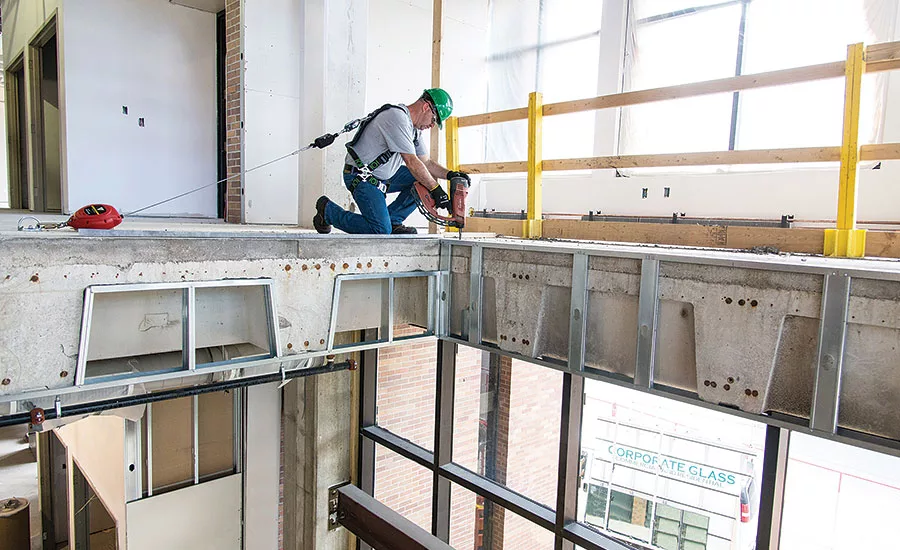
Experienced employers — from industrial safety managers to construction supervisors -- keep a close eye on measures for worker fall protection. Failures in this category have led OSHA’s annual list of top 10 most-cited violations for most of the past decade. Falling from height is a leading cause of on-the-job fatalities in the U.S.
Fall safety improvements remain an ongoing process. It’s critical you stay educated about the latest standards, regulations — and solutions.
Walking-working surfaces & fall protection
In 2016, OSHA reworked its general industry standards regarding walking-working surfaces and fall protection. As OSHA notes about the new change: “Specifically, it updates general industry standards addressing slip, trip, and fall hazards (subpart D), and adds requirements for personal fall protection systems (subpart I).”
Many of the changes took effect in February 2017. The regulation for general industry now comes close to mirroring the 1926 Subpart M fall protection regulation for the construction industry. The old regulations held general industry to a lower standard for several aspects of working-at-height safety. Now both construction and general industry segments are held to a similar higher standard, which should increase worker safety.
In addition, it eases compliance for employers who perform both types of activities.It should be simpler for them to consult and comply with a single standard.
One differing standard that was not altered: the “trigger point” of elevation at or above which OSHA requires that a worker must be safeguarded with fall protection measures. In general industry, it is four feet; in the construction industry, it is six feet. These metrics remain unchanged.
A final note: updated standards require updated training. Leading manufacturers of fall protection equipment are offering educational programs to bring their customers up to speed with all the latest requirements.
Adopting better ladder safety systems
Another new regulation, OSHA 1910.23, also went into effect in February 2017. It calls for phasing out the “safety cages” often installed around fixed ladders. Studies show these cages often do not make worker falls any safer. In fact, they may increase injuries.
However, employers won’t actually be required to abandon existing cages — for fixed ladders with a fall distance greater than 24 feet — for 18 years. That’s until November 2036.
New construction and retrofits face a much earlier deadline. Such ladders installed or replaced after November 19, 2018, while they may or may not have cages, must be equipped with either 1) a personal fall protection system (PFPS) or 2) a ladder safety system.
A PFP system will often be a self-retracting lanyard mounted above or a vertical lifeline— with the proper fall arrestor or cable grab— installed on the ladder enabling workers to attach their safety harnesses to the cable, providing effective fall protection.
Additionally, a ladder safety system may be “a carrier [rail] or a safety sleeve, which is a moving component that travels on the carrier; a lanyard; and a safety harness.” Manufacturers note that a well-designed rail system may be rated for longer service life than an equivalent cable model.
Both systems are already proven to enhance worker safety, and are available from a variety of manufacturers.
Securing tools at height
OSHA counts more than 50,000 incidents annually where a worker is “struck by falling objects,” and puts these events high on their lists of leading causes of workplace injuries and even death. It seems likely that, sooner rather than later, regulations will require tie-offs for tools and other portable objects used in work at height.
Recently, ANSI/ISEA 121-2018: American National Standard for Dropped Object Prevention Solutions was publishedA wide range of specialized pull lanyards — for everything from hand tools to gloves, tape measures to hard hats — are already available. These clip to a worker’s safety harness, or even to a structural element such as an I-beam or work surface. Different tool lanyards fit different tools, securing them during use (or between uses) via D-rings, tether loops, tapes, carabiners, etc. Look for adjustability to accommodate different tool sizes and shapes.
Catching up with edge protection
In addition to complying with regulations set by regulatory bodies such as OSHA, employers strive to meet rules set by the industry’s own standard-setting bodies such as American National Standards Institute (ANSI). For example: as its number suggests, ANSI/ASSE Z359.14-2014 — dealing with Safety Requirements for Self-Retracting Devices for Personal Fall Arrest and Rescue Systems — was issued in 2014. Employers and safety manufacturers are still working to comply with this new national standard.
It applies to the use of all kinds of self retracting devices SRDs-SRLs, but most attention has focused on the section dealing with self-retracting lanyards with leading edge capability (SRL-LEs). In the event of a fall from height, some studies state that up to 80 percent of the time, a lifeline can come into contact with an edge. Often it’s the end of a flat roof. It could be scaffolding, an I-beam or hatch, or a work surface of steel decking, concrete, or wood. The new rule requires dealing with the risk that one of these leading edges could sever that lifeline when enough fall arrest force is applied.
Safety equipment manufacturers have offered a number of new harnesses and SRLs to comply. Note also that SRLs must be tested perpendicular to the edge as well as offset laterally along the edge. Can a given lifeline withstand sliding along the edge during a fall and remain intact?
Conclusion
To avoid worker injuries — as well as violations and fines — employers should strive to stay current with all applicable job safety rules and regulations — as well as the latest product innovations.
One of the most exciting technological advancements in fall protection solutions can not only assist safety managers to support safety and ensure compliance — but even improve efficiency beyond the worksite. The equipping of new generation SRLs with RFID tags enable safety managers and workers to efficiently track important product information, inspection, and employee training in real time through enterprise safety asset management software solutions.
Managers would do well not to neglect an important source of both compliance and product news: Safety equipment makers. Personal protective equipment manufacturers can offer up-to-date help in understanding what a given rule might require of an organization, and which solutions can help managers achieve full compliance.
Looking for a reprint of this article?
From high-res PDFs to custom plaques, order your copy today!