Why you need an industrial hygienist along during OSHA site sampling
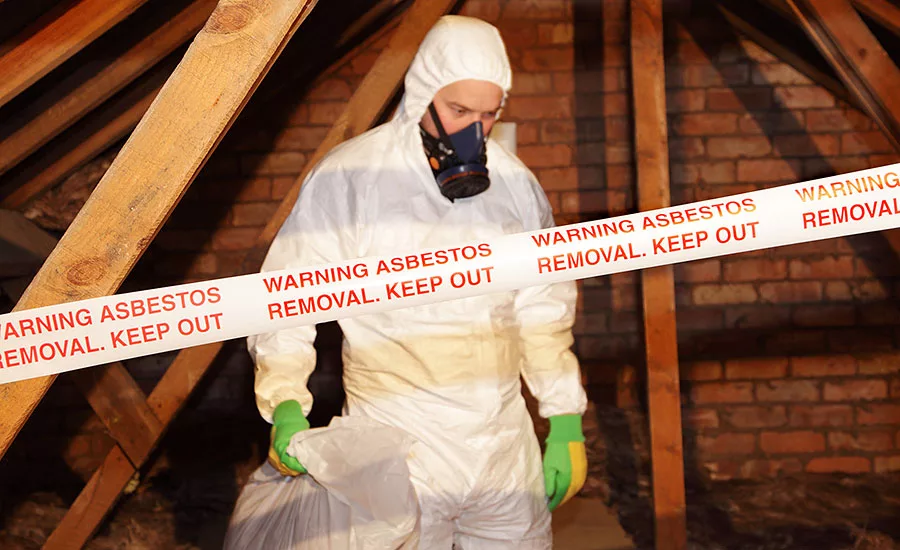
An OSHA health compliance officer (an industrial hygienist -- IH) recently put me in an ethical dilemma. While conducting “side-by-side” air sampling as the employer’s representative during an OSHA inspection, I observed that the OSHA IH was not sampling for asbestos correctly.
OSHA 29 CFR 1926.1101, Appendix B, Asbestos Sampling and Analysis, states at section 5.2.3, “Do not use luer connectors – the type of cassette specified has built-in adapter.” And section 5.2.6, states “Remove the end cap of each cassette and take each air sample open face.” These regulatory advisory sections are consistent with OSHA Method ID-160 and NIOSH 7400 for air sampling for asbestos fibers.
Metal luer connectors should not be used because they may generate static charge during sampling that may create false negative results. Failure to sample “open face” may create false positive results. The OSHA IH made the novice, but critical asbestos sampling errors, by using metal luer connectors and sampling with filter closed face.
Ethically, as the employer’s representative, should I intervene to correct OSHA mistakes that may lead to invalid results, or stay silent and let OSHA sample as they want and contest possible citations later?
Side-by-side experience
In my early days, I would intervene. The downside to incorrect IH results is great. Now I let the OSHA IH “do his thing” with as little interference as possible. Intervention only occurs today if the OSHA IH is also a certified industrial hygienist (CIH). I am a CIH; if we both are certified, obligations to uphold CIH ethics outweigh other considerations.
I’ve done enough side-by-side sampling with OSHA to know this: OSHA IHs often make critical sampling and/or observation errors. There appears to be few seasoned OSHA IHs that make site inspections. OSHA IHs with less than five years of experience are generally good with IH science but lack the “art” of IH, such as knowing when and how employees may falsely alter exposure results.
Employer responsibilities
OSHA 1903.7 regarding the conduct of inspections permits OSHA IHs to use varied investigative techniques. Most employers know that they should mimic and meticulously document these techniques. For example, if OSHA takes a picture or video, or collects IH samples, the employer should do the same.
Collecting IH samples is one of the rare times when OSHA often must schedule an inspection with the employer, particularly when eight-hour time-weighted average samples are necessary to determine compliance with permissible exposure limits -- PELs. This scheduling gives an employer an opportunity, if they choose, to bring in their own IH to conduct side-by-side sampling with the OSHA IH.
The downside to false IH results is great. In the above example, if OSHA obtains a false positive result, the employer is required to post the citation and notice of penalty. The false positive result will remain until the employer contests the citation at an informal hearing. In the meantime, employees may believe they’re breathing in asbestos fibers, creating undue concern and animosity.
Scheduled inspection
The following nine key steps should occur if OSHA schedules an IH inspection:
- Promptly secure the services of the corporate or third-party IH to conduct side-by-side sampling with OSHA. Because results may be contested, the IH should hold the CIH credential.
- Promptly advise OSHA that an IH representing the employer will conduct side-by-sampling. OSHA will often agree to reasonably arrange dates to help fit into the employer representative IH’s schedule.
- Upon request, provide the IH representative’s name and credentials e.g. CIH, CSP, etc. to OSHA. OSHA cannot refuse to work with the IH representative chosen by the employer.
- Request OSHA to provide its sampling protocol. What flow rates will OSHA use? Flow rates established for any monitoring determine how often individual samples must be changed out over the course of the workday. This information and more, including copies of all applicable safety data sheets, should be passed onto the employer IH representative.
- Advise your IH representative of expected conduct – handling ethical dilemmas, being cooperative, providing limited interference, and not volunteer information. The IH rep should be seen but rarely heard.
- The IH rep’s objective is to obtain precise and accurate results. If best practices are followed by the OSHA IH and employer representative IH, then results should be statistically similar, though not necessarily exact.
- Expedite your laboratory (should be AIHA accredited) analysis, so you have results before OSHA. Be aware that OSHA substance-specific standards e.g. asbestos, lead, benzene, etc. have time requirements for employee notification of the employer IH’s monitoring results. For asbestos, it is no later than five working days after the receipt of the results. The IH representative generally receives laboratory results first and then tabulates these findings, as appropriate, into PEL time-weighted average (TWA) comparisons. When these actions are completed, the employer is notified, and OSHA time requirements are triggered for employee notification of monitoring results.
- An employer IH report, however, is not the same as results. “Employee exposure record” at OSHA 1910.1020 includes not just results but also “…related collection and analytical methodologies, calculations, and other background data relevant to interpretation of the results obtained…” Inclusion of OSHA findings helps make the IH report complete.
- Be aware that 1910.1020 requires that exposure records be kept for a minimum of 30 years with requirements for employee access. Why? Epidemiological purposes, as one example. Because of these and other requirements, that may have significant potential future impact, the OSHA side-by-side IH report should be reviewed by the employer in draft and edited, as necessary, before final release and filling.
Looking for a reprint of this article?
From high-res PDFs to custom plaques, order your copy today!