ISHN logo
search
cart
facebook twitter linkedin youtube
  • Sign In
  • Create Account
  • Sign Out
  • My Account
ISHN logo
  • NEWS
    • Today's News
    • Global Safety News
    • Government Regulations
  • PRODUCTS
    • Product Innovations
    • Featured Products
  • TOPICS
    • Environmental Health and Safety
    • Facility Safety
    • Workplace Health
    • Occupational Safety
    • PPE
    • More Topics
  • CONSTRUCTION
  • TECHNOLOGY
  • COLUMNS
    • Best Practices
    • Dave Johnson: What’s going on
    • Editorial Comments
    • Leading Safety
  • MULTIMEDIA
    • ISHN Podcast
    • Videos
    • Cold Stress Education Quiz
    • Webinars
    • White Papers
  • MORE
    • Buyer's Guide
    • Newsletters
    • Convention Companion
    • Polls
    • Events
    • ISHN Store
    • Sponsor Insights
  • EMAGAZINE
    • eMagazine
    • Archived Issues
    • Contact
    • Advertise
  • JOIN TODAY!
Government Safety RegulationsOccupational SafetyEnvironmental Health and SafetyPPEWorkplace Safety CultureRisk Management

Hi-Visibility garments continue to evolve

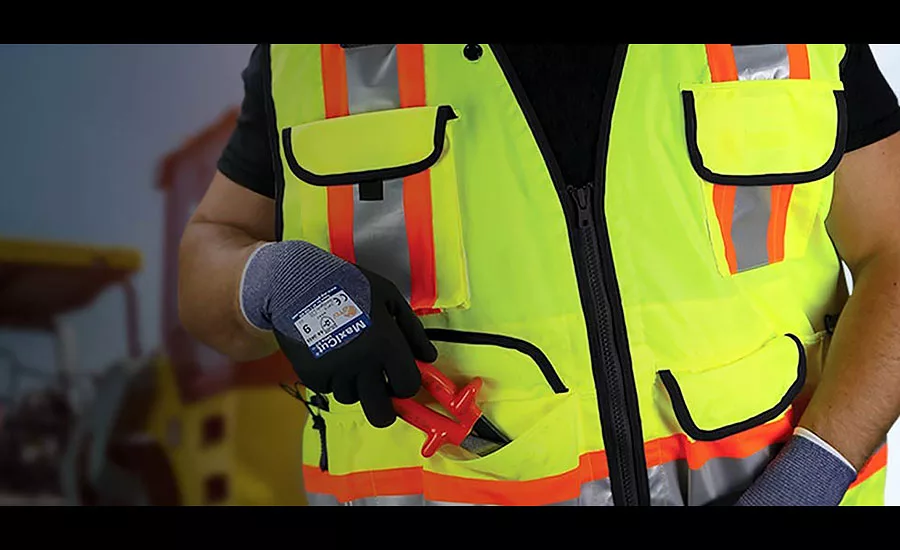
We’ve seen the popularity of lighter, more flexible and breathable segmented trim, and more enhanced visibility by integrating LED luminescence directly on the trim.
By Anthony Di Giovanni
Hi-Visibility garments
March 14, 2019

Having spent 10 years in the fire protective clothing industry, I assumed marketing Hi-Vis garment was going to be easy. Turns out, it’s far more complex than I had anticipated. While we tend to think only in terms of the visibility factor, it is important to remember that the latest ANSI/ISEA 107-2015 standard covers both basic design and performance of high visibility in work garments. The emphasis regarding high visibility garments has traditionally been on the photometric requirements -- the minimum amount of component materials, colors, and placement to create garments for enhancing the visibility of workers. Let’s review some basics on this subject.

Colors & class

For both garment and trim, there are three fluorescent colors: yellow-green, orange and red. The standard clearly charts out the amount of background material, retroreflective material (and width) based specifically on the garment type, designation, and class. 

As an example, a Type “R”, designated for Roadway, has two performance classes -- Class 2 and Class 3, with Class 3 having a higher requirement for background and retroreflective material, as well as at least one retroreflective band encircling each sleeve. There is also a Class E. ANSI Supplemental Class E applies to Hi-Vis pants, bib overalls, shorts, and gaiters. On their own, these garments are not ANSI compliant, but when combined with a Class 2 or Class 3 garment, the combination satisfies Class 3 requirements. 

Take note of other garment types: Type “O” covering “Off-road” and Type “P” covering “Fire, Police, EMS.” Additionally, the standard outlines specifications for accessories such as gloves, headgear, and bands. The ANSI/ISEA 107-2015 standard also covers specific markings, logos, and labeling, as well as laundering and use instructions.

Retro-reflective trim

Reflective trim is a reflective layer composed of wide-angle glass beads bonded to a special polymer colored fluorescent layer which has a backing for sewing or adhering directly on to garment material. Recently we’ve seen the popularity of segmented trim, which is lighter, more flexible, and breathable. We’re also observing more and more enhanced visibility by integrating LED luminescence directly on the trim.

While quite compelling, remember that this type of “visibility” is not covered by the ANSI/ISEA 107-2015. This means that industry experts related to materials and safety procedures have not studied the efficacy of this new technology. Until such time, LED luminescence and phosphorescence glow-in-the-dark garments are an enhancement feature that must be evaluated by the user and application, specifically.

Trends

Progressive manufacturers recognize we are amid an evolution in garment design. Most of this is led by the need for multiple functionalities and higher adoption by different users. Let’s begin with the latter. It was not that long ago that site engineers, project managers and supervisors did not wear hi-vis garments because perhaps they felt that, in the short time that they were on-site, their white hard hat was enough to give them enough visibility. Today, this thinking has clearly changed. Supervisors and engineers insist on setting an example for safety. In fact, they are even more particular about functional design enhancements. Examples include mobile phone pockets, table pockets and even garments that are reversible to conveniently go from office to site and back to the office.

Other trends are being driven by expanded adoption in multiple industries. Take for example airport ground workers. Today, the tarmac is shared by more and more workers – from gate catering personnel to mechanics and loading personnel for passengers, freight and even courier services. These people work 24/7 and in areas where there is moving equipment, vehicles, flashing lights and where the sound is often attenuated to protect hearing. A high degree of visibility is vital to maintaining safety in such environments.

Where are we heading?

Basic vests are becoming the norm with parking lot attendants, landscapers, and even small job-site operators. Large construction companies, industrial yards, docks, rails (the list goes on) are all looking for high-quality, comfortable and durable hi-vis garments. They learned that low-cost usually means garments need to be replaced more often. Workers and supervisors are looking for more features such as more pockets and in the case of winter wear, jackets that are 2-in-1, 3-in-1 and even more. They don’t want to be changing garments during the day – they want to layer on and layer off. Younger workers and supervisors don’t want to be changing into regular jackets at the end of the day. They prefer black bottom to hide dirt and more and more reversible type of jackets that they can even go from work-wear to weekend-wear.

We can safely assume that there will be more and more construction and infrastructure rebuilding. If we stop to consider how the workers’ reflective clothing competes with reflective cones, barriers, and signage, we can see how new technologies are needed. You would think the obvious leap is new lighted LED garments, but that may be oversimplifying. We need to think about total solutions that are carefully assessed with studies by users, manufacturers, and experts within the safety industry.

That is where the ANSI/ISEA strength lies, finding the right solution that works best for the industry. It is important that we maintain commonality and standards so we don’t end up with a road crew that has half of the workers in reflective clothing and the other half in blinking LEDs – that could turn out to be more of a problem to handle.

KEYWORDS: high-visibility apparel highway work zone safety roadwork safety worker safety and health

Share This Story

Looking for a reprint of this article?
From high-res PDFs to custom plaques, order your copy today!

Anthony Di Giovanni is Vice President of Global Marketing for PIP. He has nearly 20 years of international experience in sales and marketing industrial products, which includes some of the larger multinationals as well as his own consulting firm.

Recommended Content

JOIN TODAY
to unlock your recommendations.

Already have an account? Sign In

  • forklift safety

    Exploring the latest technologies in forklift safety

    With more staff and more stock in warehousing now more...
    Workplace Training Strategies
    By: Josh Cramer
  • welding

    All about welder’s flash or arc eye

    A flash burn is a painful inflammation of the cornea,...
    Environmental Health and Safety
  • dangerous jobs

    The 10 most dangerous jobs in the U.S.

    On-the-job deaths have been rising — hitting the highest...
    Occupational Safety
    By: Benita Mehta
Manage My Account
  • eMagazine Subscriptions
  • ISHN Newsletter & Other Newsletter Alerts
  • Online Registration
  • Manage My Preferences
  • Subscription Customer Service

More Videos

Sponsored Content

Sponsored Content is a special paid section where industry companies provide high quality, objective, non-commercial content around topics of interest to the ISHN audience. All Sponsored Content is supplied by the advertising company and any opinions expressed in this article are those of the author and not necessarily reflect the views of ISHN or its parent company, BNP Media. Interested in participating in our Sponsored Content section? Contact your local rep!

close
  • man wearing the the Sundström SR200 Full Face Mask Respirator
    Sponsored byOHD

    5 Fit Testing Mistakes That Could Cost You

  • This image shows Magid AcuSpex polarized blue mirrored safety glasses.
    Sponsored byMagid Glove and Safety

    Construction PPE Guide: What Crews Need for Each Task

  • lone worker in confined space
    Sponsored byAlphasense Ltd.

    GET THE LEAD OUT of your Safety Oxygen Sensors!

Popular Stories

SpaceX 7 launch

OSHA Investigating Fatal Fall at SpaceX Starbase

dust explosion

Tennessee OSHA Issues Record $3.1M Fine After Deadly Explosion at Munitions Plant

Worker Impairment

How to Tell When a Co-Worker is Impaired? A Safety Pro’s Challenge

top 10 most dangerous jobs

Poll

Seasonal Readiness

With the federal heat stress prevention rule on the horizon, which area of your safety program needs the most attention?
View Results Poll Archive

Products

Surviving an OSHA Audit A Management Guide, 2nd Edition

Surviving an OSHA Audit A Management Guide, 2nd Edition

See More Products

ISHN Podcasts

Related Articles

  • ladder

    From JLG Industries: Still using ladders? It’s time to evolve.

    See More
  • A+A

    A+A 2021 draws to a successful close as safety and health at work continue to move into focus of politics and society

    See More
  • 9/11

    9/11 Ground Zero exposures continue to claim lives

    See More

Related Products

See More Products
  • 1119906652.webp

    Alive and Well at the End of the Day: The Supervisor's Guide to Managing Safety in Operations, 2E

  • 111885960X.jpg

    Professional Rope Access: A Guide To Working Safely at Height

  • 1118911040.jpg

    Risk Assessment: A Practical Guide to Assessing Operational Risks

See More Products

Related Directories

  • BrimGuard

    BrimGuard fits over most any North American style hard hat (cap or full brim) and provides a highly visible color-coded identification for your new hires. With BrimGuard, you can: -Reduce the risk of accidents and injuries by making new hires stand out from the crowd -Increase the accountability and responsibility of new hires by making them easily recognizable -Enhance the communication and collaboration between new hires and seasoned workers by facilitating mentoring and feedback -Save time and money by eliminating the need for stickers, decals, or separate hard hats for new hires -Improve the morale and retention of new hires by making them feel welcome and supported BrimGuard is made of durable, lightweight, and washable reusable silicone that can withstand harsh work environments. It comes in safety colors to suit your needs.
×

Become a Leader in Safety Culture

Build your knowledge with ISHN, covering key safety, health and industrial hygiene news, products, and trends.

JOIN TODAY
  • RESOURCES
    • Advertise
    • Contact Us
    • Directories
    • Manufacturing Division
    • Store
    • Want More
  • SIGN UP TODAY
    • Create Account
    • eMagazine
    • Newsletters
    • Customer Service
    • Manage Preferences
  • SERVICES
    • Marketing Services
    • Reprints
    • Market Research
    • List Rental
    • Survey/Respondent Access
  • STAY CONNECTED
    • LinkedIn
    • Facebook
    • YouTube
    • X (Twitter)
  • PRIVACY
    • PRIVACY POLICY
    • TERMS & CONDITIONS
    • DO NOT SELL MY PERSONAL INFORMATION
    • PRIVACY REQUEST
    • ACCESSIBILITY

Copyright ©2026. All Rights Reserved BNP Media, Inc. and BNP Media II, LLC.

Design, CMS, Hosting & Web Development :: ePublishing