Safeguards for automated operations
Physically protect your workers and minimize the “safety zone” footprint.
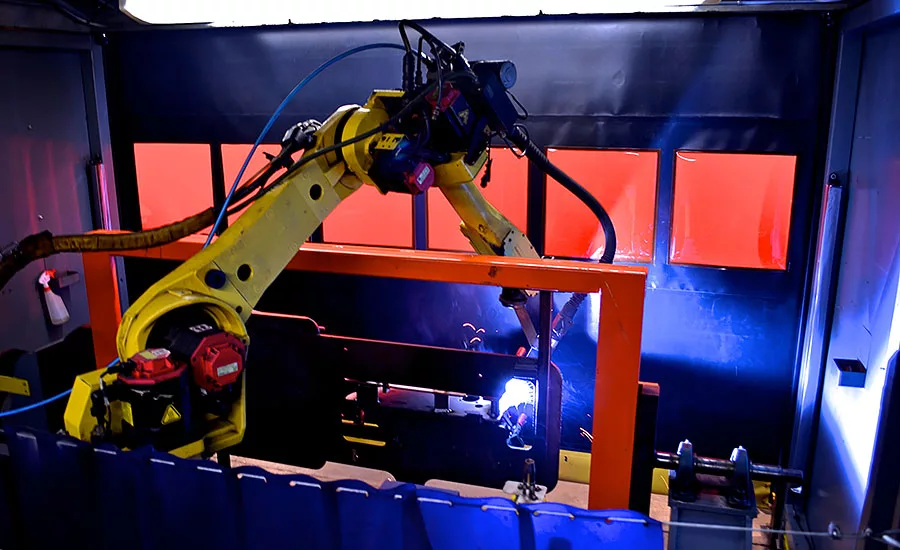
Advances in machining and robotics have increased operational efficiency in virtually all manufacturing sectors. Production and profits would plunge if operations were done by hand alone. History has shown us that the advantages of machines are undeniable. It’s why the number of industrial robots has grown from 60 million in 2009 to more than 380 million in 2017 worldwide, according to the International Federation of Robotics.
But these automated systems can create potentially dangerous hazards for workers who operate and/or interact with them. Facilities can and should protect workers by implementing safeguards at these critical points of interaction. Recent changes in regulations and protocols by national and international governing bodies like OSHA, British Standard European Norm (BS EN), and the Robotics Industries Association (RIA) reflect a conscious effort to protect employees working these advanced machining technologies.
Facility managers have a number of options to comply with these standards and improve worker safety. The proper safeguard depends on the exact application. Before examining those options, it’s critical to determine risk if a new automated operation is being introduced to a facility.
Assessing risk
Even before RIA updated its machine guarding regulation R15.06 several years ago to make risk assessments mandatory, they have always been a good idea. Point-of-operation guarding is perhaps the most involved aspect of this regulation as it represents the intersections of both man and machine, and safety and efficiency.
Because most situations require a machine operator to interface with the machine by loading or unloading materials (components to be welded or worked on) and “running” the machine, installing perimeter guarding around an entire process is rarely the proper solution. This point-of-operation requires many details to be considered, such as the layout or design of the process. Other details include limits of the system, properly identifying all associated hazards, and then devising methods for the elimination or risk reduction of those hazards.
The distance formula as identified in OSHA guidelines can assist in determining the best machine guarding device. The formula is DS = K (T) + DPF.
- DS stands for safety distance;
- K stands for the maximum speed an individual can approach the hazard;
- T stands for the total time to stop the hazardous motion;
- DPF stands for the depth penetration factor of the safeguarding device.
Per this formula, the safeguarding product has a prescribed location based on a number of factors, including secondary hazards that might harm a machine operator. This formula makes a big difference in determining which safeguarding device a facility should implement.
Presence-sensing devices
The most basic devices used for safeguarding manufacturing operations are light curtains, laser scanners and other presence-sensing devices. Operations from Tier 1 automotive to small machine shops and fabrication facilities commonly use them. Once the infrared beam of these devices are tripped, the automated process ceases.
In many instances these devices provide acceptable safety. But they’re not always the best choice in all applications, especially after a risk assessment is performed.
One of their biggest shortcomings is that workers must adhere to OSHA’s distance formula to reduce risk of injury. This can lead to larger work cells, which equates to additional time for employees to walk between the non-operational machine and the safety area when the machine is operating. Alternatively, employees who skirt the system with shortcuts only compromise their own safety. Additionally, an employee who enters a work cell can still be at risk of injury from roll inertia as a machine powers down.
From an efficiency standpoint, presence-sensing devices come with another drawback. Because an infrared beam can’t be seen, they are subject to being accidentally tripped by a worker who has no intention of entering the hazardous area. While it is better to be safe, these accidental trippings can cause delays in operations.
Automated barrier doors
In some instances, light curtains are a viable choice. They can limit exposure to the hazard and reduce risk within regulatory guidelines. On the other hand, a fast-acting automated barrier door or roll-up curtain is often a better choice because they can eliminate exposure to both the dangerous movement of the machine and secondary hazards produced by the process, potentially eliminating risk and the severity of exposure.
When they are coupled with safety interlocks (up to PLe, Cat. 4 per EN ISO 13849-1 when integrated properly), automated barrier doors and roll-up curtains offer an increased level of protection for point-of-operation guarding. Not only do they restrict access to the process, they also contain secondary hazards such as smoke, flash, splash, mist or flying debris associated with automated welding operations by placing a barrier between machine operators and machine movement. These types of guards are an ideal alternative to light curtains and other presence-sensing devices in many situations.
Making automated processes safer and more efficient
Interlocked automated barrier doors aren’t held up against OSHA’s safety distance formula because there is no depth penetration factor – allowing the safeguard to be placed much closer to the hazardous area. This correlates to less space being dedicated to a “safety zone” and directly results in reducing the manufacturing cell’s footprint. This space savings is a huge benefit in most facilities and it means workers can actually stand closer to the automated operation than with light scanners. The smaller safety zone may also make for a better ergonomic situation for the machine operator by limiting required motion and help increase productivity, an essential in today’s competitive market.
The elimination of accidental entry into the cell is another benefit of interlocked automated barrier doors. Unlike the invisible infrared beams of presence-sensing devices, barriers provide safeguarding that can be seen. The physical separation they provide is a clear visual indicator that the machine operator needs to be on task.
Properly guard machine operations
Any time a new automated machining or robotic process is being considered for a facility, a risk assessment should be performed to properly guard the operation. Once feasible safety options have narrowed down the choices, consider the safety option that interferes with productivity the least. When it comes to manufacturing facilities, physical barriers generally offer more protection than presence-sensing devices and will likely improve productivity.
Looking for a reprint of this article?
From high-res PDFs to custom plaques, order your copy today!