Baby Boomers retiring, leaving many open trades positions
Invest in the next generation
It’s 2019 and the robots haven’t taken over...yet. Despite wild internet theories and predictions that robotics and automation would take jobs away from Americans, especially in the labor and trades, the United States is actually looking at a large skills gap in the trades and an even larger number of unfilled jobs.
By some accounts, there are nearly half a million1 more jobs available in the skilled trades than workers with the skills to fill those roles, and that number is expected to rise to two million within a decade. These are good-paying jobs that are accessible through an apprenticeship or two-year degree, and many of these jobs have salaries that start out higher than jobs associated with traditional four-year college degrees. One would think that people would be lining up for these jobs... but they’re not.
So what is happening?
Bye bye, Boomers
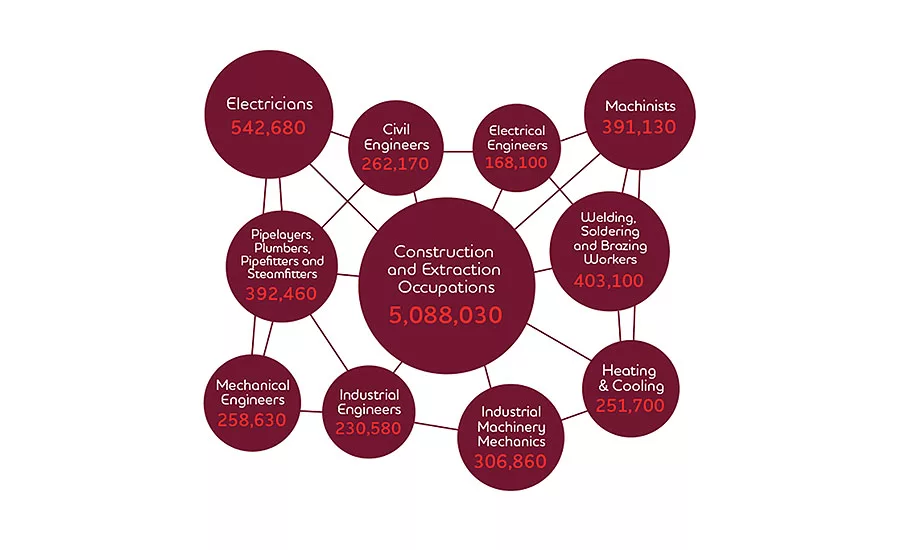
In short, there aren’t enough young people entering the trades to replace the aging Baby Boomers leaving the workforce. For every one person that enters the trades, five retire. Once all the Boomers retire, we’ll be looking at almost five million2 open positions in the construction and extraction industry alone. And it’s not just a lack of people of working-age to fill these roles. To look at why these Boomer-vacated jobs aren’t being filled, we need to look at the next generation of workers the ones currently in high school and college.
College or bust
Many young people these days are under the impression that the only way to earn a livable wage and build a good life for themselves is to go to college and get a bachelor's degree.
When it comes to the students still in high school, only one in five have taken three or more credits in occupational education, which often indicates an interest in the trades. This number has fallen from one in four students in 1990, according to the U.S. Department of Education3. To make matters worse, many schools stopped offering shop classes or mechanical classes, which was usually a student’s first exposure to the type of hands-on experience that could spark an interest in the trades.
Today, a bachelor’s degree now costs more than $100,0004, on average and at times, even more than that. According to the Federal Reserve5, in 2016, 42 percent of students borrowed money to go to college.
Meanwhile, a student entering the trades immediately out of high school will enter the workforce with little or no student loan debt and will begin earning right away – oftentimes at an hourly rate that will surpass or equal what their college-graduate peers will earn upon graduation.
New construction jobs
To add to the shortage, our population and economy continues to grow, and that growth brings an enormous need for workers in construction and extraction, especially. According to the BLS6, “employment of construction and extraction occupations is projected to grow 11 percent from 2016 to 2026, faster than the average for all occupations, a gain of about 747,600 new jobs. Overall growth in the economy and population will increase demand for new buildings, roads, and other structures, which will create new jobs in construction and extraction occupations.”
And with this growth comes technology and automation (this is where the robots come in) and the need for workers to learn, use and maintain these new technologies. Manufacturers commonly report that they are slow to invest in new technology due to the training requirements and lack of workers to actually train. These manufacturers also report7 a rising need for workers with trade skills because of the increasing technological sophistication in every industry.
Reaching the kids
However, despite all the statistics and data on good jobs available in the trades, kids are still lining up to go to college. Some states are finding ways to make the trades career path more visible to high school students. According to an NPR article8, “Iowa community colleges and businesses are collaborating to increase the number of “work-related learning opportunities,” including apprenticeships, job shadowing and internships. Tennessee has made its technical colleges free.”
In the private sector, Klein Tools partnered with SkillsUSA to launch an inaugural National Signing Day9, which celebrated thousands of high school seniors dedicated to pursuing a career in the trades on May 8, 2019. NFL Quarterback Jimmy Garoppolo signed on to participate and attend the Silicon Valley Career Technical Education in San Jose, CA, alongside his father, Tony Garoppolo, a career electrician.
Much like signing days for high school student athletes, this National Signing Day recognizes and celebrates students who are announcing their career plans and signing “letters of intent” for a job offer, apprenticeship or advanced technical training. The hope is that this program will bring more awareness to the skilled trades, and get more students on board.
The future
The future is looking bright for those who do decide to enter the trades. Employers are looking to draw in more workers and are taking a hard look at their pay scales, benefits and other perks. Salaries are currently on the rise and as the shortage continues, it will only drive those salaries higher.
Some construction managers who have experience or have worked their way up are earning an average of $101,000 annually, according to the Bureau of Labor Statistics10.
Reaching the kids to get them to see this bright outlook for themselves is step one, but with help from companies like Klein Tools and organizations like SkillsUSA, coupled with state programs that work to bring awareness to the trades, the skills gap and current decline in the trades doesn’t have to be a permanent problem.
Sources
1. https://www.manhattan-institute.org/html/issues-2016-are-skilled-trades-doomed-decline-9380.html
2. https://www.adeccousa.com/employers/resources/skilled-trades-in-demand/
3. https://nces.ed.gov/surveys/ctes/table_archive.asp
4. https://www.forbes.com/sites/jimmorrison/2018/08/05/construction-labor-shortage-creates-increasingly-lucrative-career-paths/#30df529e4cea
5. https://www.federalreserve.gov/publications/files/2017-report-economic-well-being-us-households-201805.pdf
6. https://www.bls.gov/ooh/construction-and-extraction/home.htm
7. https://www.manhattan-institute.org/html/issues-2016-are-skilled-trades-doomed-decline-9380.html
8. https://www.npr.org/sections/ed/2018/04/25/605092520/high-paying-trade-jobs-sit-empty-while-high-school-grads-line-up-for-university
9. https://www.kleintools.com/content/skillsusa-national-signing-day-sponsored-klein-tools-will-celebrate-thousands-high-school-seniors-nationwide-may-8
10. https://www.bls.gov/oes/current/oes_nat.htm#47-0000
Looking for a reprint of this article?
From high-res PDFs to custom plaques, order your copy today!


