How to deliver in-depth safety learning
Beyond typical training

Deloitte (2014) describes the modern learner in its infographic, “Meet the Modern Learner.” The infographic shows multiple constraints employees face when developing necessary skills. Many writers and training professionals interpret this to say that people today learn differently. Learning has evolved with the office.
But learning has not changed -- only the digital workplace in which learning takes place.
The foraging brain
Science writer Benedict Carey devotes a chapter to what he calls the “foraging brain” in his book How We Learn (2014). Carey says our many beliefs about learning are tightly connected with modern schooling. As students acquire the knowledge of literature and calculus, for example, we see the workings of the evolved modern brain.
But Carey and a growing body of social-behavioral science literature say we use the same foraging brain as our nomadic ancestors living in small bands of hunter-gatherers. Modern learners inherit the same foraging brain as our ancestors. The same basic brain that made stone tools and mastered fire is the same brain shared with Socrates, Galileo, and Einstein -- and us. Modern schooling shares all that human experience has accumulated until now, but with the same ancient brain.
Developing deep knowledge
Carey (2014) writes that learning is achieved through “academic and motor domains” (p. 227), his terms for declarative and procedural knowledge.
Declarative Knowing: Our ancestors acquired knowledge and skills to survive their environments just as the modern worker does today. They passed on declarative knowledge (knowledge-that), or content in the form of facts, concepts, rules and principles. This knowledge is sometimes referred to as explicit or semantic.
Procedural Knowing: Our ancestors also developed expertise through skill-building, becoming proficient at finding food and hunting animals. Our hunting today is for mentors and experts to show us how to perform better at work. We perform simple skills that require little conscious attention, such as inputting data or shutting down a work station; and we perform complex skills that require lots of conscious attention, including a surgical procedure or executing a standard work process. This is procedural knowledge (knowledge-how).
Formal schooling habits
Modern schooling and most of the training industry leans toward declarative knowledge -- the stuff of lectures and PowerPoint slide presentations. This more formal schooling approach is a hard habit to break.
Harold Stolovitch and Erica Keeps (Telling Ain’t Training, 2002) warn us that learning declarative knowledge “cannot be readily transformed into procedural knowledge” (p. 34) — and vice versa. The foraging brain keeps each type of knowledge in different kinds of memory.
Modern adult learners require deep learning, which Patti Shank (Practice and Feedback for Deeper Learning, 2017) ties to application -- knowledge that we can use. The foraging brain takes time to apply, reflect on, and fine tune both domains of knowledge. Ideally, organizations require employees to understand information (declarative) as well as apply it to relevant cases (procedural).
Declarative & procedural knowledge
Designing for deep knowledge first requires distinguishing between deep learning and surface learning. Deep learning is defined as depth through application, reflection, discussion, and problem-solving. Surface learning is the opposite: learning rigid formulas only useful for solving routine, well-structured problems. Deep learning prepares learners to solve novel or ill-structured problems beyond the rehearsed to routine.
Next consider the declarative domain. The depth principle for declarative knowledge lists the following principles:
- Mental models: identify preconceptions and prior knowledge;
- Retrieval practice: practice recalling information with corrective feedback;
- Spacing: distributing learning over time through multiple events;
- Elaboration: relating material to what’s known, explaining it to another or applying it to routine and ill-structured problems or scenarios;
- Reflection: drawing inferences on content as it relates to work roles or personal meaning.
These principles offer a strategy to facilitate transfer of knowledge to work tasks and processes.
For procedural knowledge, research findings include:
- Observation: providing demonstrations, showing the behavior so that learners can watch, imitate, and note the consequences;
- Deliberate practice: purposeful practice of part of a skill or the whole skill or behavior;
- Engagement: consciously developing, refining and fine-tuning skills and behaviors;
- Worked examples: step-by-step or part-to-whole demonstrations of tasks, skills or procedures;
- Feedback: positive or negative results of use to refine for future outcomes;
Procedural content aims at achieving proficient application on the job.
How do we design training to foster deep learning? See the following tables.
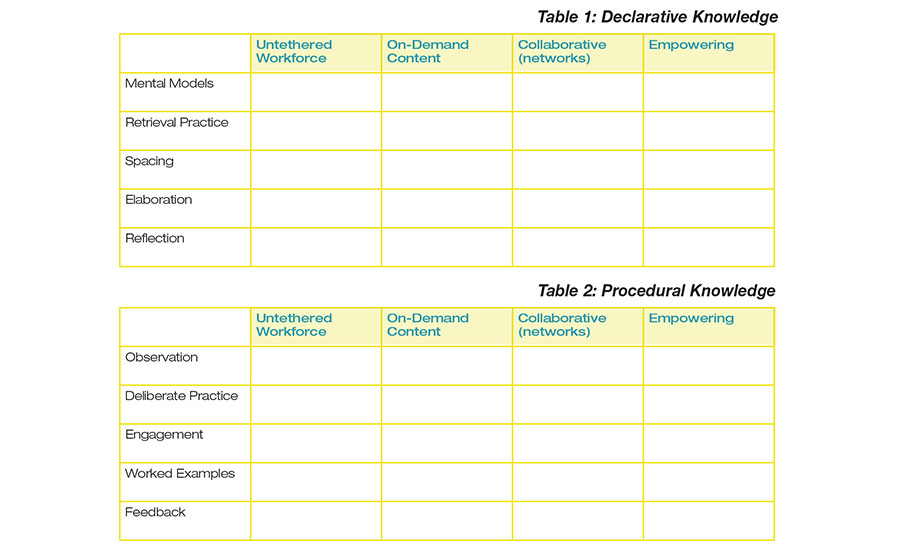
Imagine the intersection of On-Demand Content and Spacing: a learning professional can distribute five quick messages through e-mail to provide spaced interactions. Or a designer may pick the cell for Untethered Workforce and Elaboration to create, for example, mobile learning activities for application to a scenario.
With Table 2, a designer or learning professional can pick 3-5 intersecting cells more relevant to the training needs and desired outcomes. Observation through video is commonly available on social media, such as YouTube. Opportunities for Deliberate Practice and Empowering can be e-mailed or even done in-person, during micro-mentoring sessions.
Both tables provide a design tool for facilitating deep knowing. With the help of the design tools shown, learning professionals can facilitate deep learning within the complex constraints of the modern workplace.
Looking for a reprint of this article?
From high-res PDFs to custom plaques, order your copy today!