NTSB wants halt on doors-off sightseeing helicopter rides
In the wake of a fatal 2018 crash of an Airbus AS350 helicopter into New York City’s East River, the National Transportation Safety Board (NTSB) is calling for a halt to doors-off helicopter flights that place passengers in supplemental passenger restraints - until federal regulators can better evaluate the safety of the restraints, which could interfere with the aircraft and hamper escape.
Loophole allows regulatory exception
In addition, the NTSB strongly urged the Federal Aviation Administration to close a loophole that allows certain doors-off sightseeing flights to operate under an “aerial photography” exception to the tougher federal regulations and oversight that most commercial air tours operate under.
The March 18 incident killed five passengers who were taking a doors-off sightseeing flight over the city. The recommendations, approved during Tuesday’s NTSB board meeting, stem from the NTSB’s investigation of the deadly crash. The flight was operated by Liberty Helicopters Inc. under a contract with NYONair and departed from a heliport in Kearny, New Jersey.
The flight, marketed as FlyNYON, was designed to allow passengers to take photos of the city’s landmarks while extending their legs outside the helicopter. For the flight, Liberty removed the helicopter’s two right doors and front left door and locked the left sliding door in the open position.
Tether caught on lever, caused power loss
Investigators determined that during the flight the tail of the front passenger’s tether, which connected his NYONair-provided harness to the helicopter, caught on the helicopter’s fuel shutoff lever, resulting in a loss of engine power at an altitude of 1,900 feet. The pilot then successfully ditched the helicopter into the river.
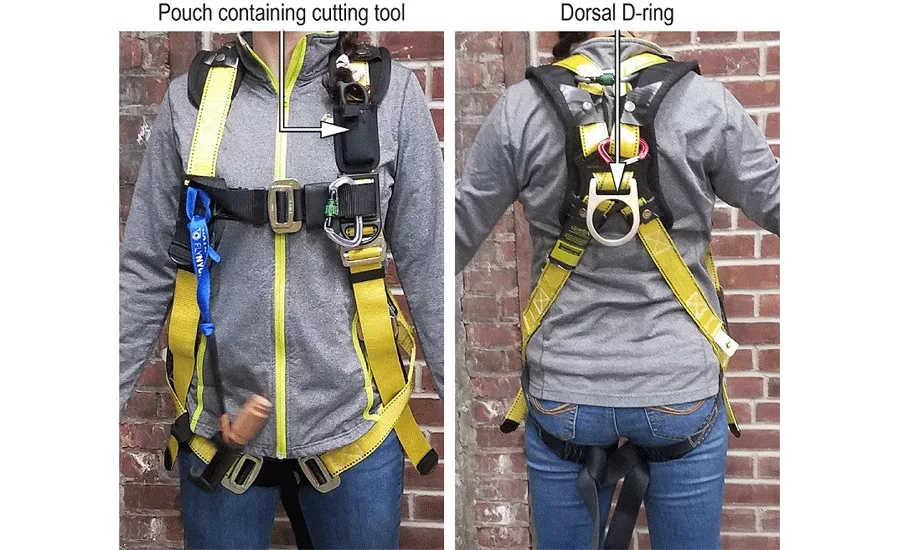
(Shown above: the front and rear view of an exemplar NYONair harness. Investigators determined that such harnesses, attached to a tether that was attached to the helicopter and secured by two separate locking carabiners, could interfere with flight operations and hamper emergency escape. NTSB photo)
While investigators found that the pilot had pulled a handle to deploy the helicopter’s emergency floatation system at an appropriate time, the floats inflated partially and asymmetrically. After landing on the water, the helicopter then rolled to the right and became fully inverted and submerged within 11 seconds.
Passengers couldn't get out of restraints
The investigation found that the helicopter’s landing was survivable. The pilot, wearing an FAA-approved restraint, escaped. However, the five passengers, each fitted with a NYONair-provided harness/tether system — secured with two locking carabiners — were not able to detach the restraints before or after becoming submerged upside down in the dark, 40-degree water, drowning as a result.
The NTSB found the immediate cause of the crash was Liberty Helicopters’ use of the NYONair harness/tether system, which caught on and activated the fuel shutoff lever resulting in the in-flight loss of engine power. Contributing to the crash was the deficient safety management of both Liberty and NYONair, who did not adequately address the foreseeable risks associated with these flights, such as having passengers attached with tethers moving around in a helicopter with vital floor-mounted controls. The companies also did not recognize the difficulty passengers would have escaping from the harnesses with only the emergency cutting tool they were each provided, a tool similar to automobile seatbelt cutters.
NTSB: companies knowingly exploited a loophole
“These companies were knowingly exploiting a loophole to avoid stronger regulation and oversight and people died because of it,” said NTSB Chairman Robert L. Sumwalt. “These types of doors-off flights with dangerous supplemental restraints that could get tangled or caught on something and hamper escape ought to stop before others get hurt.”
The NTSB issued 10 recommendations to the FAA, including one to review rotorcraft emergency flotation systems for deployment issues. During the accident sequence, the pilot said he pulled the handle to activate the emergency flotation system. He saw both floats begin to inflate. But investigators found that the handle had not been pulled through its full travel and only one of the system’s two gas reservoir assemblies activated. Subsequent tests by investigators found a force exceeding 58 lbs. was needed to pull the activation handle hard enough aft to discharge the second reservoir.
Also to the FAA, the board recommended that the regulator develop and implement a single set of national safety standards for all air tour operations.
Other recommendations include urging the FAA to provide guidance to operators who carry passengers for hire on how to identify intoxicated or impaired passengers and require all commercial air tour operators to implement a safety management system. The goal of a safety management system is to identify and mitigate safety hazards, provide regular safety assessments and continuously improve an organization’s overall level of safety.
The NTSB also recommended that Airbus modify the floor-mounted fuel shutoff lever in AS350-series helicopters, to protect it from being accidentally activated, and called on regulators to require owners and operators of existing AS350-series helicopters to retrofit the fleet.
FAA order didn't go far enough
In the days following the accident, the NTSB issued an urgent safety recommendation urging the FAA to prohibit all open-door commercial passenger-carrying aircraft flights that use supplemental passenger restraints, unless the harness system allows passengers to rapidly release the harness with minimal difficulty and without having to cut or forcefully remove it. While the FAA issued an emergency order that required operators to demonstrate the ability of restraints to be quickly released, the NTSB remains concerned that the very use of any supplemental restraints could interfere with aircraft operations or hamper the escape of passengers during an emergency.
An abstract that includes the investigation’s executive summary, findings, determination of probable cause and a complete list of safety recommendations is available at https://www.ntsb.gov/news/events/Documents/2019-EAR18MA099-BMG-abstract.pdf. The full report will be available in several weeks on NTSB.gov.
Looking for a reprint of this article?
From high-res PDFs to custom plaques, order your copy today!