10 tips for successful sound measurements
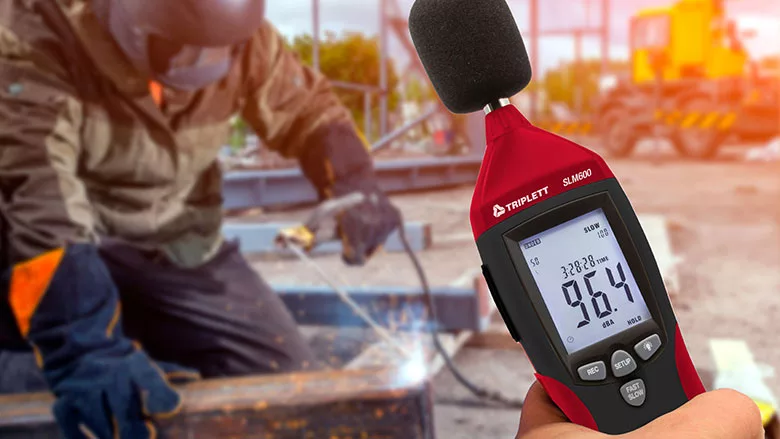
Photo credit: Triplett Test Equipment & Tools
There is a wide range of settings where measuring sound levels is a priority. In many cases, monitoring sound levels is important for worker or visitor safety, to avoid harmful sound levels. Sound level monitoring may also be tied to legal compliance. Think of a job site with loud machinery where hearing protection is needed such as a construction site or airport. Here, governing agencies like OSHA have developed regulations to define safe and unsafe sound levels for workers.
Music or live performance venues and music festivals may need to limit volumes to protect the audience’s and workers’ hearing, and for neighbors’ enjoyment of peace and quiet after a certain hour. Relatedly, new projects facing resistance like wind turbine farms may also need standardized noise level measurement to quantify actual noise levels versus nuisance complaints.
There may be local sound level laws or ordinances that require following, even for mundane locations like restaurants where loud music may be considered part of curating a desired atmosphere. One unexpected example of sound level monitoring is in a hospital’s neonatal intensive care unit or NICU. Clinical teams try hard to foster an environment without disturbances for premature babies. That can include dimmed lighting and quiet sound levels. Periodic sound level monitoring and measuring can help ensure that noise, even from excited family members of a preemie, is not at a disruptive level.
To perform sound measurements, you need the right equipment and some best practices to get results you can trust. Here is a set of tips that are useful for beginners and as a refresher for more experienced users.
1. Pick the right device: Sound level monitor vs datalogger vs meter
As with other tools, pick the right sound level measurement device for your job. Sound level meters are handheld testing devices useful for both spot readings and basic datalogging, manually recording a fixed set of readings. For more prolonged and automatic recording of readings, consider a datalogging sound level meter to record thousands of time and date stamped readings. Some handheld meters double as a datalogger. With a tripod and AC power, it can be used for extended readings over minutes, hours, or days. Finally, consider dedicated dataloggers. These may look like a USB memory stick with a foam mini-windscreen. With no display, it’s meant for one job, recording data.
2. Where’s the data? Storing sound level data records
As mentioned above, datalogging or recording can help paint a rich picture of trends or anomalies in sound levels that might not have been caught by periodic manual sound level checks. If you are datalogging, make sure your device’s storage capacity is up to the job. Many meters have on-board memory to store thousands of records. It may seem like a lot but keep in mind frequent readings can fill that up over time. So, it’s helpful to ensure that all of a device’s storage is available for a job. Check to see that previous data sets are removed to make added capacity.
With onboard memory, it’s as easy as plugging in a USB cable to transfer data to your computer for analysis. Others may use an SD storage card that is removable from the meter and can be inserted to the PC for downloading. With SD cards available in amazingly large capacities now, storage should not be an issue. Still, from a data hygiene perspective, routinely remove older sessions to avoid confusion and mix-ups, especially if more than one person is working with the sound level meter and the data.
3. Weight a minute! Weighting your sound level meter
A, C and Z weighting: Sound level measurements are often taken to measure their effect on human beings. To optimize the meter to capture that, a special “weighting” setting can be set. To focus on sound frequencies that humans can hear, a sound level meter can be set to “A-weighting.”
If a human is in a setting where sound levels are really turned up, that range of what we are sensitive to becomes broader, now including lower frequencies (think of booming bass at a concert or in the car next to you at a stoplight). When you want to represent these peakier levels, use the sound level meter’s “C-weighting.”
To track sound levels that are both within and beyond humans’ hearing, weighting can be turned off. This is called Z-weighting. One example of using Z-weighting is a more controlled setting such as testing speakers for frequency response in a design and manufacturing situation. More generally, A and C weighting are used in mainstream sound level measurements.
Fast & Slow weighting: Many sound level meters also have time weighting with two settings, fast and slow. Because sound levels can vary dramatically in real time, a digital display could look like a confusing jumble of numbers that are hard to track. To make it easier to monitor sound levels, readings can be weighted or “dampened” to show more stable, smoothed readings over time. Using the Fast setting, significant changes will show up more quickly (about 0.6 seconds) than on the Slow settings where the change may be more gradual (about 5 seconds).
Choosing fast or slow weighting in sound level measurements is a matter of preference; it can depend on what is being measured and the tradeoff between a “jumpy” display showing immediate changes and more stable readings, with a tradeoff in responsiveness.
4. Timing is everything: Synching for sound level logging
If you are recording or logging multiple readings over a period of time, it may be useful to use a recording or “datalogging” sound level meter. This type automatically takes readings at a predetermined interval. Here, it’s important that the meter is properly set and synched with actual time and date. This will make adjustments unnecessary later and will improve the credibility of results when shared with other parties. Plus, if you have more than one sound level meter placed throughout a site, having the dates and times match on all the meters will be instrumental for collating and comparing results later.
Relatedly, set the right interval for the project. If a job site has constantly changing sound levels, it may be more important to have frequent measurements to capture the variability. But if sound levels are generally unchanged or change incrementally over time, longer intervals may be okay. Keep in mind, it is a balancing act: more frequent intervals means richer data but it also means more data to analyze.
5. Get the right gear and accessories for sound level measurements
Most newcomers to sound level monitoring want to take out a meter, press ON and start measuring. But the reality is, some preparation and calibration is needed. Make sure you have the gear to do it right.
Just like a scale at the grocer can need adjustment periodically, sound level meters should also be adjusted for accuracy. The right device for the job is called a sound calibrator. This emits very accurate tones in selected decibel ranges so that the sound level meter can be matched to those for calibration. It’s easy to do and it ensures the accuracy and trustworthiness of your data. It’s a best practice to calibrate a sound level meter when starting and ending a job to keep your meter optimized.
6. Sound level meter windscreens aren’t just for windy days
You’ll notice that some images of sound level meters show a chrome probe at the top while others look more like a black sphere, almost imitating what many think of as a microphone. The difference is the windscreen, a foam spherical cover placed over the sensor to avoid inaccuracies due to wind. A sound level meter windscreen is a must for outdoor readings. You may not think it’s particularly windy out but the meter’s sensor is very sensitive, and it will pick up the most subtle air movements causing distortions and inaccuracies in the readings. Many users also use them indoors where HVAC or fan airflow can create similar wind effects. Pro tip: To avoid retaking readings, always use a windscreen.
7. Get the big picture: Document your sound level measurement job
When you are at a job site, come prepared to document the broader context of the measurement setting. Remember to take pictures of the job site. This will help you present your readings more accurately later. Today, it’s as easy as using your smartphone’s camera to take pictures or brief video clips with audio. Consider also using the sound memo function to record audio samples of the site.
It should go without saying but bring a notepad and pen, or a smartphone/tablet and stylus, to take notes or site diagrams while measuring. In today’s busy world, never trust your memory to note readings. A meter may also be able to record selected readings but it’s still valuable to have a backup.
8. Go the distance: Use a distance meter with sound level measurements
Many sound level regulations and ordinances include the distances at which a sound many not exceed a certain level of decibels. Don’t rely on actual footsteps to measure out a distance. Measure it. While some may use a tape measure, it can be cumbersome when dealing with distances like 10 meters, 25 feet, etc. that might be cited in a regulation. A laser distance meter, sometimes called a rangefinder, will give you point and shoot measurements from an array of locations at a site, ensuring you measure accurately. This may be useful as part of reporting or documentation that may be scrutinized at a later date.
9. Stay powered up: Fresh batteries and AC power supplies are must-haves
Always remember to have fresh batteries for a sound level measurement job. Some use AAA, AA or 9V batteries. Remember that temperature and usage can both impact battery life. Even with newer meters that use lithium-ion batteries, it’s always good to get a fresh charge. For extended datalogging jobs, verify if 110V outlet power is available. If so, opt for an AC adaptor cord and stay plugged in.
10. Try on a tripod for your sound level meter
When taking spot measurements, usually the sound level meter is held for a moment while readings are observed. But for extended readings, use a tripod to keep the meter stable and unaffected by movements. Large tripods, like camera tripods can be used but smaller table-top tripods are also available. But more importantly, if you plan to do extended readings or datalogging, check that your sound level meter or sound level monitor has a tripod mount underneath. This is key for a quick, secure bolt-on connection to a tripod.
Follow these tips to make your next sound level measurement job a trouble-free success, done right the first time and ready to inform compelling reports.
Looking for a reprint of this article?
From high-res PDFs to custom plaques, order your copy today!