Warning: Inspections surge ahead
Warehousing and retail will need to spot-check compliance

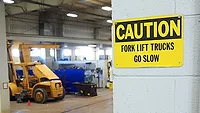
Photo credit: J. J. Keller
OSHA officers will start pounding the pavement in October under the National Emphasis Program (NEP) on Warehousing and Distribution Center Operations. State-plan states have six months to launch their own “at-least-as-effective” inspection programs. Regardless, you cannot wait for OSHA’s knock on the door to ensure compliance.
Background
OSHA says data show injury/illness rates for warehousing/distribution operations are higher than in private industry overall and, in some sectors, more than twice the rate of private industry! To address skyrocketing incidence rates, the three-year, federal NEP kicks off two inspection tracks based on North American Industry Classification System (NAICS) code:
One track has wall-to-wall safety inspections for warehousing/distribution operations (NAICS 493110, 493120, 493130, and 493190); mail/postal processing and distribution centers (NAICS 491110); and parcel delivery/courier services (NAICS 492110 and 492210).
The other track has inspections in the loading and storage areas of high-injury-rate retail establishments in NAICS 444110, 444130, 444190, 445110, and 452311. The scope of these partial inspections may expand where evidence reveals other violations.
No matter the track, OSHA officers will look for safety hazards common to these industries, including powered industrial trucks, materials handling/storage, walking-working surfaces, means of egress, and fire protection. They will also review injury/illness records. If an officer finds heat or ergonomic hazards, the inspection will expand to health hazards.
Get ready
To prepare, consider focusing on these frequently cited standards for the covered industries:
- §§1904.7, .29, .32, 39, .40, and .41, for recordkeeping and reporting of occupational injuries/illnesses.
- §§1910.22, .23, .25, .26, .28, .29, and .30, for walking-working surfaces.
- §§1910.37, .38, and.39, for exit routes and emergency planning.
- §§1910.132 to .136, .138, and .140, for personal protective equipment.
- §1910.157, for portable fire extinguishers.
- §§1910.176, .178, .179, and .184, for materials handling/storage.
Gauge compliance
To help you size up your overall compliance, let’s touch on eight compliance areas OSHA will consider during these inspections.
1. Powered industrial trucks (PITs) (§1910.178)
Common PIT citations include operating without a training certification for the vehicle type and failing to remove defective vehicles from service. Before operating a PIT, your workers must complete training and be evaluated on their operating skills. OSHA also requires PITs to be examined at least daily before being placed into service. On top of daily inspections, authorized personnel must perform routine checks and preventive maintenance to keep PITs operating safely.
2. Materials storage/handling (§1910.176)
OSHA’s storage/handling requirements make sense for any covered operation:
- Where mechanical handling equipment is used, provide safe clearance and mark permanent aisles;
- Stack, block, and interlock bags, containers, and bundles that are stored in tiers;
- Limit tiered storage height so that it’s stable and secure and won’t slide, fall, or collapse; and
- Don’t allow storage areas to accumulate materials that create a tripping, fire, explosion, or pest-related hazard.
3. Walking-working surfaces (§1910.22)
OSHA calls for walking-working surfaces to be inspected, regularly and as necessary, and maintained in a safe condition. Immediately pick up debris such as strapping and broken pallets. Where wet and wintery conditions exist, maintain drainage systems. Until any surface hazard is corrected or repaired, guard it to keep workers off the surface.
To prevent falling from loading dock edges, close dock doors when not in use or provide guardrails. “Dock jumping” is also prohibited.
4. Exit routes (§1910.37)
OSHA regularly cites §1910.37 for blocked exit routes. Exit routes must remain free and unobstructed; even temporarily storing items in the route may cost lives in an emergency. Exits must also be marked with a readily visible sign, with no other signs or distracting objects near it.
5. Fire extinguishers (§1910.157)
Typical violations include failing to keep extinguishers accessible and failing to perform the monthly/annual inspections. Unless exempted, §1910.157 calls for your workplace to mount, locate, and identify approved fire extinguishers so that they are readily accessible. Keep them fully charged and in operable condition. In addition, ensure that workers are trained per the standard where you provide extinguishers for worker use or you designate them to use firefighting equipment as part of an emergency action plan.
6. Injury/illness recordkeeping (29 CFR 1904)
Keeping complete and accurate records is another way to avoid a citation. See that your 300 and 301 forms (or equivalent) are up to date for the last five years. Next year, ensure the 300A form is posted between February 1 and April 30. Also, submit your injury/illness data electronically and on time per §1904.41.
7. Ergonomic hazards (OSH Act)
Federal OSHA doesn’t “require” employers to have an ergonomics program but can cite them for recognized hazards under their general duty to keep a safe workplace. A sound framework for addressing musculoskeletal disorders may include:
- Engineering controls, such as adjusting rack shelf heights or using equipment like angled shelving, turntables for pallets, or spring-loaded platforms;
- Administrative controls that reduce the duration, frequency, and severity of exposure;
- Training in lifting techniques; and
- Safe work practices like keeping the hands straight in line with the forearms and using boxes or totes with handholds.
8. Heat illness (OSH Act)
OSHA points to its Heat Illness Prevention Campaign materials as a “blueprint” for reducing the risk of heat illness. Think about worker training in heat hazards and watch for signs and symptoms of heat illness. Consider cooling work areas; scheduling around the heat; providing water, rest, and shade; and allowing new workers to acclimatize to a hot environment.
Final thoughts
An OSHA inspection can be a scary prospect and knowing that your facility may be selected for inspection makes it critical to prepare. Ensuring compliance with the eight areas raised in this article should get you started.
Looking for a reprint of this article?
From high-res PDFs to custom plaques, order your copy today!


.webp?t=1721257160 "download (1).jpg")