Is Industrial Hygiene Disappearing or Merely Changing?
Reflections on predictions from 25 years ago
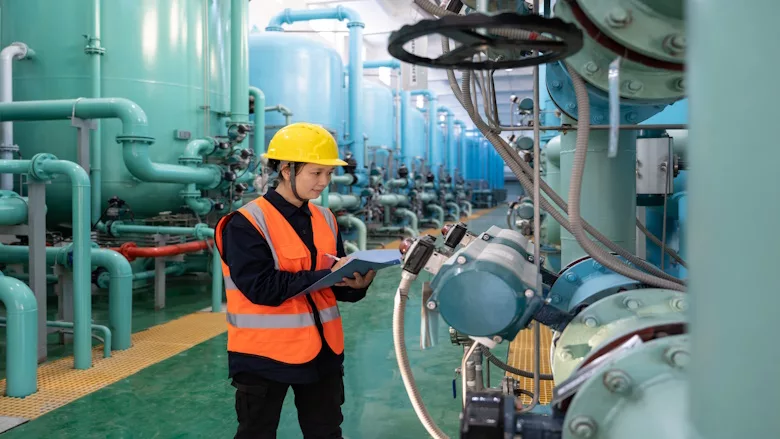
Photo credit: tianyu wu / E+ / Getty Images Plus
Twenty-five years ago, to mark the beginning of a new century, I wrote an article for ISHN called “Is industrial hygiene as you know it disappearing?” Consider this column the 25th anniversary sequel. The answer is yes, industrial hygiene is disappearing — as a term not as the traditional practice.
The term “industrial hygiene” (IH) has disappeared from many job titles and company departments, replaced by “occupational hygiene” in many cases, or “environmental health.” Today in most countries around the world the profession is known as “occupational hygiene.”
“The name (industrial hygiene) itself is not intuitive to people as to what we do,” says Nicole Greeson, president of the American Industrial Hygiene Association, which is now publicly known by its acronym AIHA. Greeson is director of the occupational hygiene and safety division at Duke University Health System.,
“I refer to myself as an ‘environmental health exposure assessment and control expert’,” says Mark Katchen, CIH. His career arc traces the evolution of the IH profession. He started as the principal industrial hygienist for a major energy company, acted as corporate director of health and safety for a major EHS consulting firm, and for 30+ years has been the founding managing director of The Phylmar Group®, a consulting, training and networking forum consultancy.
Rebranding campaign
The American Industrial Hygiene Association went through a multi-year rebranding exercise with assistance from a Chicago-based branding consulting firm, says Larry Sloan, AIHA’s CEO since 2016. “We held focus groups around the country, and everybody realized that the words ‘industrial’ and ‘hygiene’ are really limiting,” he says.
The association’s name hasn’t officially changed. Its website now describes AIHA as “the association for scientists and professionals committed to preserving and ensuring occupational and environmental health and safety (OEHS) in the workplace and community.” Absent are the words “industrial” and “hygiene.” A new AIHA logo is followed by the tagline, “Healthier workplaces, a healthier world.”
AIHA’s move is part of a larger pivot. A number of academic IH programs have been renamed as “occupational health,” “environmental health” or “occupational environmental health,” says Sloan.
“The trend in my field has definitely been toward identifying as occupational hygienists,” says Janet Keyes, CIH. The University of Minnesota program (where she received her degree) recently changed its name to occupational hygiene.
Confronting misconceptions
AIHA’s website includes a YouTube video, “The misconception that people have about industrial hygienists is that we’re glorified janitors.” It speaks to the identity confusion that has bedeviled the profession long before the article I wrote in 2000. “The term ‘hygiene’ may evoke thoughts of cleanliness or sanitation,” says Katchen. “This can lead to the misconception that industrial hygienists only deal with surface-level cleanliness, when in fact the field is highly technical and scientific, focusing on the identification, evaluation and control of environmental hazards.”
The second typical misconception: “You think of the word ‘hygienist, you think of a dental hygienist,” says Sloan. “I joke that the dental profession has a lock on the word ‘hygienist’.”
A broader role
A major factor behind the strict, narrow definition of industrial hygiene becoming less and less relevant is the evolution of the field into a broader professional model – beyond industrial workplaces and beyond traditional practices. “The modern role of an industrial hygienist is far more comprehensive than the name implies, encompassing a wide range of EHS concerns,” says Katchen. The role is now often multi-disciplinary, including broader environmental concerns, chemical management, ergonomics, heat illness prevention, infectious agents, indoor air quality, weather events, climate change, radiation, PFAS, wellness, mental health and total worker health.
“For many years now EHS professionals have been aiming to ‘send people home the same way they arrived.’ This is no longer enough to maintain and improve health and environment. We need to strive to ‘send people home better than they arrived,’ says Petya Georgieva, a regional EHS manager for a major battery manufacturer.
Still alive and well
Don’t let name changes and wearing multiple hats confuse you. The classic practice of industrial hygiene is very much alive and well. About one-third of AIHA’s approximately 8,500 members are consultants. Many are brought into companies to solve exposure problems using the fundamentals of anticipation, recognition, evaluation, control and confirmation of control strategies in the workplace. For example, companies with no in-house IH staff will call in a consultant when needed. Professionals carrying the Certified Industrial Hygienist (CIH) credential are more apt to practicing what might be called “legacy industrial hygiene.”
Fewer professionals today practice strict industrial hygiene because companies have been reducing EHS headcount for decades, again long before the ISHN article of 2000. “There is a reduction in the number of industrial hygienists that are being directly employed by industry,” says Sloan. “More companies these days are employing EHS generalists.”
“If you’re a publicly traded company trying to improve the bottom line, if you can get one person to be able to do three jobs, that’s much more efficient,” says one professional.
“The days of someone being strictly an industrial hygienist or strictly a safety professional are behind us. You need to be a subject matter expert in multiple fields,” says Tony Schwegmann, CIH, CSP, senior EHS regional manager for a national consulting firm.
“A significant need”
Industrial hygiene in 2024 is more interconnected than ever with holistic occupational and environmental health and safety programming, a collaboration that became much tighter during the Covid pandemic years. All professionals interviewed for this article believe an expanded model of industrial hygiene will continue to be practiced, if by fewer people. “There is a significant need for what we do,” says AIHA President Greeson.
Demand will grow as artificial intelligence produces reams of exposure-related Big Data requiring interpretation and analysis; industries such as biotechnology and nanotechnology expand; and issues such as sustainability, climate change, robotics and total worker health all increase demand for IH-related technical and communication skills. And there will still be a need for core IH practices of air quality monitoring, noise level assessments and chemical exposure management.
Industrial hygiene has not disappeared, it’s the name that you’ve known that has become increasingly outdated in the past 25 years.
Looking for a reprint of this article?
From high-res PDFs to custom plaques, order your copy today!