Supervisors Require Diverse Skillset to Manage Employees

Photo: aydinmutlu / E+ / Getty Images
An important element of organizational success depends on its employees’ effective and efficient performance of their assigned tasks. To put this into perspective, the ultimate goal of an organization is survival, and to accomplish this, the organization must produce something that people need and want, and must be able to produce this in a way that garners a reasonable profit. This is dependent on the customer’s satisfaction, which leads to loyalty, and retention. All this is dependent on the organization's ability to deliver on its promises.
Key to all this outcome is the dedication, engagement, capability as well as motivation of the organization's employees. This includes execution, conduct, achievement, in production, productivity, quality, safety, advocacy for the organization to name a few. The organization-employee relationship is symbiotic in nature. The employee needs the organization to provide it with a suitable job, which is relatively safe, interesting, meaningful, rewarding with sufficient compensation; and the organization needs dedicated employees who are engaged, diligently utilize the operational processes and systems, so as to efficiently produce a superior product or service.
Productive work environment
This requires that the organization hire people who are physically, cognitively, and emotionally compatible with the organizational values, processes and procedures, and who possess the personality with the appropriate mindset in order to properly “fit” in and function appropriately. Any shortcomings at point of hire should have been identified, or if not, there ought to be a process that addresses any shortcoming with the appropriate training, education, mentoring, coaching, constructive feedback, etc. in order to bring the employee up to minimum organizational expectation or standards.
To ensure the success of the employee, they should be assigned to supervisors who are effective leaders, supportive managers and who create a work environment which enables the workforce to function optimally and perform superlatively. To accomplish this the organization must create an empowering, enabling, and productive work environment, supported by integrated policies and procedures, facilitated by aligned operational systems and managed by supervision who act with integrity, exhibit appropriate leadership and people skills, emphasize supportive and trusting relationships, have an empathetic outlook, who are practical and innovative thinkers, have realistic expectations, as well as are especially able to coach, council, motivate and inspire excellence. Both the formal and informal organizational practices are generally reflective of the type of activity the organization engages in, as well as the culture and climate the leadership creates, encourages and supports.
Supervisory skills
A worker who is productive, engaged, motivated, does exceptionally well and shows initiative may be selected to become a (foreman) supervisor. However, to be a successful supervisor requires a different set of skills than those of a production worker. Unfortunately, in construction, the first line supervisors are not given much or even any formal training or education in the necessary required skills. The general expectation or belief is that they somehow will rise to the challenge and find, develop and hone those necessary skills within themselves as well as effectively utilize them.
Let's look at the mix of some key skills (technical, administrative and human relations) that workers, supervisors, and others in management positions require to function effectively. Since the supervisor will be supervising workers who may have technical skill deficiencies, the supervisor still needs technical skills to provide the worker with guidance and support. But to be an effective supervisor requires other skills that are equally or maybe more important. Some of these required skills are administrative and human relations, to name just a couple.
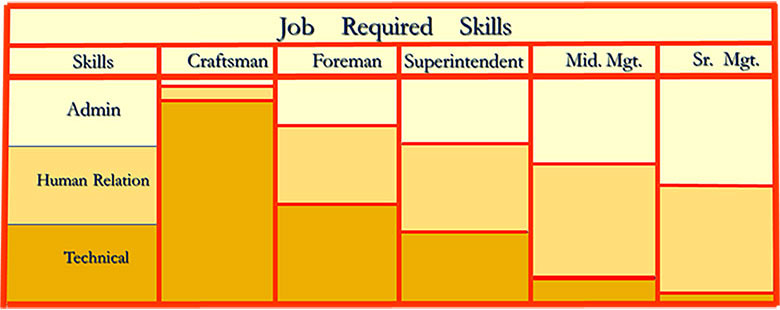
Graphic courtesy of Peter Furst
Aside from these skills the supervisor also must be able to establish a trusting, mentoring, and empathic relationship with all their direct reports. So, for the supervisor to be successful in his/her new position, it is incumbent upon management to provide the education and training required as well as oversight and guidance to make the new supervisor an effective member of the management team.
Enabling performance
A few of the practical steps the supervisor may take in order to enable the employee to perform their assigned tasks at their level best. This includes providing the required resources, reasonable but somewhat challenging goals, open lines of communication, an empathic work environment, support as required, furthering their growth and development. This not only represents the task design, and more importantly the alignment of the workers capabilities to the task demand.
Proper planning
The supervisor is responsible for operational planning. This can be a single use, or ongoing plan. The plan must ensure the timely availability of all the necessary resources, such as tools, equipment, material, information, etc. in order to enable the workforce to accomplish their tasks properly, safely, and expeditiously.
Efficacious organizing
Excellence in performance is achieved through a commitment to excellence, clearly stated purpose with lucidly articulated desired results, with open, timely, and multi-faceted communication, along with an open and supporting work climate. Ensure the worker’s skill matches the task demand. To achieve success, ensure that the worker is fully enabled, empowered, and supported.
Effective directing
Effective directing is greatly influenced by the quality of the Leader-Member exchange (LMX) relationship that develops between the supervisor and the employee. The degree of direction depends on the worker’s experience, knowledge and motivation. Some directing, guidance or support may become necessary due to changed conditions, developing situation, or new requirements.
Empathic communicating
Empathic communication (EC) is multi-dimensional and involves emotional, cognitive, behavioral, moral, communicative, and relational dimensions. Such an exchange is beneficial to both parties. EC requires both emotional intelligence as well as behavioral and character elements. Basically, EC requires recognition of when emotions may be present but not obvious or expressed directly. Inviting exploration of such feelings and effectively acknowledging the feelings so that the listener may feel understood. This greatly facilitates and enhances the exchange.
Motivation
Empowering the workforce to excel in their role creates a sense of ownership that will lead to meeting as well as exceeding expectations. This depends on having challenging as well as clear expectations, with attainable goals. Increase their freedom in self-expression and decision making. A positive work environment encourages new ideas, facilitates and fosters involvement, leading to success. Listening empathically, provides support, encourages innovation and recognizes as well as rewards accomplishment.
Problem solving or expediting
To keep the workflow in line with expectation, any and all barriers to goal achievement must be quickly identified, and effectively addressed.
Capable controlling
To avoid disruptions, or problems, supervision must ensure that all systems, processes, procedures and practices are functioning at their level best. One of the key elements is to assign the tasks to employees who have the knowledge, experience, capability, and motivation. Another important factor is to ensure that the task demand is in line with the worker’s capabilities. This means that there needs to be a mechanism to ensure this, which falls into the area of effective control.
There are many potential impediments to superior operational performance and exceptional project delivery. Some of the possible factors may include unreliable subcontractors, problems along the supply chain, a lack of skilled workers, appropriate project staff performance, inferior communication, unanticipated problems, conditions or situation beyond the general contractor’s control, excessive changes, unreliable cash and material flow, inappropriate information and/or resource flow, to name a few. This indicates that the organization must be ever vigilant to ensure that that they nip any and all deviations ‘at the bud’ before they become problems.
Conclusion
The supervisor plays an important role in ensuring that the workforce is productive, the work is going in place efficiently and the project is achieving, or better yet, exceeding performance expectations. To enable the workforce the supervisor must ensure that all the organizational policies, the operational systems, the project processes, procedures, and practices are in alignment, are supportive of worker performance, the necessary resources to perform the work is available in a timely manner. And more importantly as many of the impediments to performance are identified, addressed and resolved expeditiously.
To effectively lead and manage the workforce, the supervisor must gain their trust and respect in order to have influence. To effectively achieve this, the supervisor must demonstrate integrity, treat the workforce fairly, be empathetic and supportive. To lead effectively, the supervisor must also be able to motivate the workforce. To effectively motivate, the supervisor must understand and be sensitive to the needs of the workforce as well as provide guidance and coaching as required.
A supervisor’s view of human nature in general, and their typical attitude regarding workers behavior in particular; will critically impact the “quality” of their interaction with the workforce. This highlights the importance of management ensuring that they select a person for the supervisory position who general creates a positive work environment which is enabling, encouraging and supportive. So, in this respect, the supervisor's role becomes that of a mentor, coach, and facilitator who works toward supporting the employee in their goal attainment journey and serves as the enabler of their success.
Looking for a reprint of this article?
From high-res PDFs to custom plaques, order your copy today!