Implications of Employee Morale Significant for Safety Management

During lunch hour at a safety conference, I overheard a group of attendees discussing the importance of worker morale in managing positive safety (results) outcomes. There is no question in my mind that employee morale does in fact play a role in assisting an organization to achieve good to outstanding safety results. Such workplaces generally foster job satisfaction and are often rated by workers as preferred places to work.
Superior safety performance reduces worker compensation costs, which in turn improves a company’s bottom line. Higher employee job satisfaction and improved morale enhance productivity and efficiency as well as generate business value. When the workforce feels that they can trust the people they work with and for and that they are treated fairly by management, they tend to think of the organization as a good place to work. When the workforce perceives the work climate as being repressive, or unfair, they also generally have negative feelings about the organization. This invariably leads to higher turnover as well as making it difficult to recruit and keep competent people. All this is especially true of “high-risk” industries, which include construction.
Understanding Morale
There are many definitions for morale. One of the better ones is: “Morale is the extent and degree to which an employee exhibits a positive or motivated mental state. It can manifest itself in the exhibiting of pride in the organization, its values, vision and goals and a sense of shared purpose.” Morale is the outcome of employee satisfaction. Employees become satisfied with their jobs for a number of interlinked elements which are organizational factors, work environment and setting as well as job factors:
Organizational factors
- Workers get paid a fair wage with reasonable benefits
- They feel secure in their job
- The organization’s values are similar to the employee’s
Work Setting factors
- The work environment is positive, fair, and rewarding
- They have a constructive and trusting relationship with their supervisor
- They feel accepted by their coworkers
- There is open and constructive communication
Job factors
- They are empowered, enabled and supported in meeting expectations
- The work is interesting, challenging, and performance goals are reasonable
- They are treated equitably and fairly
- They are appreciated and valued
- There is potential for growth and advancement
Except for the organizational factors, the employee’s immediate supervisor has considerable impact over virtually all the other factors listed. So, organizations need to enlighten supervisors to all the means and methods under their control with which to affect worker job satisfaction thereby increasing their morale. This will lead to higher productivity, greater work output, better quality as well as improved safety. Employees expect a fair wage reflective of their efforts, reasonable benefit, a safe work environment, and to be treated equitably. This falls within the purview of the organization.
So obviously, employee morale is germane to a great number of organizational functions as well as outcomes. That being the case, then the important question is, how does an organization go about achieving high levels of employee morale so as to reap the benefits of outstanding operational as well as organizational performance? Unfortunately, many organizations seem to have a knack of somehow demoralizing and demotivating their employees (see research done by Dr. David Sirota and the Three Factor Theory of Motivation).
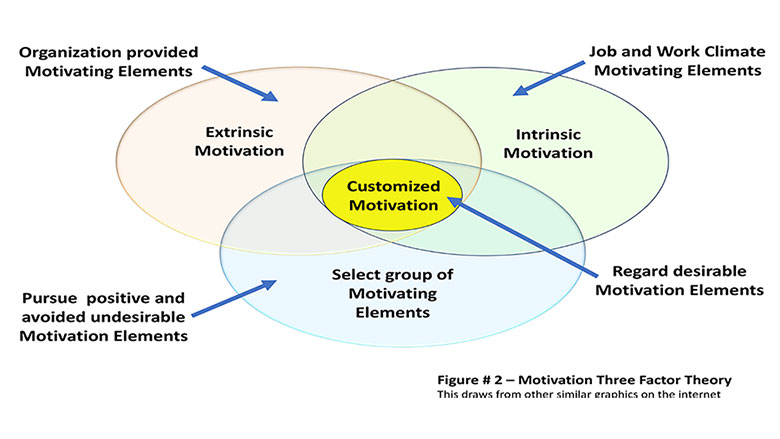
Graphic credit: Peter Furst
Undesirable Factors
David Sirota’s research involved over four million workers. He found that virtually every newly hired worker started off with high motivation and good morale. Organizations over time, due to inherent dysfunctions brought on by misaligned policies, procedures, and practices, create complexity, dysfunction, barriers, and confusion in the workplace. Unwittingly the immediate supervisor’s management style and treatment of the employees tended to demotivate and demoralize them. Demotivating factors include:
- Organizations focused on what they thought was important and ignored what may be important to employees.
- The supervisor leadership style
- Supervisors perceived as untrustworthy, inconsiderate, unfair, etc.
- Lack of support, inadequate information or resources and unrealistic goals, to name a few
- Supervisors play an incredibly important role in creating a positive work environment, devise an enabling, trusting and constructive relationship which enhances the building of employee morale. Such a work environment will lead the workforce to feel good, leading to greater engagement as well as job satisfaction.
Morale Improvement Factors
To effectively and holistically address employee morale requires the evaluation and revision of underlying aspects resulting in an organization-wide improvement initiative. The key aspects involve the following:
Organizational factors effect
Organizational culture creates a work climate shaping employee’s behavior, values, norms, beliefs, etc.
The basic recompense the employee receives for their performance and efforts.
Management factors
This represents the policies, practices, and procedures devised to direct and control the daily action and performance of the employees.
Shaping the employee’s perceived boundaries on their ability to excel in their jobs, achieve goals, aspirations, growth, and career outcomes.
Supervision factors have the greatest effect on the employee’s actions, and outcomes. Covering both the human and administrative aspects of the relationship between them.
The supervisory impact on the employee’s work environment includes: a trusting, friendly relationship, honest and open communication, constructive feedback, mentorship, respect, active listening, accepting of employee’s comments, suggestions and ideas, empowerment and some level of autonomy, etc.
The employee reaction shaped by the supervisor’s management style and interaction with the other employee will foster a positive perception of the work environment. They will feel valued, respected, and have a positive outlook on their growth opportunities.
The other employees factor
Involves interpersonal relationship between the employee and others. How well they get along, mutual trust and respect, willingness to help and/or support each other, etc.
These shape the employee’s sense of belonging and acceptance by peers. It also allows employees to evaluate their assessment of supervision or the organization by sharing information and thoughts.
The job factors
This involves task design as well as demand. These factors represent the basic elements of the work, such as the availability of relevant and timely information, required resources, achievable production goals, sufficient time to be able to safely complete the task, etc.
A match between the task demand and the employee’s capabilities
The supervisor and the other employee factors are linked when the employee works as part of a crew or team. Such situations affect work design and crew members' interaction, impacting performance by causing pressures or conflict. This may result in increasing or decreasing an individual worker’s morale, leading to deficient performance or potential for errors which may lead to lower quality or an accident.
Morale Improvement Strategy
Research on shaping morale indicates that the formative issues are varied and complex. Morale is influenced by a number of factors that can influence the employee emotionally as well as cognitively. It is a fact that high job satisfaction is crucial to fostering high morale. The organization’s policies, practices and procedures as well as management-employee interaction can create a culture that is open and friendly or restrictive and forbidding. This then shapes the worksite’s characteristics, sets the project tone, and goes a long way toward influencing an employee’s overall perception of the workplace, affecting job satisfaction as well as framing the employee’s morale.
Another important factor is the job design and demand including associated tasks, duties, responsibilities, working conditions, and requirements in order to achieve organizational as well as individual objectives.
Job design defines the methods to be used in carrying out the task, relating to techniques, systems, processes, and procedures as well as establishing the relationships that should exist between the jobholder, the superior and peers.
Job demand provides information on the necessary skills and competence required to effectively and efficiently perform the task. Ultimately, job demand attempts to create an alignment between the job requirements and available human resource skills, capabilities and attributes.
The jobs should be designed in such a way so as to motivate employees to execute tasks in the best possible manner. The design of the job has significant influence on productivity as well as job satisfaction. Poorly designed jobs often result in decreased productivity, boredom, leading to such negative outcomes as inattention, errors, poor quality as well as increased chances of accident, injuries and losses.
The most discernible factor influencing employee morale is the day-to-day interaction with their supervisor and the quality of that relationship. The supervisor needs to communicate openly, sympathetically, be attentive, show concern, be friendly and have an open-door policy. Allowing employees to “safely” express their opinion, respectfully taking their input into consideration, allowing some autonomy in their prosecution of the work, goes a long way in building job satisfaction. Supervisors utilizing the democratic style of leadership rather than the autocratic one were generally more effective in fostering high morale. generated higher production, with better quality, reduced work-related risk and greatly improved morale.
Conclusion
The examples discussed above tend to be more important in fostering job satisfaction, which leads to high morale, than some of the typical interventions such as providing a lunch cook-off once or twice during the life of the job or handing out dollar bills to one or two workers during a monthly site tour. Morale building factors should be perceived as genuine, meaningful, and given soon after something noteworthy occurring.
Looking for a reprint of this article?
From high-res PDFs to custom plaques, order your copy today!