The Appreciative Inquiry Index Offers Transformational Management Tool

To improve operational outcomes, businesses commonly focused on what was not working in order to “fix” them and so improve organizational results. Several popular methods such as Total Quality Management, Continuous Quality Improvement, the Balanced Score Card, and Appreciative Inquiry have been used to improve business outcomes. The Appreciative Inquiry (AI) Model was influenced by numerous research studies of positive outcomes in the fields of sports, medicine, and behavior science.
The Appreciative Inquiry Theory (AI) was developed in the mid-1980s from an earlier research study of physician leadership in one of the highly regarded medical centers in the United States. Physicians were asked to describe their successes and failures. Their responses painted a picture of amazing cooperation, incredible innovation, superior involvement, and fair-minded execution when they were most effective. The resulting findings developed into the Appreciative Inquiry Model for a successful change initiative implementation and management.
The Basics of AI
The AI model has developed into one of the more influential means for positive organizational change and development. Antithetical to the traditional problem-solving approaches where management determined that some problems have become intolerable and deciding to change things. Strating by identifying causes, followed by listing possible solution, selecting the “best” solution to replace the deficient process, practice or procedure.
AI views organizational issues and concerns in a significantly different way. Rather than a focus on fixing problems, management looks at well working processes and envisions innovative means and methods resulting in far superb results. These changes are then implemented.
The AI Method
It was David Cooperrider who devised AI which rested on four principles. Strating with appreciation, done collectively, provocatively and it should be applicable. These general philosophical underpinnings resulted in various ways of performing AI.
- Inquire — Analysis to identify the best of what exists
- Imagine — A vision of what is possible
- Innovate — Consent through collaborative dialog about what should prevail
- Implement — Collective analysis of what improvement can be achieved
It wasn’t until 1997 that the 4 I model of AI was created. The general, outline of the four I’s included Inquire, Imagine, Innovate and Implement.
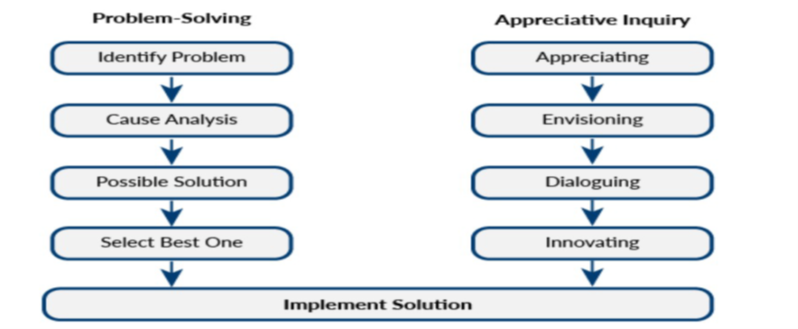
Chart credit: Peter Furst
Inquire
The process starts by identifying the “best of what is occurring” in the organization’s operations. This involves their systems: policies, protocols processes, procedures, or practices that were driving good results, but could be best in class. The results are carefully analyzed to identify “better” ways to achieve more desirable outcomes. This engages all participants as both interviewer and interviewees on the act of inquiry.
Imagine
The second phase involves imagining “what might be” (the very best state) of the function or outcome under consideration. This is then articulated as clearly as possible
Innovate
This phase shifts from imagining to creating. Encourage the participant to create or design an organizational or operational system, which support the “dream” as defined in the previous step. This required the development of concrete proposals involving the means and methods to create the desired future state.
Implement
Its aim is to sustain the developments and innovations of the inquiry process and to nurture a collective sense of destiny. In this phase everyone makes a commitment to devise a practical means to enable the transition of the design to fruition.
The organization’s leadership must support encouraging and enabling the people in the AI process as well as ensuring all the people in the organization are actively engaged in the deployment and successful implementation of the desired changes.
AI’s Effect on Participants
A positive relationship evolves when people participate in the AI process in order to achieve improvement of organizational outcomes was confirmed by research. Participation fosters personal as well as organizational power, which drives excellence. It can involve one or all of the six defined freedoms listed.
- To be positive
- To act
- To contribute
- To be heard
- To conceptualize
- To excel in relationship
Any one or all of the six freedoms can significantly change people’s perception of their power within the team as well as the organization at large. People learn, grow, gain confidence and become more effective in contributing toward the betterment of the organization as a whole. The AI process is capable of transforming personal and collective realities than many other organizational change processes.
This is significant because what is in the process of changing are the core assumptions the people held about the norms, beliefs or values — both theirs as well as the organization. AI causes people to stop thinking in the traditional way and results in participants finding means and methods to transform their processes, practices and/or procedures. AI can also become transformational and cause culture change.
Ensuring the AI Process Success
Commencing with a compelling objective is crucial if management is going to take a dozen or more people offsite for several days to participate in this event. Management must assign an AI champion to ensure that the group’s mission is clearly understood and that innovative thinking is valued as well as provide the necessary oversight and guidance, support and encouragement if necessary, so as to facilitate engagement, remove barriers and ensure success.
One of the common concerns is how broad the scope of the topic should be. Obviously, this depends on a number of factors. Generally, a narrow scope tends to be more effective in getting to some tangible results in a reasonable time. It is also possible that during the interviews scope creep occurs through the introduction of related functions or factors. Another reason is that as the topic grows broader the harder it is to be specific about the desired outcomes.
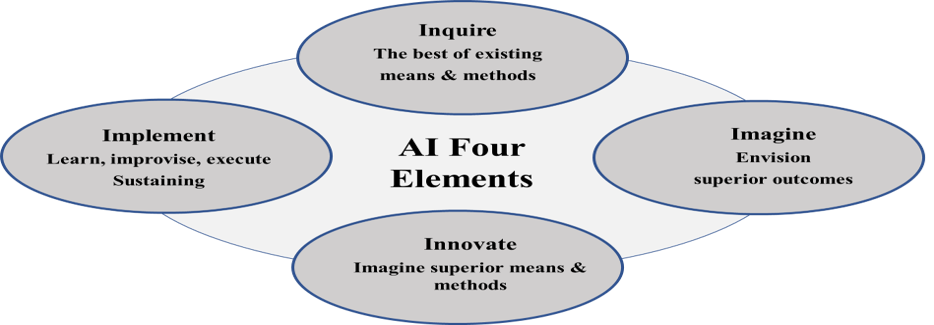
Chart credit: Peter Furst
Train a core team
To run successful AI summits requires that some of the participants have prior experience to be able to provide guidance and support to the rest or the champion must intercede. It will also require people working in the departments where the improvement (change) is required, for their intimate knowledge of operations and challenges, for their input. There will be situations necessitating the running of an AI summit with a large number of people which requires a lot of preparation and planning. The core team will require formal training as well as some practical experience in order to facilitate expanding the AI process successfully throughout the organization. The responsibilities of the core team will include:
- Acting as internal champions of the AI process
- Supporting the AI teams in their improvement summits
- Providing guidance in mini problem-solving situations
- Interfacing and communicating with the organization at large
Obviously selecting the “right” people for the core team is important. They have to have some leadership qualities, enjoy working with people, relish learning, problem solving and motivated to improve operational processes, as well as organizational outcomes.
The AI Means and Methods Design
The AI inquiry process requires agreement on the topic to establish the focus of the summit. This is then followed by devising the questionnaire to guide the fact-finding process. This starts off with a set of generic question regarding the general positive experiences at work. The next set of questions revolves around the summit’s topic.
This then is followed up with open ended questions focused on deveining what the ideal state night look like, or how superior outcomes might be achieved. The number of question as well as the number of people interviewed depends on a number of factors. The number of questions depend on the complexity of the system or function, the diversity of applications or usage, as well as its significance or importance to the organization’s performance.
Safety and AI
Research has shown that engaged employees tend to have fewer accidents due to their greater level of involvement which is an indirect benefit of applying AI thinking to organizational systems as well as operational practices and procedures. The application of AI thinking to safety management means and methods will identify best practices and engage the workforce in devising innovative ways to improving their utilization as well as outcomes.
AI thinking will also foster greater acceptance and usage of preventive means and methods by the workforce in their daily activities. Areas where AI thinking may be pivotal in improving safety results include the following:
- Accident investigation
- Education more than training
- Task design to address risk
- Task demand to match capabilities
- Performance expectations
- Communication
Research has shown that AI thinking fosters exciting transformations in the way people work together and the results they achieve. It has the potential to lead to greater innovation, higher productivity, safer work, better communication, employee satisfaction, and organizational profitability. All of this has a positive effect on people interacting, listening to one another and looking out for each other, which directly impacts how safety is treated, accepted and promoted in the organization.
Conclusion
The AI process is a change philosophy and methodology which carries the best of the past forward and improves its outcomes to the best imaginably possible. This harnesses the people’s power of unconstrained imagination. This creates a process for change that distills the best of the past with possibilities for potential future enhancements. The desire for an improved future creates a tension which motivates action.
Looking for a reprint of this article?
From high-res PDFs to custom plaques, order your copy today!