Well suited to respond
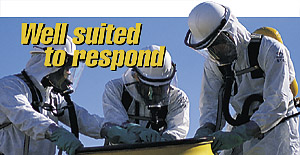
An emergency response hazmat team is called to an incident that may involve dual-use industrial chemicals or chemical or biological terrorism agents. One of the first concerns of an emergency response incident command leader is: Does the team have the appropriate level of protective clothing for the intended operation?
Here is where experience, judgement and professional knowledge kicks in. Selection must be based on an evaluation of the performance characteristics of the protective clothing relative to the requirements and limitations at the incident scene, the task-specific conditions to be encountered by responders, and the hazards and potential hazards identified at the incident site.
When intentional, criminal release of chemical/biological agents is involved, ensembles manufactured and independently certified to NFPA 1994, Protective Ensembles for Chemical/Biological Terrorism Incidents, should be used. The NFPA 1994 standard addresses three levels of protective ensembles that may be selected based on performance requirements. (Note that the requirements stated in NFPA 1994 are based on a single exposure wearing of the protective ensemble for such chemical/biological terrorism incidents. The ensemble consists of garments, gloves and footwear approved as a system.)
Class 1 - for the unknown
A Class 1 ensemble shall be used for chem/bio terrorism incidents where:
- The vapor or liquid is unidentified or the concentration is unknown; or
- Exposure will result in the substantial possibility of immediate death/serious injury/illness; or
- The ability to escape from the scene will be severely impaired.
Scenarios may involve a responder likely to be stepping over deceased, or victims are unconscious or not symptomatic, and not ambulatory. Class 1 ensembles are intended for the worst-case circumstances, where the substance involved creates an immediate threat, where there is still an ongoing release with likely gas/vapor exposure, and the responder is close to the point of release. Stay times in the hazard zone are likely to be short and limited to breathing air available from a self-contained breathing apparatus (SCBA).
Controlled laboratory tests have been specified in the requirements for NFPA 1994 Class 1 ensembles in order to determine compliance with performance requirements. Designed to offer the highest level of protection, Class 1 ensembles must meet performance requirements when tested by the certification organization. Class 1 ensembles shall:
- Provide gas-tight integrity by passing an inflation test (with the exhaust valves plugged).
- Show very low levels (less than 0.02 percent) for penetration of surrogate gas during an inward leakage test involving a human test subject exercising while wearing the ensemble.
- Use materials (garment, visor, glove, footwear and seams) that provide the highest level of permeation resistance against chemical warfare agents as well as toxic industrial chemical liquids and gases.
- Use garment, glove and footwear materials that possess relatively high levels of physical hazard resistance (to abrasion, tearing, punctures and cuts).
Class 2 - intermediate
The NFPA 1994 Class 2 ensembles are an intermediate level protection from harmful vapors and liquids and are designed to protect emergency responders where a risk assessment of the incident indicates that victims at the scene are alive but not ambulatory and are symptomatic, and the potential for direct liquid droplet or aerosol contact is probable. Conditions of exposure include possible contact with residual vapor or gas and highly contaminated surfaces.Use of Class 2 ensembles at the emergency scene is appropriate where the agent or threat may be identified, when the actual release has subsided, or in an area where live victims may be rescued. Emergency responders will be limited by their SCBA breathing time, however powered air purifying respirators (PAPRs) may be used in certified ensemble configurations.
Testing performance requirements of the Class 2 ensembles are:
- The ensembles must show no more than 2.0 percent leakage of the outside environment into the ensemble as demonstrated by the same surrogate gas test described for Class 1 ensembles.
- The ensemble must also pass a "shower" test that shows that the suit will not allow any penetration of liquid when sprayed from several directions.
- The materials used in the Class 2 ensembles, gloves and footwear must demonstrate permeation resistance to chemical warfare agents and liquid/gaseous toxic industrial chemicals. However, lower concentrations of these chemicals are used in testing as compared to Class 1.
- Class 2 garment, glove and footwear materials must still be rugged but at lower physical property levels compared to Class 1 ensembles.
Class 3 - on the periphery
Protection from liquids at a chem/bio incident are provided by NFPA 1994 Class 3 ensembles. These ensembles are intended for use long after the release has occurred, at relatively large distances from the point of release, or in the peripheral zone of the release scene for such functions as decontamination, patient care, crowd control, perimeter control, traffic control and cleanup. A risk assessment of the scene indicates that victims are impaired or symptomatic, but ambulatory, and the potential for direct liquid droplet or aerosol contact by the emergency responder is possible.
Class 3 ensembles should only be used when there is very little potential for vapor or gas exposure, exposure to liquids is expected to be incidental through contact with contaminated surfaces, and when dealing with patients or self-evacuating victims. The use of air-purifying respirators (APRs)
is likely.
Enhancing the standard
The NFPA 1994 standard is currently under review by an NFPA Technical Committee. Ensembles have been out in the field since early this year, and both manufacturers and the NFPA have received input from responders on ways to enhance the standard.Feedback on needs of the response community can be provided to NFPA at www.NFPA.org. To obtain information on ensembles certified to NFPA 1994, please visit the Web sites of the certification organizations: www.SEInet.org and www.ul.org.
Looking for a reprint of this article?
From high-res PDFs to custom plaques, order your copy today!