ISHN logo
search
cart
facebook twitter linkedin youtube
  • Sign In
  • Create Account
  • Sign Out
  • My Account
ISHN logo
  • NEWS
    • Today's News
    • Global Safety News
    • Government Regulations
  • PRODUCTS
    • Product Innovations
    • Featured Products
  • TOPICS
    • Environmental Health and Safety
    • Facility Safety
    • Workplace Health
    • Occupational Safety
    • PPE
    • More Topics
  • CONSTRUCTION
  • TECHNOLOGY
  • COLUMNS
    • Best Practices
    • Dave Johnson: What’s going on
    • Editorial Comments
    • Leading Safety
  • MULTIMEDIA
    • ISHN Podcast
    • Videos
    • Cold Stress Education Quiz
    • Webinars
    • White Papers
  • MORE
    • Buyer's Guide
    • Newsletters
    • Convention Companion
    • Polls
    • Events
    • ISHN Store
    • Sponsor Insights
  • EMAGAZINE
    • eMagazine
    • Archived Issues
    • Contact
    • Advertise
  • JOIN TODAY!
Columns

MANAGING BEST PRACTICES: Setting risk response priorities
August 1, 2004
Table 1
Risk is the likelihood that a hazard may cause harm or create an unwanted condition. Or viewed as an equation: risk = probability x severity.

One purpose of a risk assessment is to establish priorities — what risks must we deal with now, and what risks should we address as time permits?

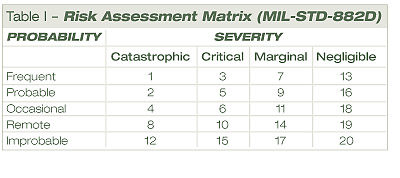
A risk assessment matrix is a tool that can be used to help quantify a risk assessment and establish priorities. Table I is an example of a risk assessment matrix specified by the Department of Defense’s Standard Practice for System Safety. See http://akss.dau.mil/docs/ 882d.pdf.

The matrix shown in Table I breaks down probability and severity into manageable categories. Each cell — such as “frequent and catastrophic” — in the matrix is provided a number. These numbers characterize the overall risk for an identified hazard. The numbers may be combined to further categorize risk. For example, numbers 1-5 may be called “high” risk; 6-9 “serious” risk; 10-17 “medium” risk; and, 18-20 “low risk.”

The groups of numbers within the table can also be shaded with colors to further visualize risk. Generally, high risk is red; serious risk is yellow; medium risk is orange; and, low risk is green.

Table 2

Matrix design

The first step in developing a risk assessment matrix is to have a team agree on its design and intended use. For example, Table I has 20 cells to score risk. Would 40 cells be better? Probably not, as too many cells complicate the process. A team, however, must decide on the matrix’s functionality and ease of use.

The team must agree on definitions for words or terms used in the matrix. Tables II and III are examples of matrix summary definitions.

Table 3

Response

A major purpose of a risk assessment matrix is to determine response based upon where a hazard is ranked. Table IV provides an example of how this may be done.
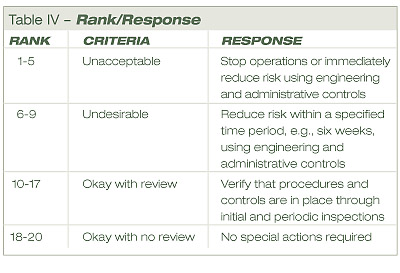
Table 4

Integration

A risk assessment matrix is generally not a stand-alone tool. The matrix usually supplements other hazard and risk assessment tools such as Hazard and Operability Study (HAZOP), Failure Mode and Effects Analysis (FEMA), and Fault Tree Analysis.

Hazard and risk assessment tools should be integrated because no tool alone may be fully effective in determining adequate response to risk, particularly when a risk may be complex and involve numerous variables.

Qualitative vs. quantitative

All risks are initially determined by perception. Skilled professional judgment may narrow the perception but subjectivity is still at play. The risk assessment matrix takes something that begins mostly as a qualitative process and makes it more quantitative. Management of risk is made more comfortable when numbers are applied.

But herein lies a problem. In attempts to make a risk assessment matrix more quantitative, some designers add 50 or more cells (beyond 24 is probably too many). They have lengthy definitions for words and terms used with the matrix, or they employ complex equations and other actions to remove cells to devise “iso-risk contour” lines, etc. These actions may not improve the matrix and may give a false sense of security.

An effective risk assessment matrix should be easy to understand, have clear objectives and purpose, and not require extensive technical risk assessment knowledge or skills to use. The primary objective for a risk assessment matrix is to effectively prioritize response to risks. When this is done properly it is easier to discuss — and visualize — risks with employees or managers and get buy-in on how quickly or deliberately risks should be controlled.

Share This Story

Looking for a reprint of this article?
From high-res PDFs to custom plaques, order your copy today!

Recommended Content

JOIN TODAY
to unlock your recommendations.

Already have an account? Sign In

  • forklift safety

    Exploring the latest technologies in forklift safety

    With more staff and more stock in warehousing now more...
    Workplace Training Strategies
    By: Josh Cramer
  • welding

    All about welder’s flash or arc eye

    A flash burn is a painful inflammation of the cornea,...
    Environmental Health and Safety
  • dangerous jobs

    The 10 most dangerous jobs in the U.S.

    On-the-job deaths have been rising — hitting the highest...
    Construction Industry Safety and Health
    By: Benita Mehta
Manage My Account
  • eMagazine Subscriptions
  • ISHN Newsletter & Other Newsletter Alerts
  • Online Registration
  • Manage My Preferences
  • Subscription Customer Service

More Videos

Sponsored Content

Sponsored Content is a special paid section where industry companies provide high quality, objective, non-commercial content around topics of interest to the ISHN audience. All Sponsored Content is supplied by the advertising company and any opinions expressed in this article are those of the author and not necessarily reflect the views of ISHN or its parent company, BNP Media. Interested in participating in our Sponsored Content section? Contact your local rep!

close
  • man wearing the the Sundström SR200 Full Face Mask Respirator
    Sponsored byOHD

    5 Fit Testing Mistakes That Could Cost You

  • This image shows Magid AcuSpex polarized blue mirrored safety glasses.
    Sponsored byMagid Glove and Safety

    Construction PPE Guide: What Crews Need for Each Task

  • lone worker in confined space
    Sponsored byAlphasense Ltd.

    GET THE LEAD OUT of your Safety Oxygen Sensors!

Popular Stories

SpaceX 7 launch

OSHA Investigating Fatal Fall at SpaceX Starbase

Automated loading dock equipment

After March 2026 Rivian Death, Safety Managers Reassess Loading Dock Systems Under OSHA's Warehouse Emphasis Program

psychology in the workplace

Most Workplaces Measure Psychological Safety, Ignoring Psychosocial Risks

top 10 most dangerous jobs

Poll

Seasonal Readiness

With the federal heat stress prevention rule on the horizon, which area of your safety program needs the most attention?
View Results Poll Archive

Products

Surviving an OSHA Audit A Management Guide, 2nd Edition

Surviving an OSHA Audit A Management Guide, 2nd Edition

See More Products

ISHN Podcasts

Related Articles

  • MANAGING BEST PRACTICES: How to implement best practices

    See More
  • MANAGING BEST PRACTICES: Risk management for your career

    See More
  • MANAGING BEST PRACTICES: How to talk about risk

    See More

Related Products

See More Products
  • 1119906652.webp

    Alive and Well at the End of the Day: The Supervisor's Guide to Managing Safety in Operations, 2E

  • 9781482217148.jpg

    Fall Prevention and Protection: Principles, Guidelines, and Practices

See More Products
×

Become a Leader in Safety Culture

Build your knowledge with ISHN, covering key safety, health and industrial hygiene news, products, and trends.

JOIN TODAY
  • RESOURCES
    • Advertise
    • Contact Us
    • Directories
    • Manufacturing Division
    • Store
    • Want More
  • SIGN UP TODAY
    • Create Account
    • eMagazine
    • Newsletters
    • Customer Service
    • Manage Preferences
  • SERVICES
    • Marketing Services
    • Reprints
    • Market Research
    • List Rental
    • Survey/Respondent Access
  • STAY CONNECTED
    • LinkedIn
    • Facebook
    • YouTube
    • X (Twitter)
  • PRIVACY
    • PRIVACY POLICY
    • TERMS & CONDITIONS
    • DO NOT SELL MY PERSONAL INFORMATION
    • PRIVACY REQUEST
    • ACCESSIBILITY

Copyright ©2026. All Rights Reserved BNP Media, Inc. and BNP Media II, LLC.

Design, CMS, Hosting & Web Development :: ePublishing