AEDs come of age in the workplace
Each year more than 250,000 people in the United States experience Sudden Cardiac Arrest (SCA). In the workplace, SCA represents 13 percent of deaths at the rate of over 400 worker deaths per year. This number does not include the hundreds of workplace visitors and customers who are also victims of SCA.
All too often, Sudden Cardiac Arrest is a fatal event. Nationally, successful resuscitation of SCA victims in the out-of-hospital setting is less than 5 percent. But technology now available in the workplace may provide the hope of greatly reducing these numbers. Automated External Defibrillators, or AEDs, are devices that can be used by non-healthcare providers with minimal training and have the potential to greatly increase the victim's chance of survival.
SCA can strike without warning, often affecting individuals where sudden death was least expected. Different from a heart attack, SCA means the person's heart has stopped beating and they are no longer conscious, breathing or have a pulse.
While there are many risk factors that may predispose a person to being a candidate for SCA such as smoking, obesity and high blood pressure, many SCA victims were previously considered healthy. So it's difficult to predict whom SCA will strike.
In December 2001, OSHA released Technical Information Bulletin 01-12-17 on "Cardiac Arrest and Automated External Defibrillators." OSHA concluded that worksite AED responder programs could save as many as 160 worker lives per year.
Time is critical
When a person suffers SCA, time is the biggest enemy to a successful resuscitation. Typically the person's heart goes into a chaotic beating pattern called ventricular fibrillation that produces no pulse or blood flow. What's needed is a special electrical shock designed to allow the heart to reorganize its own electrical activity and return to a normal beating pattern. This shock is called a defibrillation.For each minute the person remains in cardiac arrest, the odds of survival go down 7 percent to 10 percent. A delay of just five minutes in delivering the defibrillation means a reduction in survival percentages of up to 50 percent. Delays of ten minutes or greater mean the chances of survival are next to nothing.
AEDs represent great hope in reversing the dismal survival statistics for SCA by placing lifesaving therapy in the hands of coworkers who can respond quickly in the event of this often lethal emergency. As part of a complete emergency response program - called the "Chain of Survival" - that includes notification of 911 or other local emergency resources, initiation of basic life support or CPR, and implementation of advanced life support procedures by paramedics or hospital personnel, the AED has the potential to become a valuable workplace lifesaving device.
In one of the most dramatic studies of AED effectiveness, security officers in several casinos in Nevada and Mississippi were trained on how to operate the AED and perform CPR. In the 148 SCA events they responded to during the study period, 56 (38 percent) survived. While that number was much higher than national averages of less than 5 percent, they found that when the AED was used within three minutes of the victim's collapse, the survival rate was an amazing 74 percent.
Simple to use
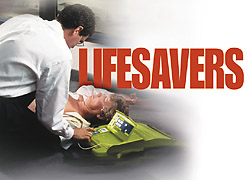
Although AED technology has been available for about a decade, what's new is the realization of how effective it can be when applied in SCA events. The device works by attaching two electrode patches to the victim's chest and allowing the AED to automatically analyze the victim's heart rhythm to see if ventricular fibrillation is present. If this rhythm is found the AED will automatically charge to the proper power output level and the rescuer will discharge the electrical shock with the push of a button.Simple in its design, an AED is made for the layperson to use. Audio or text messages inform the rescuer what to do next. The patches feature easy-to-follow diagrams of where and how to place them.
The rescuer's role does not involve any critical medical decision-making on operating the AED. The clinical decisions for appropriate use of the defibrillation therapy are made by the device itself using diagnostic software.
AEDs are available from several different manufacturers. Depending on options selected, prices for a fully equipped unit range from $1,500 to $3,500.
Training for AED rescuers can be completed in three to four hours and can often be incorporated into regular first-aid training for workplace emergency response team members or others involved in workplace disaster or emergency actions. Training is available from several organizations such as the American Heart Association (www.americanheart.org).
Limiting risk
Public Access Defibrillation (PAD) programs are built to support lay-responders in using AED treatment on patients in SCA. Many states have enacted liability protection laws that protect users, employers and trainers when an AED is used.One part of many of these laws is the requirement for a PAD program medical director. This physician is responsible for ordering the device (in most cases a physician order or prescription is required), approving the training program and being available to review uses of the AED for quality improvement purposes.
Maintenance is minimal as most AEDs have built-in diagnostics with easy-to-read visual indicators of unit readiness. Battery life is often greater than three years.
If PAD programs are implemented on a nationwide scale in both public places and the workplace, the American Heart Association predicts the potential to save 50,000 lives per year. Already, many programs such as the Chicago HeartSave Program in that city's airport system have saved numerous lives. Other programs based in police and fire departments as well as shopping malls, sports arenas and golf courses have also saved hundreds of lives.
With state liability protections in place for AED use, risks are limited. In fact, a growing number of legal experts cite developing case law that indicates the potential for increased liability for not having an AED program in place.
Making a difference
While AED use is, fortunately, not an everyday occurrence at most workplaces, having an AED available for what is usually a fatal event gives employees and employers some ability to make a difference. An AED provides the workplace with some insurance against potential tragedy, much in the same way sprinkler systems protect against potential fire.Nationally, many organizations such as the American College of Occupational and Environmental Medicine and the Building Operators and Managers Association have supported PAD program development.
Workplace AED programs can and will make a difference in many people's lives over what once was an almost always tragic outcome.
SIDEBAR: Sudden Cardiac Arrest vs. Heart Attack
Sudden Cardiac Arrest (SCA)The victim:
- is completely unresponsive
- is not breathing
- has no pulse or signs of circulation
- has poor skin color
Emergency treatment:
- Airway - open the victim's airway
- Breathing - provide mouth-to-mouth or mouth-to-mask ventilations
- Circulation - start chest compressions
- Defibrillation - use an AED to determine if a shock is needed
The victim:
- is most often awake
- is still breathing
- still has a pulse and other signs of circulation
- is experiencing chest pain or pressure that may extend into the arms, back or neck
- may have a cold sweat or nausea
Emergency treatment:
- call 911 or your local EMS number
- keep patient comfortable
- know how to do CPR in case victim goes into cardiac arrest
Looking for a reprint of this article?
From high-res PDFs to custom plaques, order your copy today!