The two faces of Cal/OSHA
The California Division of Occupational Safety and Health — Cal/OSHA — leads a schizophrenic existence.
On one hand, the agency is considered by many to be the “premier state plan” among the 21 states with state OSHAs, frequently leading the way nationally with new regulations and approaches to workplace safety.
On the other hand, the agency has been so starved of political support and resources over the last decade — by politicians from both parties — that it more resembles a “98-pound weakling” rather than a “heavyweight champion” hero rushing to the rescue of the state’s 17 million workers.
The malign neglect of Cal/OSHA mirrors the national pattern of anti-regulation politicians undermining regulatory enforcement agencies by keeping them under-resourced, under-staffed and over-whelmed so that no matter how strict the laws, actual enforcement barely lands a punch. This is a cautionary tale for other state plans and Fed OSHA itself — if it can happen in California, then it can happen anywhere.
Ergonomics standard — “Only in Californiaâ€
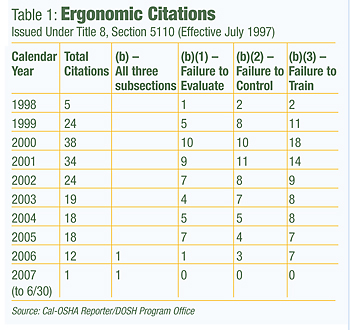
In July 1997, California became the first and only state in the nation to regulate ergonomic hazards — the leading source of occupational injuries in the U.S. — and to require employers to identify, evaluate and control these hazards, and to train employees.The actual enforcement of the ergo regulation, however, has been almost invisible, as indicated by Table 1. There are more than one million work sites in California, but ergo enforcement maxed out at 38 citations in 2000, and has been on a steep decline ever since.
There are several reasons for the non-enforcement of the ergo standard. One is the daunting threshold that must be met before the regulation even applies. Second is that Cal/OSHA must prove that any required ergonomic controls are both economically and technically feasible for the employer who is cited. Both of these requirements make ergo inspections very labor-intensive and time-consuming — a problem both for individual inspectors and for the agency.
A third reason is that in March, 2006 Cal/OSHA essentially abolished its Medical Unit, critical for evaluating whether the regulation’s threshold has been triggered. In 1975, Cal/OSHA had seven physicians and three nurses on the payroll. In 2007, there is one nurse in southern California and no physicians anywhere.
New regs for new hazards
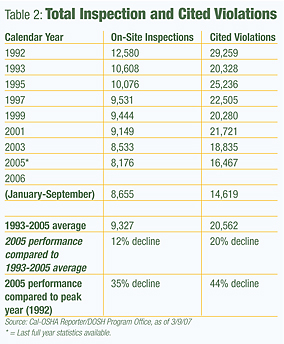
To its credit, Cal/OSHA is way ahead of Fed OSHA in addressing newly recognized hazards such as diacetyl exposures (“popcorn lung”) with an accelerated standard-setting process as well as diacetyl-related enforcement inspections and citations. Cal/OSHA has an outdoor heat illness standard on the books — after a wave of farmworker fatalities in 2005. The division regularly updates its permissible exposure limits for chemicals — Fed OSHA is still using its original 1970 exposure limits — and has revised a wide variety of regs from lockout/tagout to grain handling procedures to laboratory hoods.But what is offered with one hand is taken away with the other, as Cal/OSHA’s enforcement performance of all regulations has been in a steady decline for 15 years, as documented in Table 2.
Both the number of on-site inspections and of cited violations has slowly but surely declined from the 1992 peak. In 2005, the last year when complete statistics are available, there was a 12-percent decline in the number of inspections and a 20-percent decline in citations issued compared to the 1993-2005 average. The 2005 performance represented a 35-percent decline in inspections and a 44-percent decline in citations from the 1992 peak figures. Preliminary figures for Cal/OSHA’s 2006 performance indicate an up-tick from 2005, but still below the 1993-2005 average levels.
Worse yet is that Cal/OSHA does not verify abatement or correction of many of the citations that it does issue — arguably the most important function of the agency. For the federal fiscal year that started in October 2006, Cal/OSHA district offices have verified only 61 percent of private sector citations as abated, with a 75 percent verification rate for public sector employer corrections. Some of Cal/OSHA’s 23 enforcement offices have hazard correction verification rates as low as 50 percent.
Protecting immigrant workers
Cal/OSHA’s parent agency, the Department of Industrial Relations (DIR), issued a courageous policy following the 2002 U.S. Supreme Court’s Hoffman Plastics decision that stated that undocumented immigrant workers do not qualify for workers’ compensation benefits. DIR stated that all workers in California — with or without immigration papers — “are protected by state laws regulating wages and working conditions” and that DIR agencies “will not question workers about their immigration status.”Cal/OSHA has also established a special “Economic & Employment Enforcement Coalition” (EEEC) with other state agencies to enforce wage, hour and safety regulations in the “underground economy” employing vulnerable, low-wage workers in agriculture, construction, garment sweatshops, car washes and restaurants.
Unfortunately, these important initiatives are undermined by under-staffing — the EEEC Unit has only ten inspectors state-wide — and the numbers of inspections in the target sectors has also been on the decline from peak levels earlier in this decade.
Moreover, there is a lack of language resources within Cal/OSHA. An estimated 4.5 million of California’s 17 million workers do not speak English, making a multilingual inspectorate essential for interacting with these workers as accident victims, witnesses and complainants. Yet Cal/OSHA only has 30 field inspectors able to speak a language other than English.
Lack of political will & sufficient resources
Underlying all of Cal/OSHA’s problems is a clear lack of political will on the part of the state’s executive and legislative branches, and the resulting lack of financial and human resources. Democrat and Republican politicians alike have left Cal/OSHA high and dry.Cal/OSHA has not had a chief for more than five years, since John Howard left to lead NIOSH in July 2002. Acting chief Len Welsh has been “in charge” but also in political limbo for more than four years. The deputy chief for health position has been completely vacant since November, 2001. The last time Cal/OSHA had all three key chief/deputy chief positions filled was in October, 2001.
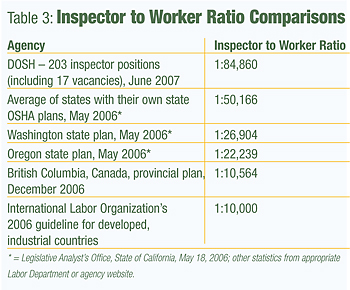
The vacant leadership positions reflect the severe under-staffing of Cal/OSHA’s field enforcement units as a whole. There were 186 compliance officers in the field in June, 2007, to cover more than 17.2 million workers in more than one million workplaces throughout the state. There are more Fish & Game Wardens (200 wardens) working in the field in California than there are Cal/OSHA compliance officers.
Table 3 shows how under-staffed Cal/OSHA is in comparison with other states with their own state OSHA plans, and Canada puts the Golden State to shame. Surely workers in California deserve the same level of protection that workers in Oregon, Washington and British Columbia enjoy. Yet in July, 2006, Governor Arnold Schwarzenegger vetoed a very modest $1.5 million budget item approved by the legislature to hire an additional 15 Cal/OSHA compliance officers as “unnecessary.”
The lack of enforcement personnel means longer delays in responding to worker complaints and accidents; less thorough inspections when done, and less time in verifying correction of cited hazards. Because of under-staffing in the 19 district offices, specialized units of Cal/OSHA, such as the High Hazard Unit, have been pulled away from their programmed inspections to conduct accident and complaint inspections that should be done by the district offices.
Another marker of lack of political will is that the appeals process has been allowed to descend into crisis. There is now more than a two-year backlog of employer appeals of citations, meaning that a hearing on cites issued tomorrow will not be held for at least two years, and often closer to three years.
This “justice delayed is justice denied” scenario makes it very difficult for Cal/OSHA to find witnesses and successfully present cases years after the inspection occurred. Since employers are not required to abate citations that are under appeal, hazardous conditions can continue uncorrected for years unless Cal/OSHA goes in again under the rarely used “imminent hazard” provisions of workplace safety laws.
The appeals crisis was generated by a significant increase in civil penalties implemented in 2000 that sparked a wave of increased employer appeals. The state’s political leaders, however, did not increase the number of administrative law judges (ALJ) handling these cases, and, in fact, there have been persistent ALJ vacancies since 2000. Once a backlog of cases develops, it grows exponentially as new cases are filed.
The ongoing appeals crisis undermines Cal/OSHA’s effectiveness as compliance officers become less willing to issue citations that employers are likely to appeal, while district managers and Cal/OSHA’s legal unit (also seriously under-staffed) horse-trade away citations in order to reduce the number of appealed cases going to hearing to a manageable level.
“Tougher Regs†reputation undeserved?
Some California OHS professionals think that even the state’s “tougher regulations” reputation is undeserved.They point out that the rule-making Standards Board, which carefully designed the ergo standard, has refused repeated proposals to correct its acknowledged defects and to increase its applicability and enforcement. The outdoor heat illness regulation provides only a paltry five-minute “rest and recovery” period. The actual number of workers exposed to diacetyl who will be covered by the proposed regulation is not yet clear.
These OHS pros also note that recent political appointments to the key Standards and Appeals boards — in a fashion similar to federal regulatory agency appointments — have included anti-regulatory zealots intent on curbing or weakening new regulations, and in reversing long-standing precedents on the Appeals Board.
The national impact
Cal/OSHA has a national reputation for being a leader of our nation’s workplace safety regulatory agencies. But the lack of political support for the agency’s mission, and a not-coincidental lack of adequate resources, means many of these regulations are simply not being enforced, are not being verified as corrected when cited, and not being defended when appealed.The people who pay for the disconnect between the national reputation and the actual level of regulation and enforcement are, of course, California’s workers. Vulnerable workers — those without union protection and especially those without immigration papers — are especially at risk.
There is nothing on the state’s political horizon to indicate that Cal/OSHA will get the political support and resources that it needs to do its job. But that job will definitely get larger as the state’s population continues to grow, as multi-billion dollar infrastructure projects approved in 2006 get underway, and as Cal/OSHA looks toward future hazards such as pandemic avian flu or emergency response to terrorist attacks.
If the nation’s “premier state plan” fails to meet its mission, or even its legal mandate, then this bad news for workers not only in California but also for workers across the country as California “sets the trend” for workplace safety.
Looking for a reprint of this article?
From high-res PDFs to custom plaques, order your copy today!