The ins and outs of confined space safety
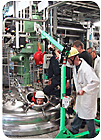
Confined space entry is a specialized, niche area for fall protection equipment. Specific elements are required to assure the utmost safety in what can be a high-risk situation.
Whether a worker is entering a manhole or using a side entry opening, several basic fall protection equipment components are needed to provide an efficient and effective confined space mechanism. Equipment choices will depend mainly on the unique needs of the job site, but three basic components make up the majority of confined space fall protection systems: support structure, winching mechanism and a full-body harness.
Support structure
A variety of support structures exist to service the unique needs of a number of environments. The variations are highly dependent on the type of work and the particular environments that the worker will be entering.
Support structure options include:
• Tripods. Ideal for manhole entry and retrieval applications, tripods are often lightweight, portable and can be easily set up by one worker. One limitation is the size of the manhole it can accommodate.
• Davit Arms or Davit Posts. Davits are an alternative to the basic tripod. They have a variety of base configurations that make the confined space entry possible. Some have adjustable bases to hoist the worker over larger openings; others are fixed in a “V” shape and placed adjacent to the opening. Both portable and fixed position bases are available for davit systems.
• Counterweight System. A counterweight system allows for the upper davit arm to be extended over the side of a building, or any other confined space that does not allow the legs of the tripod or the davit arm system to be placed adjacent to the opening. Weights, resembling traditional gym weights, are placed on one side of the counterweight system to provide a sturdy support structure that is able to withstand a significant load on the other side.
• Side Entry System. In a league of its own, the side entry system is designed for confined space entry/retrieval and rescue operations involving horizontal entries with vertical positioning or retrieval required inside the space. This support system clamps or bolts to the side of a tank, for example, to provide an anchorage point and base for attaching a winching mechanism.
Winching mechanism
For years, retrieval from confined spaces was accomplished by sending a man in with a piece of rope tied around him. When the work was done, three to four people would pull the man out using only muscle power. These days, winching mechanisms are used.
The key factor of the winching mechanism is its mechanical advantage, which enables, for example, a 90-pound female to hoist a 350-pound man out of the opening. The winching mechanism increases the safety of the retrieval by providing a braking system, protecting the worker being raised. If the handle of the winch is released, automatic brakes will prevent the cable from unraveling. Using a winch, a worker can descend and ascend slowly and in a controlled fashion. This allows for communication between the operator and worker.
Factors to consider regarding winching mechanisms include:
• Line Material. Line material is one of the key factors when considering the winching mechanism. The standard is a stainless steel or galvanized rope. However, in highly explosive environments, synthetic lines will reduce the amount of metal that is exposed in the volatile environment.
• Fall Protection Capability. Most man-rated winches for confined space use provide raising and lowering capabilities. Some retractable-type winching mechanisms with a built-in retrieval mechanism are equipped with an inertia break that activates to stop a fall in action. This system is termed as the three-way device, raising, lowering and fall protection.
• Means of Using Power. This is an optional feature that makes frequent raising and lowering procedures easier on workers. The winch has manual capabilities, but is available with an optional power drive that automatically powers the mechanism.
• Rope and Pulley System. A rope and pulley system allows the person making the entry to pull himself or herself out of the confined space, if necessary. A stand-by person can also perform the raising or lowering operation. The rope runs through a series of pulleys that creates the mechanical advantage for this system. This would be used instead of the traditional winching mechanism.
Full-body harness
The person going into the confined space should be wearing a full-body harness with rescue capabilities. Ideally, the person should be connected to the winch line when entering and working in the space. This allows a rescuer to perform the rescue without entering the area and potentially endangering his or her life. Depending on the type of work involved and how much mobility is needed, the worker may need to disconnect from the cable, but having the emergency retrieval equipment available is crucial.
Specialized harnesses outfitted with D-rings or connecting points on top of each shoulder strap are available for entry and retrieval. A separate device, shaped like an upside-down “Y,” is attached to the harness. One of the Y legs attaches to each of the shoulders, and the remaining single line connects to the winching mechanism’s connection line. This allows for very straight, vertical lifting, which is important if working in a very small confined space opening (18, 20, 24 inches). If the person being raised is connected to the dorsal D-ring of a normal harness, he or she would be diagonally positioned, which can be awkward in small spaces. The person could also get caught in the surrounding structure, which can result in massive bodily injury if not freed in a timely manner.
In summary
When considering confined space entry equipment: select the appropriate support system; choose the proper option for the winching mechanism; and make sure the full-body harness is equipped with the appropriate connectors.
Looking for a reprint of this article?
From high-res PDFs to custom plaques, order your copy today!