One dock fire is too many
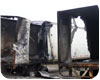
Virtually all safety and loss prevention managers appreciate the inherent dangers of the loading dock, especially since it’s usually a very busy place with forklifts, semi-trailers and pedestrians. That’s why forward-thinking companies install state-of-the-art equipment at the dock, ranging from vehicle restraints to communications technology and more. Yet the potential for loading dock fires is something that escapes far too many decision-makers. And one dock fire is too many by any measure.
Here’s why and what managers need to do to keep them from happening at their facility.
The reality of dock fires
According to our estimates, more than 200,000 U.S. dock positions are at risk due to the type of dock enclosures used at their facilities. Our company has identified hundreds of burned dock seal incidents at a wide array of industrial and commercial facilities across North America.
The problem has to do with the interaction between traditional dock seals and the marker lights of semitrailers parked at the dock. Potential for a fire occurs when energized semi-trailer marker lights are compressed against any make or model of compressionstyle foam dock seal.
In addition to the safety threat that a fire presents, the costs associated with damage caused by a dock seal fire are often far-reaching. The estimated value of a trailer loaded with computer chips, for example, is as high as $6 million. That figure doesn’t account for the costs of building repairs and lost building contents. Other monetary losses include:
- temporary shutdowns/facility evacuations;
- lost dock positions during repair;
- increases in property and liability insurance premiums;
- legal and other professional fees; and
- dock seal repair and/or replacement costs.
If an employee is injured, or worse, the additional costs involved are crippling to virtually any company.
The root of the problem
Trailers docked while running with their lights left energized are the root cause of most dock fires because they can cause ordinary seals to burn. Heatdissipating seals can put an end to such a fire before it has a chance to start.
Tests have shown that low wattage bulbs in trailer marker lights can create the high temperatures needed to melt or burn vinyl, hypalon and polyurethane foam -the components of typical compression-style foam dock seals. The heat output of individual marker lights will build to a high temperature in a very concentrated area due to the insulating effect of being compressed into a foam dock seal pad over a period of time.
The fact that low-wattage bulbs can create high temperatures is a hard concept to accept. However, tests reveal that heat generated by ordinary trailer marker lights can build to dangerous levels in as little as 20-30 minutes when compressed into a foam seal. Temperatures at the seal/trailer interface can reach beyond 900 degree F, which is well above the auto-ignition point of polyurethane foam. Additionally, combustion can become violent if exposed to a sudden and large influx of oxygen - like that from the air drawn into the foam of a dock seal header when a trailer parked at the dock pulls away. Under such circumstances, fire can engulf a head pad in only a few minutes.
A dock seal fire doesn’t always mean the entire seal will be engulfed in flames. Instead, there can be significant burn damage to the seal’s foam core before any evidence of burning is apparent on the outer surface of the header because foam degrades at a lower temperature than the fabric covering it. More often than not, evidence of burn damage on the seal’s outer fabric means that substantial burning has already occurred inside, and the next dose of heat and pressure from a parked trailer could cause an actual fire to erupt.
Take the right precautions
The risk of dock fires is expected to last as long as it takes for newer trailers with non-heat generating LED lights to eventually outnumber the hundreds of thousands of trailers on U.S. highways with traditional, heat-generating, incandescent marker lights. Yet the risk can be avoided with the right approach.
Recognize the potential for the problem. Conduct a dock inspection, which involves a close examination of places where the dock seal comes into contact with trailer lights. Burn damage on dock seals shows up in the form of scorch marks on the surface of the seals - or even more threatening - burned cavities that vary in size from a marble to a softball.
Hot-burning marker lights are a clear indication of serious danger. Yet the risk still exists when there are no indications of burning, which is why it is critical to install dock seals that prevent the problem from occurring in the first place.
Safe dock seals use internal heat-dissipating layered foil technology guaranteed to prevent burning from the heat of trailer marker lights. Technology keeps the temperature at the surface of the seal at a low, safe level –- below 400 degree F - and prevents scorching or burning. This level of protection is not always included as a standard dock seal feature, so check carefully. By the same token, use caution when considering ordinary fire-retardant fabrics and foam. They cannot prevent heat buildup from marker lights, which means these materials cannot prevent burning but can only extinguish a fire once it starts.
Leave nothing to chance
Investigators are often unable to determine the cause of a fire, especially when the damage is catastrophic. Many times a fire originated in the loading dock area for reasons unknown. Given the stakes involved, take a closer look at the dock and consider replacing existing seals with seals that prevent heat buildup that can cause a fire. When it comes to dock fires, leave nothing to chance.
Looking for a reprint of this article?
From high-res PDFs to custom plaques, order your copy today!