Detecting gas in confined spaces
Your sensors have benefits — and limits
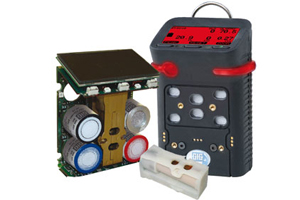
Confined space gas detectors include sensors used to measure the most commonly encountered hazards: oxygen deficiency (and enrichment), percent LEL
|
| Photo courtesy of GfG |
combustible gas, carbon monoxide and hydrogen sulfide. Sensors utilized in these portable gas detectors are extremely good at detecting what they are designed to measure. However, they still have limitations.
It is critically important for instrument users to understand what their instrument sensors can and cannot properly measure. Specific conditions and hazards may require the use of specialized sensors, or a specialized calibration strategy that will provide more accurate readings for the gases actually present.
The good news is that there is an extremely wide range of technologies and types of sensors available for use in portable multi-sensor instruments. Just because one type of sensor does not work for a particular gas does not mean there are no alternatives. The only limitation is that the instrument must be sufficiently flexible to make use of the most appropriate detection technologies.
The sensor with the most important limitations is the traditional “catalytic” or “pellistor” type percent Lower Explosive Limit (LEL) combustible gas sensor. In spite of the millions of combustible sensor-equipped atmospheric monitors in service around the world, there is still a lot of misinformation and misunderstanding when it comes to the performance characteristics and limitations of this very important type of sensor. Understanding how combustible sensors detect gas is critical to correctly interpreting readings and avoiding misuse of instruments that include this type of sensor.
“Pellistor” type LEL sensor
“Pellistor” type LEL sensors detect gas by catalytically oxidizing or “burning” the gas on an active bead or “pellistor” located within the sensor. The heating effect on the bead is proportional to the amount of combustible gas present in the atmosphere. Catalytic-bead sensors respond to a wide range of ignitable gases and vapors, but are unable to differentiate between different combustible gases. They provide one signal based on the total heating effects of all the gases capable of being oxidized that are present in the vicinity of the sensor. The heating effect or “relative response” of the sensor varies from gas to gas. Generally speaking, the larger the molecule, the lower the relative response.
Pellistor type sensors generally include a flame arrestor that can slow, reduce or prevent larger hydrocarbon molecules from entering the sensor. Small combustible gas molecules like hydrogen (H2), methane (CH4) and propane (C3H8) diffuse through the flame arrestor very rapidly. The larger the molecule, the slower it diffuses through the flame arrestor into the sensor. Saturated hydrocarbons larger than nonane (C9H20) are unable to penetrate the flame arrestor at all in appreciable quantities. Traditional pellistor type LEL sensors should not be used to measure hydrocarbon gases larger than nonane in size. To put this in perspective, less than four percent of the molecules in a bucket of diesel fuel are small enough to pass through the flame arrestor and enter the sensor. This is one reason that pellistor LEL sensors show such a low response when exposed to the vapors of “heavy” fuels such as diesel, kerosene, jet fuel and heating oil.
Although most VOC vapors are combustible, the toxic exposure limits are much lower than the flammability limits. For example, for diesel fuel, 10 percent LEL is equal to about 600 ppm vapor. However, the TLV© (Threshold Limit Value©) for diesel vapor is only 15 ppm (as an 8 hour TWA). If you wait for the combustible gas alarm to go off at 10 percent LEL, you could potentially exceed the toxic exposure limit by 40 times! Clearly, from a toxic exposure limit standpoint, a different detection technique is required.
Another limitation is that pellistor type LEL sensors require the presence of oxygen in order to oxidize the gas being measured. Most manufacturers stipulate that the atmosphere must contain at least 10 percent O2 in order for the LEL sensor to detect gas accurately. Readings are increasingly affected as the concentration drops below this level. In zero percent O2, pellistor type combustible sensors cannot detect gas at all. For this reason, confined space instruments that contain catalytic pellistor type LEL sensors should also include a sensor for measuring oxygen.
Pellistor sensors can be rapidly poisoned by exposure to contaminants such as silicones, tetraethyl-lead, phosphorus containing compounds and high concentrations of H2S, and they can be damaged by exposure to high concentrations of combustible gas. They can also simply lose sensitivity slowly over time, which is why it is so important to regularly test their response to known concentration calibration gas.
Fortunately, there are alternative detection techniques that are not affected by these constraints. It is important to note that these alternative types of sensors should not be seen as replacements for the pellistor LEL sensor. Pellistor sensors are still the best and most cost-effective solution for many applications. But in many cases, the best approach is to include one or more additional types of sensors in the instrument.
The major alternatives for confined space instruments for combustible gas and VOC measurement are photoionization detectors (PIDs) and non-dispersive infrared (NDIR) sensors. Photoionization detectors (PID) for VOC measurement Solvent, fuel and other VOC vapors are pervasively common in many workplace environments. Most have surprisingly low toxic exposure limits. For most VOCs, the toxic exposure limit is exceeded long before you reach a concentration sufficient to trigger an LEL alarm. PID-equipped instruments are generally the best choice for measurement of VOCs at exposure limit concentrations. Photoionization detectors use high-energy ultraviolet light from a lamp housed within the detector as a source of energy used to remove an electron from neutrally charged VOC molecules, producing a flow of electrical current proportional to the concentration of contaminant. The amount of energy needed to remove an electron from the target molecule is called the ionization energy (IE). Larger and/or more reactive molecules usually have lower ionization energies than smaller, less reactive molecules. Thus, in general, the larger the molecule, the easier it is to detect. This is quite different than the performance characteristics of catalytic pellistor type combustible sensors. Pellistor type combustible sensors and photoionization detectors represent complementary, rather than competing, detection techniques. Pellistor sensors are excellent for the measurement of methane, propane and other common combustible gases that are not detectable by means of a PID. On the other hand, PIDs can detect large VOC and hydrocarbon molecules that are effectively undetectable by pellistor sensors, even when the catalytic sensor is operable in ppm measurement ranges. The best approach for VOC measurement in many cases is to use a multi-sensor instrument equipped with both a pellistor LEL sensor and a PID sensor.
Non-dispersive infrared (NDIR) sensors for combustible gas measurement
Non-dispersive infrared (NDIR) sensors measure gas as a function of the absorbance of infrared light at a specific wavelength or range of wavelengths.
Different molecules absorb infrared radiation at different wavelengths. When infrared radiation passes through a sensing chamber containing a specific contaminant, only those wavelengths that match the absorbance spectrum of the molecule are absorbed. The rest of the light is transmitted through the chamber without hindrance. For some types of molecules (like combustible gases) it is possible to find an absorbance peak that is not shared by other types of molecules likely to be present. The active detector in an NDIR combustible gas sensor measures the amount of infrared light absorbed at this wavelength. A reference detector measures the amount of light at another wavelength where there is no absorbance.
The greater the concentration of combustible gas, the greater the reduction in the amount of light that reaches the active detector when compared to the reference signal.
It is the chemical bonds in the molecules being measured that actually absorb the infrared light. The sensitivity of the sensor to a particular gas depends on how well (and how many) chemical bonds in the molecule absorb IR light at the measurement wavelength. Since larger molecules have more chemical bonds holding the atoms in the molecule together, they provide more opportunities for infrared radiation to be absorbed. Thus, an NDIR sensor is very sensitive to larger molecules such as octane and nonane.
NDIR combustible gas sensors have a number of other advantages when compared to pellistor type sensors. NDIR sensors do not have a flame arrestor that limits the ability of large molecules to diffuse into the optical sensing chamber. NDIR sensors do not require oxygen. They are also not subject to damage due to exposure to sensor poisons. Finally, unlike pellistor type sensors, they can be used for measurement of high concentration combustible gas above the 100 percent LEL concentration.
One of the most important limitations of NDIR combustible gas sensors is that they cannot be used for measurement of hydrogen (H2). In applications where H2 may be potentially present, the instrument should be equipped with a type of sensor that does respond well to H2, such as a pellistor LEL sensor or an electrochemical sensor capable of measuring H2 in the desired range. Depending on the design, NDIR sensors may or may not be capable of measuring acetylene and certain other VOC molecules that do not absorb infrared well at the measurement wavelength. Consult the manufacturer for specific details.
Looking for a reprint of this article?
From high-res PDFs to custom plaques, order your copy today!